When you’re prescribed a tricyclic antidepressant like amitriptyline or nortriptyline, you’re not just getting a drug for depression or nerve pain. You’re also getting a powerful blocker of acetylcholine - a key chemical in your brain and heart. This isn’t a side effect you can ignore. It’s called anticholinergic burden, and it’s quietly raising your risk of memory loss, confusion, and dangerous heart rhythms - especially if you’re over 50.
What Is Anticholinergic Burden?
Anticholinergic burden is the total effect of all the medications in your system that block acetylcholine. Think of acetylcholine as the body’s natural signal for memory, muscle control, digestion, and heart rhythm. When drugs like tricyclic antidepressants (TCAs) shut down these signals, your brain and heart start to stumble.TCAs were developed in the late 1950s. They work by boosting serotonin and norepinephrine - good for lifting mood. But they also stick tightly to muscarinic receptors, the same ones that control saliva, bladder function, and attention. This dual action is why they’re so effective for some people - and so dangerous for others.
Doctors now use a tool called the Anticholinergic Cognitive Burden (ACB) Scale to rate how strong this effect is. TCAs like amitriptyline and nortriptyline get the highest score: 3. That means they’re classified as having definite high anticholinergic activity. For comparison, most modern antidepressants like sertraline or escitalopram score 0 or 1. Even common over-the-counter sleep aids like diphenhydramine (Nytol) score a 2. When you stack these together - say, a TCA plus an antihistamine for allergies - your total ACB score can hit 5 or 6. That’s when the real risks kick in.
Cognitive Risks: Mimicking Dementia
One of the most alarming things about TCAs is how easily their side effects look like dementia. Forgetfulness? Check. Trouble finding words? Check. Confusion in the evening? That’s a classic sign. Many older adults are wrongly diagnosed with Alzheimer’s or other dementias - when the real culprit is their medication.A landmark study published in JAMA Internal Medicine tracked over 3,400 adults over 65 for seven years. Those taking medications with an ACB score of 3 or higher had a 54% higher risk of developing dementia. And the damage? It didn’t always reverse after stopping the drug. For some, the cognitive fog stuck around for years.
Clinicians in Australia and the UK report the same pattern: a patient comes in with memory problems. Family thinks it’s early dementia. But after switching off the amitriptyline and waiting six weeks, their recall improves. Their Mini-Mental State Examination (MMSE) score goes up by 2 to 3 points - enough to go from borderline impairment to normal function. That’s not dementia. That’s drug-induced.
And it’s not just memory. Patients describe dry mouth so bad they need artificial saliva at night. Constipation that requires daily laxatives. Trouble focusing during conversations. These aren’t minor annoyances. They’re signs your brain isn’t getting the signals it needs to function.
Cardiac Risks: When Your Heart Gets Confused
While your brain is struggling, your heart is also in danger. TCAs act like class 1A antiarrhythmics - the same drugs used to treat irregular heartbeats. But here’s the catch: they’re not meant to be used that way. At therapeutic doses, amitriptyline can prolong your QRS complex by 10-25%. In overdose, that jumps to 50%. That’s not just a lab result. That’s a real risk of ventricular tachycardia, torsades de pointes, or sudden cardiac arrest.Compared to SSRIs, TCAs carry about three times the risk of dangerous heart rhythm changes. Amitriptyline specifically increases the risk of QT prolongation by 2.8 times more than sertraline. If you already have heart disease, low potassium, or are taking other QT-prolonging drugs - like some antibiotics or antifungals - your risk multiplies.
Patients in online support groups tell stories of waking up with palpitations, dizziness, or fainting after just a few weeks on amitriptyline. One man from Melbourne ended up in the ER after his ECG showed a QT interval of 520 milliseconds - far above the safe limit of 450. He had no prior heart history. His only new medication? Amitriptyline for chronic back pain.
Why Are TCAs Still Prescribed?
If the risks are so clear, why are doctors still writing these prescriptions?Because for a small group of people, they still work - better than anything else. If you’ve tried SSRIs, SNRIs, and even psychotherapy without success, and you have severe treatment-resistant depression or neuropathic pain, TCAs can be a last resort. Nortriptyline, in particular, is sometimes preferred over amitriptyline because it has slightly less anticholinergic activity - though it still scores a 3 on the ACB scale.
But here’s the problem: many prescriptions aren’t written with that level of care. A GP sees a patient with insomnia and mild depression. They reach for amitriptyline because it’s cheap, familiar, and “helps with sleep.” They don’t calculate the ACB score. They don’t check for other anticholinergic meds. They don’t warn about the heart risks. That’s how preventable harm happens.
What Should You Do?
If you’re on a TCA, here’s what matters:- Know your ACB score. Add up every medication you take - even OTC ones. Amitriptyline = 3. Diphenhydramine = 2. Oxybutynin = 3. Add them. If your total is 3 or more, you’re in the danger zone.
- Ask about alternatives. For depression: try an SSRI or SNRI like duloxetine (ACB=0-1). For pain: gabapentin, pregabalin, or even low-dose nortriptyline with close monitoring. For sleep: melatonin or CBT-I, not diphenhydramine.
- Don’t stop cold turkey. Withdrawal can cause nausea, anxiety, and rebound insomnia. Taper slowly over 4-8 weeks under supervision.
- Get an ECG. If you’re over 60 and on a TCA, ask for a baseline ECG. Check again after 3 months. Watch for QT prolongation.
- Review your meds every 6 months. Use the ACB Calculator - it’s free and built into many Australian and UK EHR systems now. If your doctor doesn’t know about it, ask them to look it up.
Research shows that when structured deprescribing programs are used - especially in older adults - 78% of patients reduce their anticholinergic burden, and 63% show measurable cognitive improvement within six months. That’s not a small gain. That’s your memory, your independence, your safety.
The Bigger Picture
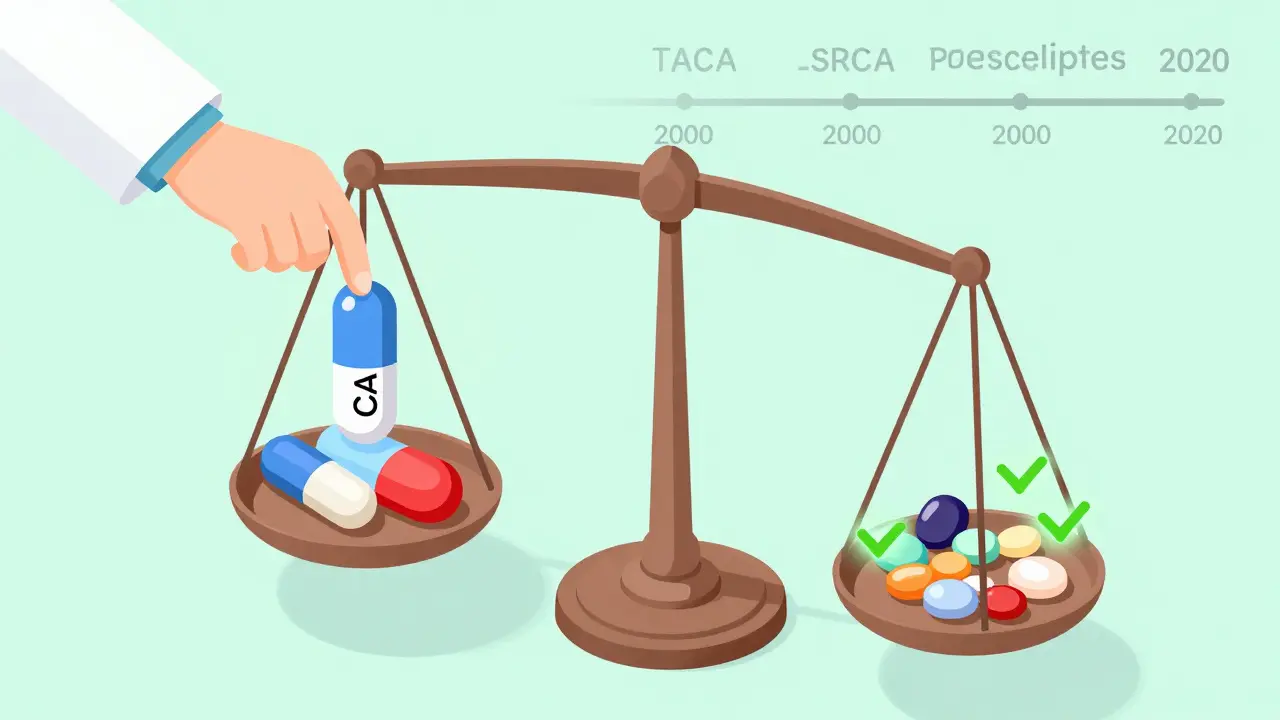
Prescribing rates for TCAs have dropped sharply in the last 20 years. In 2000, they made up 15% of antidepressant prescriptions in the U.S. By 2020, that fell to 4.7%. Why? Because we now know the cost.Regulatory bodies like the Beers Criteria have listed TCAs as “potentially inappropriate” for older adults since 2012. The 2023 update made it even clearer: avoid them in adults 65+ unless other options have truly failed.
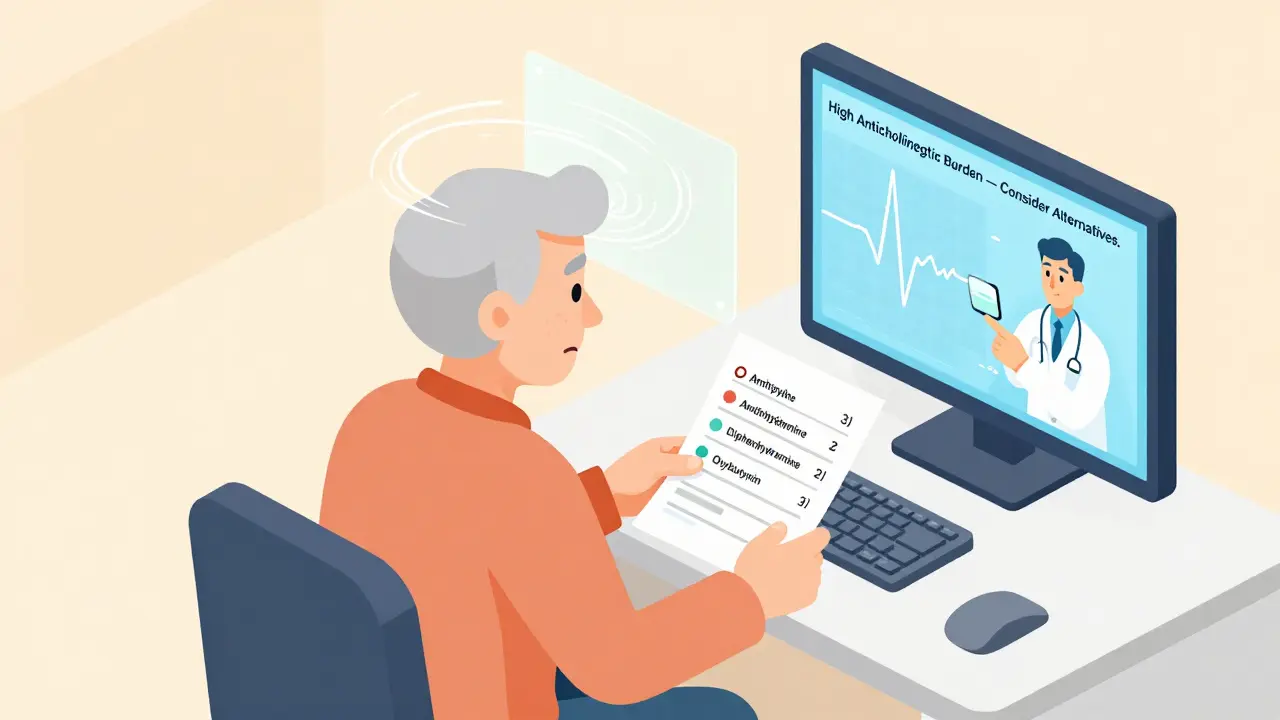
Technology is catching up, too. NHS Digital is piloting AI tools that flag high ACB scores at the moment a prescription is written. If your doctor tries to prescribe amitriptyline to a 72-year-old with high blood pressure and a history of falls, the system pops up: “High anticholinergic burden. Consider alternative.”
This isn’t about banning TCAs. It’s about using them wisely - only when the benefit clearly outweighs the risk. For most people, it doesn’t.
Can tricyclic antidepressants cause dementia?
They don’t cause dementia directly, but long-term use significantly increases the risk of developing it - especially in people over 65. Studies show a 54% higher risk over seven years in those taking medications with a high anticholinergic burden (ACB ≥3). In many cases, the cognitive decline looks exactly like dementia and can be mistaken for it. Stopping the medication may improve symptoms, but not always fully - some damage may be irreversible.
Is amitriptyline safe for seniors?
No, it’s generally not recommended for older adults. The Beers Criteria and NICE guidelines both advise avoiding amitriptyline in people over 65 due to its high anticholinergic burden and cardiac risks. It can cause confusion, falls, urinary retention, constipation, and dangerous heart rhythm changes. If used at all, it should be a last resort after other treatments have failed and with close monitoring.
What are safer alternatives to tricyclic antidepressants?
For depression, SSRIs like sertraline or escitalopram, or SNRIs like duloxetine, are preferred. They have little to no anticholinergic effect (ACB=0-1). For nerve pain, gabapentin, pregabalin, or topical lidocaine are safer options. For insomnia, cognitive behavioral therapy (CBT-I) or melatonin are better than sedating antihistamines. Always discuss alternatives with your doctor before switching.
How do I know if my meds are adding to anticholinergic burden?
Use the Anticholinergic Cognitive Burden (ACB) Scale. Common high-burden drugs include amitriptyline (3), nortriptyline (3), diphenhydramine (2), oxybutynin (3), and chlorphenamine (2). Add up the scores of all your medications - including over-the-counter ones. A total score of 3 or more puts you at higher risk. Ask your pharmacist or doctor to calculate your total ACB score during your next review.
Can I stop taking a tricyclic antidepressant on my own?
No. Stopping suddenly can cause withdrawal symptoms like nausea, anxiety, insomnia, and even rebound depression. Always work with your doctor to taper off slowly - usually over 4 to 8 weeks. They may switch you to a safer alternative first, then reduce the TCA gradually. Never discontinue without medical supervision.
Anu radha
December 16, 2025 AT 19:08I started taking nortriptyline for my back pain last year, and I didn’t realize how much it was messing with my memory until my granddaughter pointed out I kept forgetting her name. I switched to gabapentin after reading this, and now I remember birthdays again. Thank you for sharing this.
Salome Perez
December 18, 2025 AT 13:22This is one of the most lucid, meticulously researched pieces I’ve encountered on the hidden dangers of legacy psychotropics. The ACB scale isn’t just a clinical tool-it’s a moral compass for prescribers. I’m a geriatric pharmacist in Seattle, and I’ve seen too many elders quietly deteriorate under polypharmacy with anticholinergics. The fact that AI systems are now flagging these prescriptions? That’s not innovation-it’s overdue accountability. Let’s hope this becomes standard in every EHR, not just pilot programs.
Kent Peterson
December 20, 2025 AT 05:32Josh Potter
December 20, 2025 AT 09:48Evelyn Vélez Mejía
December 22, 2025 AT 06:46The ethical imperative here transcends pharmacology-it is a profound indictment of our medical culture’s fetishization of convenience over cognition. We have normalized the erosion of human memory as a ‘side effect’ rather than an iatrogenic catastrophe. The fact that TCAs remain on formularies for non-refractory conditions is not merely negligent-it is a violation of the Hippocratic Oath’s first principle: primum non nocere. The 54% increased dementia risk is not a statistic; it is the silent erasure of identity. And yet, we continue to prescribe them like aspirin.
Victoria Rogers
December 22, 2025 AT 23:04Jane Wei
December 23, 2025 AT 17:06Nishant Desae
December 24, 2025 AT 02:30As someone who grew up in a small village in India where doctors rarely had time to explain anything, I’ve seen how these medications get handed out like candy. My uncle was on amitriptyline for 12 years for ‘nerves’-he stopped recognizing his own children. When we finally switched him to an SSRI and stopped his antihistamine for allergies, it was like watching a ghost come back to life. This isn’t just about science-it’s about dignity. We need community health workers, not just AI alerts, to catch these things. And we need to teach families to ask: ‘What is this drug doing to his mind?’-not just ‘Does it help the pain?’