Imagine you’ve scheduled a crucial CT scan, but your medical history flags a past reaction to iodinated contrast media is a substance used in imaging procedures like CT scans to enhance visibility of internal structures. Panic sets in. Do you skip the test? Risk another reaction? The answer isn’t to avoid imaging-it’s to prepare for it. With the right pre-medication protocol, you can safely undergo necessary diagnostic tests even if you’re considered high-risk.
Contrast dye reactions are real, but they are also manageable. For most people, these reactions are rare-occurring in less than 0.2% of cases with modern low-osmolar agents. However, if you have had a previous allergic-type reaction, that risk jumps significantly. This guide breaks down exactly how safety planning works, what medications are involved, and why timing is everything when it comes to protecting yourself during radiology procedures.
Understanding Contrast Dye Reactions
To manage the risk, we first need to understand what actually happens. A contrast dye reaction refers to an adverse response to the iodine-based solution injected into your bloodstream. These aren't true allergies in the classic sense (like peanut or pollen allergies); instead, they are often non-immune mediated responses where the body reacts directly to the chemical properties of the dye.
The American College of Radiology (ACR is the primary professional organization representing radiologists in the United States, setting standards for medical imaging practice.) classifies these reactions based on severity:
- Mild Reactions: Symptoms include mild nausea, vomiting, or a few hives. These are uncomfortable but not dangerous.
- Moderate Reactions: More extensive hives, swelling of the face or throat, or wheezing that requires medication to resolve.
- Severe Reactions: Life-threatening events such as anaphylaxis, which involves a drop in blood pressure, difficulty breathing, and loss of consciousness.
Here is the critical piece of data: If you have had a prior reaction, your risk of having another one without protection is approximately 35%. That is a massive increase compared to the general population. However, studies dating back to Greenberger et al. (1986) and confirmed by recent research from Dr. James McDonald (2021) show that proper pre-medication can slash this recurrence rate down to about 2%.
Who Actually Needs Pre-Medication?
Not everyone needs extra preparation. In fact, over-prescribing steroids and antihistamines adds unnecessary burden to patients who don't need them. Let’s clear up some common myths first.
Myth: Shellfish or Iodine Allergies Increase Risk. Many patients believe that because they are allergic to shellfish or use Betadine (povidone-iodine) on cuts, they will react to CT dye. Major institutions like UCLA Health and the University of Wisconsin confirm this is false. Having a shellfish allergy increases your risk only slightly (2- to 3-fold), which is still very low. It does not warrant routine pre-medication unless you have a specific history of reacting to contrast dye itself.
Who DOES Need It? The primary candidate for pre-medication is someone with a documented history of an allergic-type reaction to intravascular iodinated contrast media. Here is how different hospitals categorize the approach:
- Mild Prior Reaction: Many centers, including UCSF Radiology, now suggest that mild prior reactions may not require pre-medication at all, especially if a different brand of contrast is used. The risk is minimal.
- Moderate Prior Reaction: Pre-medication is strongly recommended. You should also consider switching to a different type of contrast agent within the same class.
- Severe Prior Reaction: This is the highest risk category. Pre-medication is mandatory, and the scan should ideally be performed at a facility with advanced emergency care capabilities nearby.
The Standard 13-Hour Oral Protocol
If your doctor decides you need pre-medication, the gold standard is the oral regimen. This is the most studied and reliable method, but it requires planning ahead. You cannot take these pills last minute; your body needs time to build up the protective effect.
Here is the typical schedule followed by major academic centers like Dartmouth-Hitchcock Medical Center:
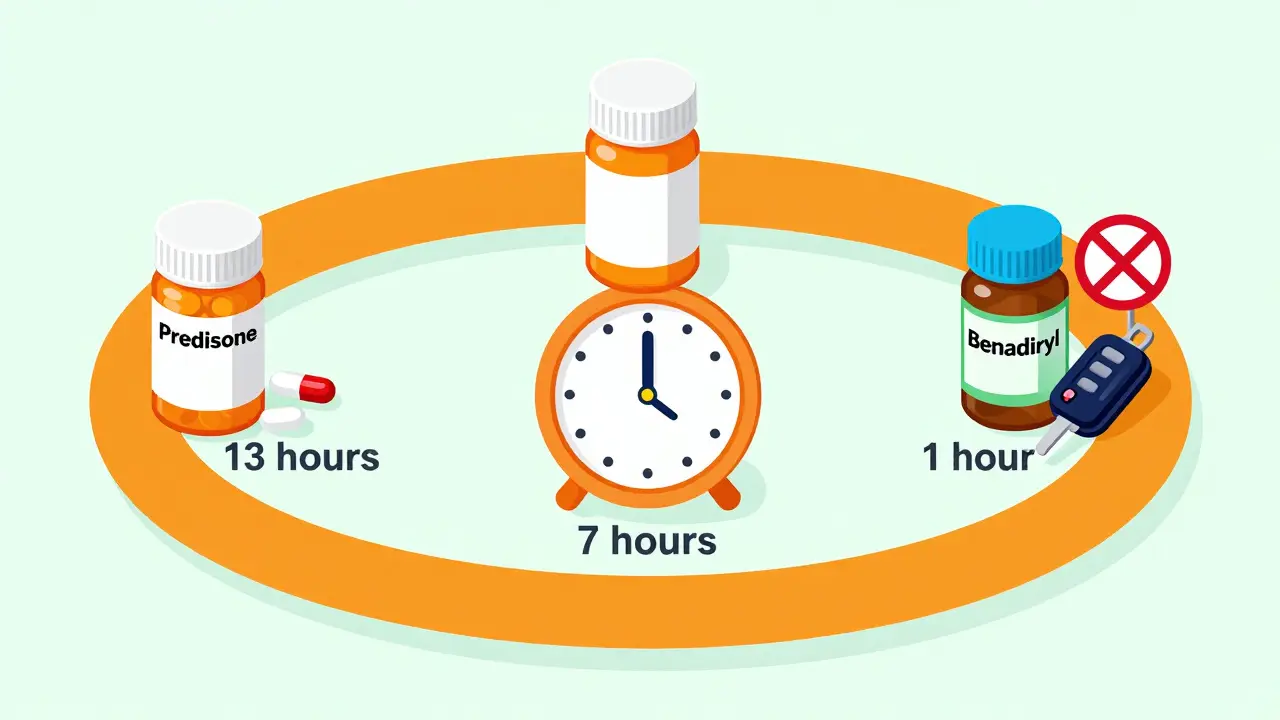
- 13 Hours Before Scan: Take Prednisone 50 mg by mouth.
- 7 Hours Before Scan: Take Prednisone 50 mg by mouth.
- 1 Hour Before Scan: Take Prednisone 50 mg by mouth AND Diphenhydramine (Benadryl) 50 mg by mouth.
Important Note on Benadryl: Diphenhydramine causes drowsiness. Because of this sedating effect, you must arrange for someone else to drive you home after the appointment. As UCLA Health explicitly states, if you do not have a ride, the study may be rescheduled.
This protocol takes nearly half a day. If your scan is scheduled for 8 AM, you start taking pills the night before around 7 PM. Plan accordingly.
Intravenous and Accelerated Protocols
What if you find out you need contrast last minute? Or what if you are already admitted to the hospital? The 13-hour oral plan won’t work. Fortunately, there are alternatives.
Inpatient IV Regimen: For patients in the hospital, doctors use intravenous steroids. Common options include Methylprednisolone (Solu-Medrol) 40 mg IV every 4 hours starting immediately until the scan, plus Diphenhydramine 50 mg IV one hour before the procedure. Hydrocortisone is another option used similarly.
The 5-Hour Accelerated Protocol: For urgent cases where 13 hours isn't possible but you aren't in immediate emergency status, a 5-hour protocol exists. Research by Dr. Behrang Mervak (2017) published in *Radiology* showed that taking Methylprednisolone 32 mg orally at 5 hours before and again at 1 hour before the scan was comparable in efficacy to the traditional long regimen. This is a lifesaver for urgent diagnostics.
| Protocol Type | Lead Time Required | Medications | Best For |
|---|---|---|---|
| Standard Oral | 13 Hours | Prednisone + Benadryl | Elective outpatient scans |
| Accelerated Oral | 5 Hours | Methylprednisolone PO | Urgent cases, short notice |
| Inpatient IV | Immediate (q4h) | Solu-Medrol/Solu-Cortef IV + Benadryl IV | Hospitalized patients |
Safety Planning Beyond Medication
Taking the pills is only half the battle. True safety planning involves logistics and environment. Even with perfect pre-medication, there is still a small "breakthrough" risk-about 2% of premedicated patients can still have a severe reaction. Therefore, where you get scanned matters.
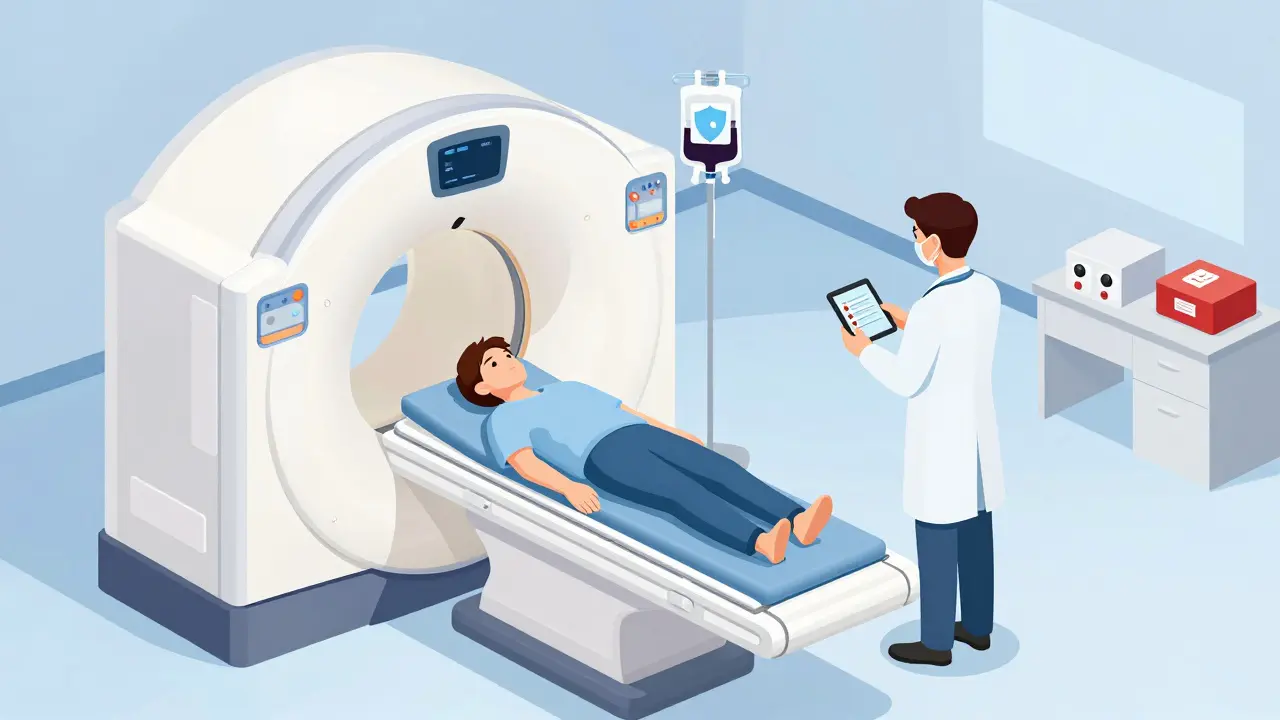
Facility Selection: If you have a history of severe reactions, UCSF and Yale Radiology recommend scheduling your exam at a site with primary response teams immediately available. Ideally, this means a hospital setting rather than a standalone imaging center. Ensure the facility has crash carts and trained personnel ready to handle anaphylaxis if it occurs.
Contrast Agent Switching: Did you know that simply changing the brand of contrast dye can help? If you reacted to Brand A, asking your radiologist to use Brand B (a different agent within the same class) can reduce risk. Yale Radiology emphasizes this as best practice: "Switch to a different contrast agent within that class if the inciting agent is known." Sometimes, this substitution alone is enough to mitigate risk, potentially reducing the need for heavy steroid use.
Documentation and Communication: You must ensure your requesting physician consults with a radiologist before scheduling. Don't just check a box on an intake form. Have a conversation. Tell them, "I had a reaction before," and ask, "Are we using a different agent? Are we doing pre-med?" Clear communication prevents errors.
Pediatric Considerations
Children are not just small adults. Their dosing and risk profiles differ. For children aged 6 years and older, if antihistamine-only premedication is indicated (for very low-risk scenarios), UCSF specifies Cetirizine 10 mg by mouth one hour prior. Full steroid protocols for children are weight-based and must be calculated by a pediatric radiologist. Never give adult doses to children without explicit medical instruction.
Cost and Accessibility
One concern patients often have is cost. The good news is that pre-medication is incredibly affordable. At current Medicare reimbursement rates, Prednisone 50 mg tablets cost roughly $0.25 each, and Diphenhydramine is about $0.15 per dose. Compared to a CT scan costing $500-$1,500, the pre-medication represents less than 0.1% of the total expense. Insurance typically covers these preventive meds when prescribed for a medically necessary procedure.
Frequently Asked Questions
Can I drive myself home after taking pre-medication for a CT scan?
No, you should not drive yourself home if your protocol includes Diphenhydramine (Benadryl). This medication causes significant drowsiness and sedation. Most major health systems, including UCLA Health, require patients to have a designated driver. If you do not have a ride, your appointment may need to be rescheduled for your safety.
Does a shellfish allergy mean I am allergic to CT contrast dye?
No. Despite common belief, a shellfish allergy or sensitivity to iodine (like Betadine) does not significantly increase your risk of reacting to iodinated contrast media. Your risk is only 2- to 3-fold higher than the general population, which remains very low. Routine pre-medication is generally not required solely based on a shellfish allergy.
How effective is pre-medication at preventing reactions?
Pre-medication is highly effective. For patients with a prior history of contrast reactions, the risk of recurrence drops from approximately 35% to about 2% with proper steroid and antihistamine prophylaxis. However, it is not 100% foolproof; a small "breakthrough" risk remains, which is why scanning at a facility with emergency resources is important.
What if my CT scan is urgent and I don't have 13 hours to prep?
There are accelerated protocols available. A 5-hour oral regimen using Methylprednisolone has been shown to be comparable in efficacy to the traditional 13-hour protocol for urgent cases. In emergency department settings, intravenous steroids administered every 4 hours can also be used. Discuss your timeline with your radiologist to choose the appropriate rapid protocol.
Should I switch contrast agents if I had a bad reaction before?
Yes. Best practices from Yale Radiology and the ACR recommend switching to a different contrast agent within the same class if the specific agent that caused your previous reaction is known. Substitution can sometimes be as effective as pre-medication in reducing recurrence risk, especially for mild to moderate prior reactions.