Medication Dry Mouth Risk Calculator
Enter the medications you're taking to assess your risk level and get personalized management recommendations
~70% risk of dry mouth
~58% risk of dry mouth
~63% risk of dry mouth
~50% risk of dry mouth
Check all that apply
When you wake up with a cottony throat, struggle to swallow your toast, or find yourself sipping water every five minutes just to speak, you might think it’s just dehydration. But if you’re on any regular medication, there’s a good chance your dry mouth isn’t from lack of water-it’s from the drugs you’re taking. This isn’t a minor annoyance. It’s a widespread, under-treated side effect that’s quietly damaging teeth, making eating painful, and lowering quality of life for millions. Around 11 million Americans experience dry mouth directly because of their prescriptions, and the number is rising as more people take multiple medications daily.
Why Your Medication Is Killing Your Saliva
Your saliva doesn’t just help you taste food or speak clearly. It’s your mouth’s natural defense system. It washes away food particles, neutralizes acids, and protects enamel from decay. When medications interfere with this process, your mouth becomes a breeding ground for problems. The culprit? Most often, drugs that block acetylcholine, a neurotransmitter that tells your salivary glands to produce saliva. This is called an anticholinergic effect.Over 1,110 medications are known to cause this. The biggest offenders fall into a few key categories:
- Overactive bladder meds like oxybutynin (Detrol) and tolterodine: Up to 70% of users report severe dry mouth.
- First-gen antihistamines like diphenhydramine (Benadryl): About 58% of users experience it-much higher than newer ones like loratadine (Claritin), which only affects 12%.
- Tricyclic antidepressants like amitriptyline: 63% of patients deal with dry mouth, compared to 31% with SSRIs like sertraline.
- Antipsychotics like haloperidol: Nearly half of users report it, while newer drugs like aripiprazole are less likely to cause it.
It’s not just the drug itself-it’s how many you’re taking. If you’re on three or more medications, your risk of dry mouth jumps by 2.3 times. For those on five or more, 18% experience near-total saliva shutdown. That’s not just uncomfortable-it’s dangerous.
The Hidden Dental Damage
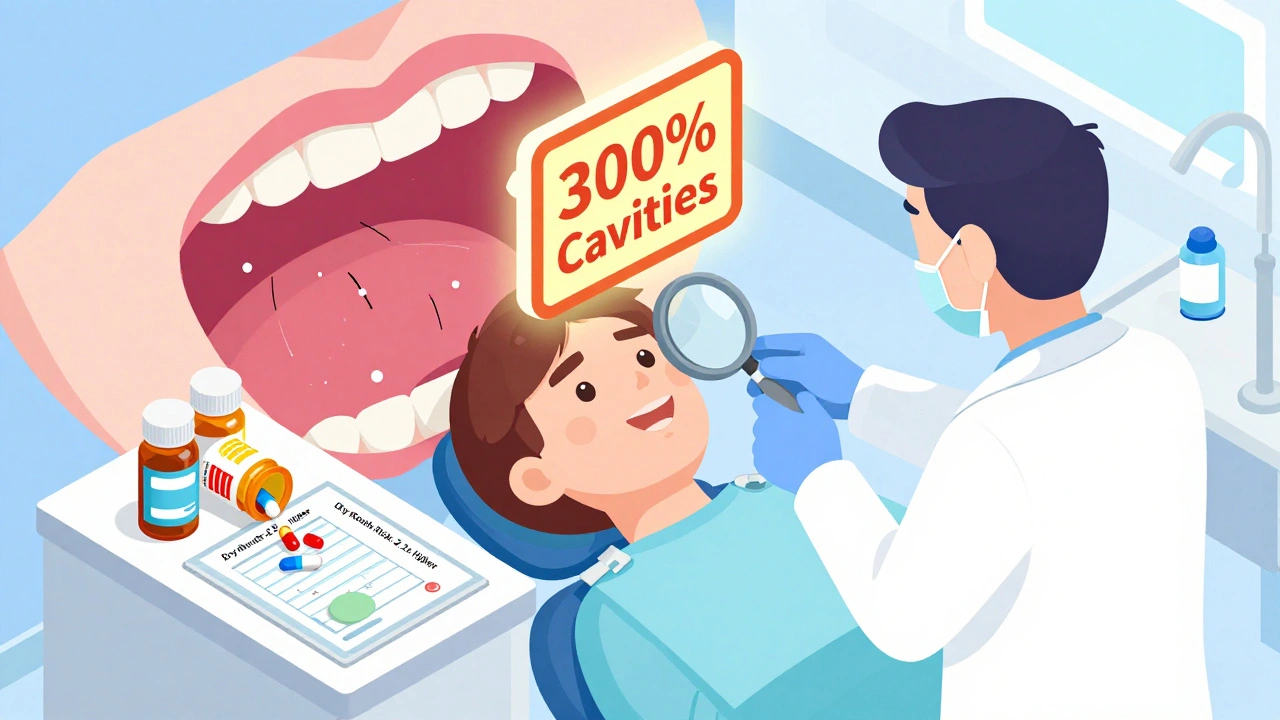
Most people don’t realize dry mouth isn’t just about thirst. It’s a direct path to tooth decay, gum disease, and mouth infections. Without saliva to buffer acids and wash away bacteria, your teeth start breaking down-fast.Studies show that within 12 months of developing medication-induced dry mouth, the risk of cavities increases by 300%. Older adults are hit hardest: 76% of dry mouth cases are in people over 65, and nearly 40% of them take five or more prescriptions daily. That’s why dentists now see more root cavities in this group than ever before. One dental study found patients on three or more meds had a 47% higher Root Caries Index than those on one or two.
It’s not just teeth. Dry mouth leads to cracked lips, sore tongue, fungal infections like thrush, and difficulty wearing dentures. Many people think, “I brush twice a day, so I’m fine.” But without saliva, brushing alone isn’t enough. Bacteria cling to teeth like glue. And if your dentist doesn’t know you’re on these meds, they won’t catch the early signs.
What You Can Do Right Now
You don’t have to live with constant dryness. There are proven steps you can take-starting today.- Review your meds with your doctor. Ask: “Could any of these be causing dry mouth?” In 42% of cases, switching to a different drug in the same class-like swapping oxybutynin for solifenacin-reduces or eliminates the problem. Never stop a medication without talking to your prescriber, but do ask if alternatives exist.
- Use a prescription salivary stimulant. Pilocarpine (Salagen) and cevimeline (Evoxac) are FDA-approved drugs that directly trigger saliva production. In clinical trials, they boosted saliva flow by 63% to 72% within two weeks. These aren’t OTC fixes-they require a prescription, but they work.
- Choose the right oral moisturizer. Not all mouthwashes are equal. Products like Biotene Dry Mouth Oral Rinse contain enzymes that mimic natural saliva. In user studies, 81% reported relief lasting up to 4 hours. Newer formulas, like Biotene’s Enzyme-Activated Moisturizing System, now last up to 7 hours.
- Hydrate smartly. Sip water all day-not gulps, but small sips. Avoid sugary drinks, alcohol, and caffeine. They dry you out further. Keep a water bottle with you at all times.
- Chew sugar-free gum with xylitol. Chewing stimulates saliva naturally. Xylitol also fights cavity-causing bacteria. Look for gum with at least 1 gram of xylitol per piece.
When to See a Dentist (And What They’ll Do)
If you’ve had dry mouth for more than a few weeks, schedule a dental checkup-even if you don’t have pain. Dentists are now trained to spot early signs of medication-related decay. They’ll look for:- White spots on teeth (early decay)
- Smooth, shiny surfaces on tooth roots (sign of root caries)
- Cracked or peeling tissue inside the mouth
- Thick, stringy saliva or no saliva at all
Instead of the usual six-month checkup, you’ll likely need to come in every three months. Your dentist may recommend:
- Fluoride treatments or prescription-strength fluoride toothpaste
- Antifungal rinses if you have thrush
- Custom mouthguards to protect teeth at night
The key? Make sure your dentist and doctor talk to each other. When they coordinate care, dental complications drop by 57%. Ask your dentist to send a note to your prescriber about your dry mouth-it’s not uncommon anymore, and many doctors appreciate the heads-up.
What Doesn’t Work (And Why)
There’s a lot of misinformation out there. Don’t waste time on these:- Just drinking more water. It helps, but won’t fix the root cause. If your glands aren’t producing saliva, water just sits in your mouth-it doesn’t replace what’s missing.
- Over-the-counter “saliva substitutes” that are just flavored water. Many are sugar-laden and actually promote decay. Always check the label for xylitol or enzymes.
- Staying up late or breathing through your mouth. These make dryness worse, but they’re not the cause. Fix the medication issue first.
And please-don’t ignore it. Too many people suffer in silence because they think it’s “just part of aging” or “nothing serious.” But untreated dry mouth leads to emergency dental visits, tooth loss, and even difficulty eating nutritious foods. It affects your nutrition, your sleep, your confidence.

The Bigger Picture
The dry mouth management market is growing fast-over $1.2 billion in 2022-and new products are hitting shelves every year. But the real problem isn’t lack of solutions. It’s lack of awareness.Only 28% of primary care doctors routinely ask patients about dry mouth when prescribing meds. And only 34% of seniors with the condition get proper care. Meanwhile, 89% of dentists now ask about medications during exams-but only half feel trained to manage it.
The good news? Change is coming. In January 2024, the NIH launched a $15.7 million study to find non-anticholinergic alternatives for bladder meds. The FDA approved cevimeline for severe dry mouth in 2023. And by 2027, the American Dental Association predicts all new medications will be required to carry dry mouth risk warnings.
For now, you don’t have to wait. If you’re on meds and your mouth feels like sandpaper, talk to your doctor. Ask your dentist. Don’t let a side effect steal your comfort, your health, or your smile.
Can dry mouth from medication be reversed?
Yes, in many cases. If the medication causing it can be switched to a lower-risk alternative, saliva production often returns within days or weeks. If not, treatments like pilocarpine or cevimeline can stimulate saliva flow. Even if you can’t stop the drug, managing symptoms with oral moisturizers, hydration, and dental care can prevent long-term damage.
Is dry mouth a sign of something worse?
Not always, but it can be. While most cases are caused by medications, persistent dry mouth can also signal autoimmune conditions like Sjögren’s syndrome, diabetes, or nerve damage. If you’ve tried all the management steps and still have no relief, ask your doctor for blood tests to rule out other causes. But for most people on multiple prescriptions, the medication is the main culprit.
Do all antihistamines cause dry mouth?
No. First-generation antihistamines like diphenhydramine (Benadryl) and chlorpheniramine are strong anticholinergics and cause dry mouth in over half of users. Second-generation ones like loratadine (Claritin), cetirizine (Zyrtec), and fexofenadine (Allegra) are much less likely to cause it-only about 10-15% of users report dryness. If you’re taking an older antihistamine for allergies, ask your doctor if you can switch.
Can I use mouthwash if I have dry mouth?
Yes-but only alcohol-free, sugar-free mouthwashes designed for dry mouth. Regular mouthwashes with alcohol can burn and dry out your tissues even more. Look for products with xylitol, enzymes, or glycerin. Biotene, Oralbalance, and ACT Dry Mouth are good options. Avoid brands that list alcohol as one of the first ingredients.
Why does dry mouth get worse at night?
At night, your body naturally produces less saliva, and many people breathe through their mouths while sleeping-especially if they have nasal congestion. This combination dries out the mouth even more. Using a humidifier in your bedroom, staying hydrated before bed, and applying a thick oral moisturizer before sleeping can help. Some people find relief by wearing a saliva-stimulating oral gel overnight.
Lydia Zhang
December 2, 2025 AT 02:37My pill organizer looks like a rainbow and my mouth feels like a desert
Thanks for the list, I’m swapping out Benadryl tomorrow
Kay Lam
December 3, 2025 AT 10:52I’ve been on amitriptyline for five years and never realized my constant thirst and cracked lips were side effects not aging
I thought it was just me being old but now I see it’s the meds
I started sipping water all day and chewing xylitol gum and it’s made a difference
My dentist noticed the early root decay and gave me prescription fluoride
I didn’t know to ask about alternatives until I read this
Now I’m talking to my doctor about switching to an SSRI
It’s scary how many people just accept this as normal
We’re told to take our pills and shut up
But your mouth matters
Saliva isn’t just for talking
It’s your first line of defense
And if you’re on three or more meds you’re basically gambling with your teeth
Why isn’t this on every prescription label?
Why do doctors still not ask about dry mouth?
I’m glad someone finally said it out loud
Thank you for writing this
It’s not just about comfort
It’s about not losing your teeth before you’re 70
Shashank Vira
December 5, 2025 AT 06:43How quaint. You Americans treat pharmaceutical side effects like a minor inconvenience, as if your body were a poorly calibrated vending machine
Real medicine requires sacrifice
And if your salivary glands fail under polypharmacy, perhaps you should reconsider your entire pharmacological dependency
Western medicine has turned patients into consumers of symptom management rather than healers of root causes
Have you considered fasting? Or Ayurvedic tongue scraping?
Or perhaps simply reducing your reliance on synthetic chemicals altogether?
Irving Steinberg
December 6, 2025 AT 12:47Bro I was just about to buy a whole case of Biotene
Then I saw the price and thought ‘nah I’ll just chug water like a camel’
Turns out that doesn’t work lol
Thanks for the tip on cevimeline
I’m booking an appt with my doc tomorrow 😎
Also xylitol gum is life
I’ve been chewing it since 2021 and my dentist still thinks I’m 25
Courtney Co
December 6, 2025 AT 13:21I’ve been dealing with this since my mom started on oxybutynin
She won’t talk to her doctor about it because she thinks it’s ‘just part of getting older’
But I see her struggling to eat, she avoids social dinners now
She says she doesn’t want to be a burden
But it’s not about being a burden
It’s about being heard
I printed out this article and left it on her pillow
She cried
I’m so tired of people normalizing suffering
Why do we accept this?
It’s not normal
It’s not okay
And we need to fight for better care
Not just for ourselves
For our parents
For our grandparents
For everyone who’s too tired to speak up
Adrian Barnes
December 6, 2025 AT 22:28While the data presented is statistically significant, it is methodologically flawed in its reliance on self-reported outcomes and lacks longitudinal control groups
The correlation between polypharmacy and xerostomia, while well-documented, does not establish causality without adjusting for confounding variables such as age-related salivary gland atrophy, dehydration, or comorbid autoimmune conditions
Furthermore, the recommendation to switch medications without considering therapeutic equivalence is clinically irresponsible
One cannot simply substitute solifenacin for oxybutynin without evaluating bladder compliance, renal clearance, and anticholinergic burden across the entire pharmacological profile
The assertion that 42% of cases improve with substitution is misleading without disclosing the attrition rate of patients who discontinue due to adverse effects of the replacement agent
Moreover, the promotion of OTC products as therapeutic interventions borders on pharmaceutical marketing disguised as patient advocacy
One must ask: who funds these clinical studies?
And who benefits from the $1.2 billion dry mouth market?
Until we interrogate the commercialization of side effects, we are merely rearranging deck chairs on the Titanic
Jaswinder Singh
December 7, 2025 AT 09:16Bro I’m on 6 meds and my mouth feels like sandpaper at night
But I just keep drinking water and using Biotene
It’s not perfect but it’s better than nothing
My dentist told me I’ve got early root decay
So I started chewing xylitol gum after every meal
Now I’m asking my doctor if I can switch my antidepressant
Stop suffering in silence
You’re not alone
And you don’t have to live like this
Bee Floyd
December 7, 2025 AT 21:29Remember when we used to think dry mouth was just something that happened to grandmas?
Turns out it’s the quiet epidemic of the pharmacological age
And nobody talks about it because it’s not sexy like heart disease or diabetes
But it’s the little things that ruin your life
Not being able to taste your coffee
Having to carry a water bottle everywhere
Feeling embarrassed to speak in public
Waking up with your lips stuck together
It’s not just discomfort
It’s erosion of dignity
And the fact that dentists are now the first line of detection says everything about how broken our system is
Doctors write prescriptions like they’re ordering coffee
‘One amitriptyline, hold the saliva, extra dry mouth’
Meanwhile, your teeth are slowly turning to dust
Thank you for naming this
And for giving us tools to fight back
Not just pills
But agency
Jeremy Butler
December 9, 2025 AT 18:53The ontological implications of pharmacologically induced xerostomia reveal a deeper epistemological crisis within contemporary medical paradigms
Where the reductionist model of disease management supersedes holistic patient autonomy
Saliva, as a biological mediator of oral homeostasis, is rendered irrelevant in the algorithmic prioritization of symptom suppression
One must interrogate the hegemony of the pharmaceutical-industrial complex, wherein side effects are commodified as collateral damage
And yet, the individual, burdened with polypharmacy, is expected to navigate this labyrinth alone
Without institutional support, without systemic reform, without mandatory prescriber education
We are left with mere palliative coping strategies
And the illusion of agency
Is this truly healing?
Or merely the management of a systemic failure?
Eric Vlach
December 10, 2025 AT 09:43I’ve been on 5 meds for 3 years and never thought to ask if they were killing my saliva
Now I’m switching my antihistamine to Claritin and trying the pilocarpine
My wife says I talk more now
And I can actually taste my food again
Thanks for the nudge
It’s not just about teeth
It’s about being able to enjoy a damn cup of tea without feeling like you’re swallowing sand
Also xylitol gum is a game changer
Don’t let anyone tell you otherwise