Taking five or more medications a day isn’t uncommon - especially for older adults or people managing several chronic conditions. But the more pills you take, the higher your risk of dangerous drug interactions. These aren’t just theoretical risks. They can lead to falls, kidney damage, confusion, hospital visits, and even death. The good news? You don’t have to accept this as normal. With the right approach, you can cut down on unnecessary meds, avoid harmful overlaps, and take only what truly helps you.
What Exactly Is Polypharmacy?
Polypharmacy isn’t just about taking a lot of pills. It’s when you’re regularly using five or more medications at once - prescription, over-the-counter, or even supplements. This number isn’t random. Research shows that once you hit five medications, your chance of a harmful interaction jumps significantly. It’s not about quantity alone; it’s about whether each drug is still needed, working as intended, and safe with the others.Some people need multiple meds because they have complex health issues - like diabetes, heart disease, arthritis, and depression. That’s appropriate polypharmacy. But too often, people end up on meds that no longer help, duplicate each other, or were prescribed to treat side effects of another drug. That’s inappropriate polypharmacy - and it’s far more common than most realize.
In the U.S., nearly half of adults over 65 take five or more prescription drugs daily. One in five take ten or more. Many of these meds were added over years, by different doctors, without ever stepping back to ask: “Is this still helping?”
How Do Dangerous Drug Interactions Happen?
Drug interactions don’t just occur because two pills clash in your body. They happen because of how care is delivered - and how often it’s fragmented.Imagine this: You see your cardiologist for high blood pressure. They add a new beta-blocker. A few weeks later, you visit your GP for joint pain and get prescribed a strong NSAID. Neither doctor knows about the other’s prescription. The NSAID can raise your blood pressure, undoing the beta-blocker’s effect. Worse, together they can strain your kidneys. That’s a prescribing cascade - one drug causing a problem that leads to another drug being added.
Another common issue? You start a new medication for sleep, but it makes you dizzy. So your doctor gives you something for dizziness. Now you’re on three meds for what started as one problem. And you didn’t tell anyone you’re also taking melatonin and turmeric supplements because you “think they help.”
Over-the-counter meds and supplements are often overlooked. St. John’s Wort can cancel out antidepressants. Calcium supplements can block thyroid meds. Even grapefruit juice can make cholesterol drugs dangerously strong. These aren’t “natural” extras - they’re active chemicals with real risks.
Five Proven Ways to Manage Multiple Medications Safely
Managing polypharmacy isn’t about taking fewer pills - it’s about taking the right ones. Here’s how to do it right.
- Keep a living medication list - Write down every pill, patch, liquid, and supplement you take. Include the name, dose, why you take it, who prescribed it, and any special instructions (like “take with food” or “avoid grapefruit”). Update this list every time you see a doctor or get a new prescription. Bring it to every appointment - even if you think you remember everything.
- Use one pharmacy - Pharmacies have systems that flag dangerous combinations. If you fill prescriptions at different places, those systems can’t work. A single pharmacy can catch interactions your doctors might miss. They can also tell you if a new drug clashes with something you’ve been taking for years.
- Ask: “Why am I still taking this?” - At every visit, pick one medication and ask: “Is this still helping? Are there side effects I’m ignoring? Could I stop it safely?” Don’t wait for your doctor to bring it up. Most providers don’t have time to review every med on every visit - but they’ll respond if you lead the conversation.
- Watch for prescribing cascades - If you started a new drug and then got another one to treat its side effect, pause. That’s a red flag. Ask: “Could this second drug be a reaction to the first?” Sometimes, stopping the original drug makes the “side effect” disappear - and you avoid adding more pills.
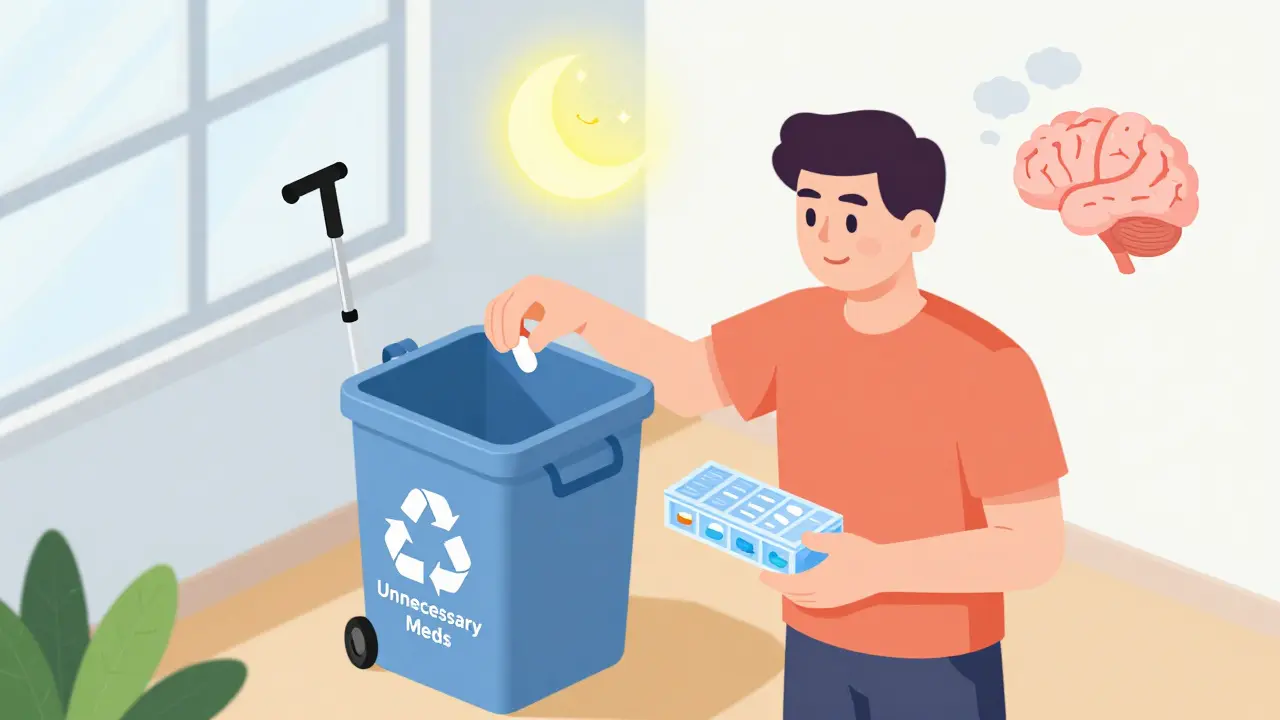
- Deprescribe, don’t just stop - Never quit a medication cold turkey, even if you think it’s not working. Some drugs - like antidepressants, blood pressure meds, or steroids - can cause dangerous rebound effects if stopped suddenly. Deprescribing means slowly reducing under medical supervision. It’s not about cutting pills; it’s about removing what no longer serves you - safely.

Deprescribing: When Less Is More
Deprescribing isn’t about going off meds because you’re tired of taking them. It’s a planned, evidence-based process of stopping drugs when the risks outweigh the benefits. It’s especially important for older adults, people with limited life expectancy, or those with declining function.
For example, an 80-year-old with dementia may be on a statin for cholesterol - but if they’re not eating well and their life expectancy is under two years, the long-term benefit of preventing a heart attack doesn’t outweigh the risk of muscle pain, liver stress, or cognitive side effects. Stopping it can improve their daily comfort.
Another common case: someone on a proton pump inhibitor (PPI) for heartburn for five years. These drugs are often prescribed for short-term use, but many people stay on them indefinitely. Long-term use raises risks of bone fractures, kidney disease, and infections. A careful taper, with diet and lifestyle changes, can often replace the pill entirely.
Studies show that when deprescribing is done properly - with patient input and gradual reduction - people feel better. They have fewer side effects, fewer falls, and better quality of life. But it only works when it’s planned. Never guess. Always work with your doctor or pharmacist.
Your Role: Be the Boss of Your Meds
Doctors and pharmacists are partners - but you’re the one who takes the pills. That means you’re the most important person in this process.
Here’s what you can do every day:
- Link your meds to daily habits. Take your pills after brushing your teeth or with breakfast. This builds routine and reduces missed doses.
- Use a pill organizer - but don’t rely on it alone. Check the labels each time you fill it.
- Write down any new symptom: dizziness, fatigue, confusion, nausea, rash. Note when it started and what meds you took that day. Bring this to your next visit.
- Ask: “Is there a simpler way?” Could a once-daily pill replace two? Could a non-drug option - like exercise, diet, or sleep - reduce your need for a med?
- Never assume a supplement is safe. Tell your provider about every vitamin, herb, or OTC product - even if you think it’s “just natural.”
And if you’re ever unsure - call your pharmacist. They’re medication experts, not just pill dispensers. Most will take 10 minutes to review your list over the phone, free of charge.
Teamwork Makes It Work
Managing multiple meds isn’t a solo job. It needs a team: your doctor, pharmacist, nurse, and sometimes a caregiver.
Pharmacists are your secret weapon. They’re trained to spot interactions, check for duplicates, and suggest alternatives. Many clinics now include pharmacists in regular care visits - especially for patients on five or more drugs.
At care transitions - like leaving the hospital - medication reconciliation is critical. That means someone compares your home meds with what you were given in the hospital. If that doesn’t happen, you could go home with extra drugs, missing ones, or dangerous combos.
Don’t let this slip through the cracks. Ask: “Will someone review all my meds before I leave?” If you have a caregiver, include them in discussions. They can help spot changes in your behavior or side effects you might miss.
What to Do If You’re Overwhelmed
If you’re drowning in pills, you’re not alone. And you don’t have to fix it all at once.
Start small:
- Make your living medication list - today.
- Call your pharmacy and ask for a free med review.
- Pick one drug you’re unsure about and write down why you take it.
- Next time you see your doctor, say: “I’d like to review my meds. Can we focus on one to see if it’s still needed?”
Progress isn’t about cutting 10 pills in a week. It’s about making one safe change, then another. Over time, you’ll have fewer pills, fewer side effects, and more control.
Remember: The goal isn’t to take zero meds. It’s to take only what improves your life - and nothing more.
What counts as polypharmacy?
Polypharmacy is defined as taking five or more medications at the same time - including prescription drugs, over-the-counter medicines, and dietary supplements. This threshold is used because research shows the risk of harmful drug interactions increases significantly at this point. It’s not just the number, though - it’s whether each medication is still necessary, effective, and safe with the others.
Can I stop a medication if I think it’s not helping?
No - never stop a medication on your own, even if you think it’s unnecessary. Some drugs, like blood pressure medications, antidepressants, or steroids, can cause serious rebound effects or withdrawal symptoms if stopped suddenly. Always talk to your doctor or pharmacist first. They can help you safely taper off if it’s appropriate.
Are over-the-counter drugs and supplements safe with my prescriptions?
Not always. Many OTC drugs and supplements interact dangerously with prescriptions. For example, St. John’s Wort can reduce the effectiveness of antidepressants and birth control. Calcium supplements can block thyroid medication. Even common pain relievers like ibuprofen can raise blood pressure or damage kidneys when taken with certain heart or kidney drugs. Always tell your provider about every supplement and OTC product you use - even if you think it’s harmless.
How often should I review my medications?
You should review your full medication list at least once a year - and ideally every time you see a new doctor or get a new prescription. If you’re on five or more medications, ask for a formal medication review during your annual check-up. Many clinics now offer these reviews with a pharmacist. Don’t wait for symptoms - prevention is key.
What’s the difference between appropriate and inappropriate polypharmacy?
Appropriate polypharmacy means you’re taking multiple medications because each one is necessary, evidence-based, and aligned with your health goals - and you’re able to take them safely. Inappropriate polypharmacy happens when you’re taking drugs that no longer help, duplicate each other, cause side effects, or aren’t aligned with your current health status or goals. The key difference is intention and outcome: one improves your life; the other adds risk without benefit.
James Nicoll
January 26, 2026 AT 12:37So let me get this straight - we’re treating aging like a software bug that needs patching with more pills? 🤔
My grandpa took 12 meds and still outlived his doctor. Turns out, the real interaction was between his stubbornness and the system.
Also, who wrote this? A pharmacist who moonlights as a TED Talk scriptwriter? Too clean. Too neat. Life doesn’t come with a bullet-pointed medication list.
But hey, at least it’s better than the ‘just take two and call me in the morning’ era. I’ll give it that.
SWAPNIL SIDAM
January 28, 2026 AT 01:24My mother take 8 medicine. One for blood, one for sugar, one for pain, one for sleep, one for heart, one for stomach, one for joint, one for memory.
Doctor say all needed. But she feel tired all time. I ask: why so many? No answer.
Now she take only 5. Sleep better. Walk more. I think some medicine just make money for pharmacy.
Thank you for write this. My mother now ask question too.
Sally Dalton
January 28, 2026 AT 04:06OMG I NEED TO SHARE THIS WITH MY MOM 😭
She’s been on 9 meds since 2020 and she swears she ‘just forgets’ to tell her doctors about the turmeric and the melatonin and the gummy vitamins she thinks are ‘harmless’.
I cried reading this because I’ve been so scared to say anything - like, what if I sound like I’m trying to kill her?
But you’re right - we’re the ones who swallow these things. We should be the ones asking ‘why?’
Going to print this out and bring it to her next appointment. Thank you for saying this so clearly ❤️
Allie Lehto
January 28, 2026 AT 12:43Deprescribing? What a fancy word for ‘giving up’.
You know what’s really dangerous? The medical-industrial complex that profits from lifelong dependency.
They don’t want you to feel better - they want you to keep buying.
And don’t get me started on ‘pharmacists as secret weapons’ - like, yeah, the guy who’s paid by the pharmacy chain to upsell you on probiotics while flagging your blood pressure med.
Real talk: if you’re on five meds, you’re already a product. Stop pretending this is about safety.
It’s about control. And profit. And fear.
And you’re all just clicking ‘like’ while the system eats your parents alive. 🤡
Dan Nichols
January 29, 2026 AT 13:16Five meds = danger? That’s arbitrary. My uncle takes 17 and he’s hiking at 82.
Some people need them. Some don’t. Stop generalizing.
Also ‘living medication list’? That’s not a thing. It’s a spreadsheet. And if you’re too lazy to keep it updated, that’s your problem.
And why is the pharmacist the ‘secret weapon’? Because doctors are incompetent? That’s a lazy cop-out.
And ‘deprescribing’ sounds like a buzzword made by consultants who’ve never held a pill bottle.
Real solution? Better coordination. Not more lists. Not more guilt. Just better systems.
Also - grapefruit juice? Really? That’s your big warning? Wow.
So many red herrings. So little substance.
Uche Okoro
January 29, 2026 AT 18:43As a clinical pharmacologist, I must emphasize the pharmacokinetic and pharmacodynamic synergies that underpin polypharmacy risks.
Enzyme inhibition via CYP450 isoforms, particularly CYP3A4 and CYP2D6, dramatically alters bioavailability of concomitant agents.
Moreover, renal clearance thresholds in geriatric populations are frequently misestimated, leading to toxic accumulation.
Pharmacist-led medication reconciliation protocols reduce adverse drug events by 38% in randomized trials - a statistically significant finding (p < 0.01).
However, the article’s framing is dangerously reductionist. It ignores socioeconomic determinants: access to specialists, insurance formularies, and medication affordability.
Deprescribing is not merely clinical - it’s structural. You cannot deprescribe poverty.
Also - ‘natural supplements’? Please. Turmeric is a COX-2 inhibitor. It’s a drug. Stop romanticizing it.
Joanna Domżalska
January 31, 2026 AT 05:06Everyone’s so obsessed with cutting pills like it’s some kind of spiritual cleanse.
What about the people who need those pills? Who are you to decide their quality of life?
My aunt stopped her blood thinner because ‘it wasn’t helping’ - guess what? She had a stroke.
Now she’s paralyzed. And you’re all over here talking about ‘deprescribing’ like it’s yoga.
Stop pretending this is about empowerment. It’s about fear. Fear of complexity. Fear of responsibility.
And don’t even get me started on the ‘pharmacist as hero’ nonsense - they’re just the ones who hand you the pills after the doctor screws up.
Stop romanticizing the system. It’s broken. And you’re just rearranging deck chairs.
Josh josh
February 2, 2026 AT 04:08bro i just took 6 pills this morning and i was like wait am i a lab rat
then i read this and i was like ohhhh so i’m not crazy
also i’ve been taking ashwagandha for ‘stress’ and turns out it messes with my thyroid med??
my pharmacist literally laughed and said ‘yep that’s why you’re so tired’
so yeah. stop assuming supplements are chill
also i printed this and taped it to my fridge
my mom is gonna cry
thanks
bella nash
February 3, 2026 AT 11:54It is imperative to recognize that the clinical management of polypharmacy necessitates a multidisciplinary, evidence-based, and patient-centered paradigm that transcends simplistic reductionist frameworks.
While the conceptual framework presented herein is laudable in its intent, it lacks sufficient granularity in addressing the heterogeneity of geriatric pharmacotherapy, particularly with regard to comorbid cognitive impairment, adherence dynamics, and the longitudinal trajectory of disease progression.
Furthermore, the implicit assumption that deprescribing is universally beneficial may inadvertently undermine the therapeutic alliance in patients for whom medication continuity confers psychological stability, irrespective of physiological necessity.
It is therefore incumbent upon clinicians to avoid heuristic-based decision-making and instead engage in structured, time-intensive, and individualized medication reviews - not as a checklist, but as a sacred ritual of care.
One must never forget: the pill is not the problem. The system is. And the system is not fixed by bullet points.
Renia Pyles
February 4, 2026 AT 11:08Oh please. You think this is about safety? It’s about control.
Doctors don’t want to admit they prescribed wrong. Pharmacies don’t want to lose revenue. Insurance companies don’t want to pay for the ‘real’ solution - therapy, diet, exercise.
So they keep adding pills to cover up the side effects of other pills.
And now you’re telling people to ‘ask questions’? Like that’s gonna change anything?
Try asking your doctor to take you off your statin and they’ll treat you like you’re trying to steal their car.
And don’t even mention supplements - they’ll roll their eyes and say ‘that’s not science’ - until you’re on a new one they prescribed.
This isn’t advice. It’s a Band-Aid on a gunshot wound.
Shweta Deshpande
February 4, 2026 AT 12:05This made me cry happy tears 🥹
My dad is 78 and takes 11 medicines. He forgets half of them. He says ‘I’m just trying to live longer’ but he’s always tired, always dizzy.
I started helping him write down his meds - just a piece of paper with pen - and we went to his pharmacist together.
They took away one blood pressure med that was doing nothing. Stopped the sleeping pill he didn’t need. Said the turmeric was fine but to stop the calcium with his thyroid pill.
Now he sleeps better. Walks to the mailbox. Laughed yesterday for the first time in months.
You don’t need to be a doctor to make a difference. Just care enough to ask.
Thank you for giving us the words to say it.
Aishah Bango
February 5, 2026 AT 08:12Let me be clear: if you’re taking more than five medications, you’re failing at life.
It’s not the system’s fault. It’s yours.
You didn’t eat right. You didn’t exercise. You didn’t meditate. You didn’t take responsibility.
Now you want the system to patch your poor choices with more pills?
And you think a pharmacist is your ‘secret weapon’?
That’s not empowerment. That’s dependency with a side of guilt.
Stop outsourcing your health to a pill bottle.
Take ownership. Or stop complaining.
Simran Kaur
February 6, 2026 AT 14:36I live in India. My grandmother takes 7 medicines. No one checks if they work together.
She goes to different doctors. Different pharmacies. Sometimes she takes the wrong one because the labels are in English and she can’t read.
When I came home from college, I made her a picture chart - with colors and faces - for each pill.
Now she smiles when she takes them.
It’s not about the number. It’s about love.
Someone has to care enough to sit with them. To listen. To write it down.
This post? It’s not just advice.
It’s a reminder: you are not alone. Someone is watching. Someone cares.
Jessica Knuteson
February 7, 2026 AT 16:14Deprescribing is a myth. It’s what doctors say when they’re tired and don’t want to deal with the real issue - which is that we’ve medicalized aging.
People aren’t ‘polypharmacy patients’. They’re people who’ve lived long enough to accumulate damage.
And now we’re supposed to fix it by taking away the crutches?
What’s the alternative? Let them fall?
Let them suffer?
Or just tell them to ‘ask questions’ while their doctor’s on a 7-minute visit?
This isn’t empowerment. It’s victim-blaming with a side of bullet points.
Stop pretending complexity can be solved with a checklist.
It can’t.