Imagine picking up a prescription that looks nothing like the one you took last month. The color is off, the texture feels gritty, or worse, it doesn’t seem to work at all. For millions of patients relying on affordable medicine, this isn't just a cosmetic annoyance-it’s a serious safety concern. While generic drugs are supposed to be identical to their brand-name counterparts in strength and effect, the reality of manufacturing issues often tells a different story.
The gap between expectation and reality in generic pharmaceuticals is widening. Recent data from the FDA Drug Shortages Task Force reveals that quality problems account for 62% of drugs entering shortage status between 2013 and 2017. Even more alarming, generic injectables made up 78% of those shortage cases. Why? Because when manufacturers cut corners to compete on price, the result is often a product that fails to meet basic safety standards. This article breaks down exactly where these failures happen, why they persist, and what it means for your health.
The Root Cause: Price Pressure vs. Quality Investment
To understand why defects occur, you have to look at the economics. Generic pharmaceuticals represent about 90% of prescriptions filled in the U.S., yet they account for only 23% of total drug spending (IQVIA, 2023). This massive volume with thin margins creates intense pressure to keep costs down. But quality assurance doesn't come cheap.
Branded manufacturers typically allocate 15-18% of production costs to quality assurance. In contrast, generic manufacturers average only 8-10% (JMCP, 2020). That difference might sound small on paper, but in a factory running 24/7, it translates to fewer inspections, older equipment, and less rigorous testing. Dr. Scott Gottlieb, former FDA Commissioner, warned that "the relentless price pressure on generics has compromised the reliability of our drug supply." When facilities share production lines for multiple drugs, the risk of cross-contamination spikes. Add aging infrastructure that hasn't been updated since the 1990s, and you have a recipe for disaster.
Common Physical Defects in Solid Dosage Forms
Most people think of pills as simple compressed powder, but making them is complex engineering. When things go wrong, specific physical defects appear. These aren't random; they point to exact failures in the manufacturing process.
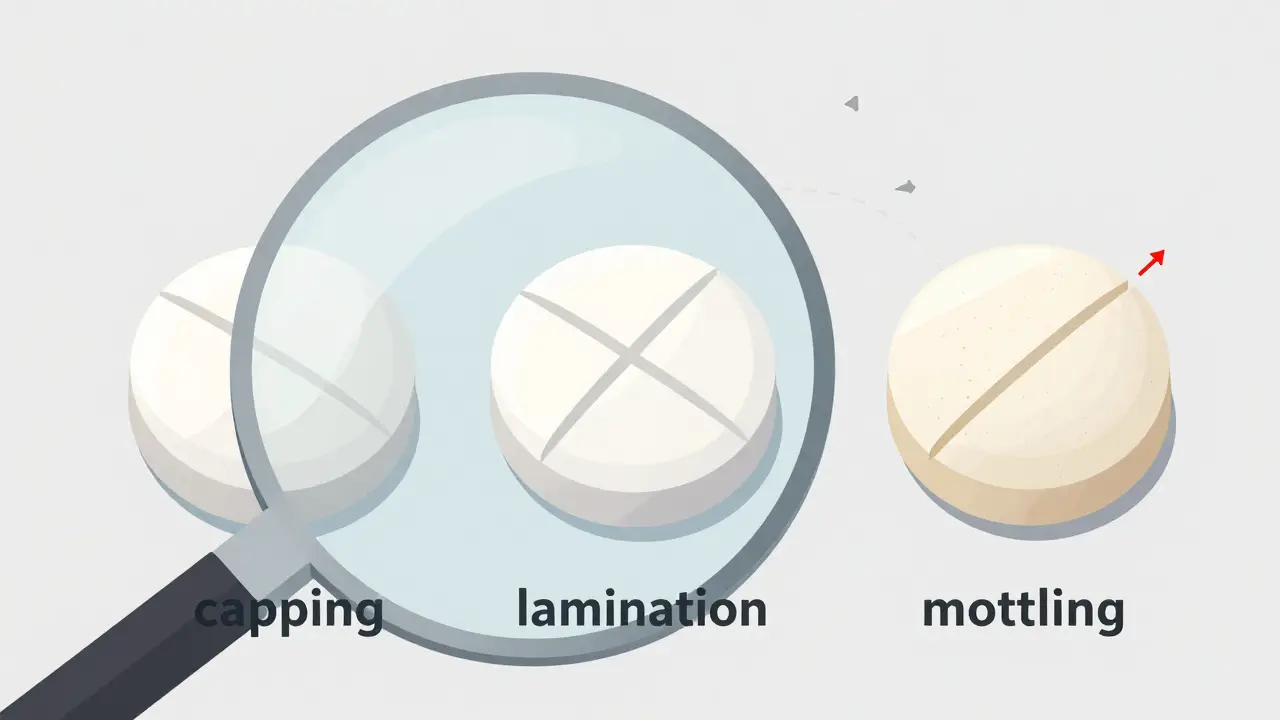
- Capping: This happens when the top layer of a tablet separates horizontally from the rest of the body. It usually occurs when compression force exceeds 15 kN while moisture content in hydrophobic formulations drops below 2%. Air trapped inside the granules escapes during decompression, pushing the cap off.
- Lamination: Similar to capping, but the separation happens within the layers of the tablet rather than at the surface. This typically appears at turret speeds above 40 rotations per minute when pre-compression is insufficient. Laminated tablets can crumble in the stomach, releasing the drug too quickly or not at all.
- Punch Sticking: Material adheres to the punch heads used to shape the tablet. This increases ejection forces by 300-500 Newtons. It’s common when active pharmaceutical ingredients (APIs) with melting points below 120°C encounter moisture levels above 4% during long production runs. The heat from friction melts the API slightly, causing it to stick.
- Mottling: Uneven coloring or spotting on the tablet surface. While often considered cosmetic, severe mottling can indicate poor mixing of ingredients or inconsistent coating application, which may affect how the drug dissolves in the body.
These defects are classified by the FDA’s Product Quality Defect (PQD) system. Critical defects affect dose accuracy-like weight variation greater than 5%. Major defects compromise patient confidence, such as severe mottling. Minor defects are acceptable deviations with justification. However, even "minor" issues can signal deeper systemic problems in the facility.
Sterile Injectables and Particulate Contamination
If solid tablets are tricky, sterile injectables are even higher stakes. You cannot afford any contamination in a drug that goes directly into your bloodstream. Yet, sterile injectables show an 8.7% defect rate, primarily due to particulate contamination (Overview.ai, 2023).
Particulates can be anything from glass shards to rubber particles from stoppers. They pose immediate risks: blocking blood vessels, causing inflammation, or triggering immune reactions. The problem is exacerbated by limited competition. There are far fewer manufacturers producing generic injectables compared to oral solids. When one major plant shuts down for quality issues, the entire supply chain collapses. This was evident in the 2013 heparin crisis and continues today with various antibiotic and chemotherapy agents.
Weight variation is another critical issue in solids. When granule flow rates fall below 0.5 g/s, dose uniformity fails in 12.7% of affected batches (Vici Health Sciences, 2023). If one pill has 90% of the required drug and the next has 110%, your body receives inconsistent dosing. For narrow-therapeutic-index drugs like warfarin or levothyroxine, this inconsistency can be life-threatening.
Data Comparison: Generic vs. Branded Quality Performance
| Metric | Generic Manufacturers | Branded Manufacturers |
|---|---|---|
| Manufacturing Facility Inspection Failure Rate | 57% | 28% |
| Recall Events Per Facility | 2.3x higher | Baseline |
| % of Recalls Due to Manufacturing Defects | 63% | 41% |
| Complex Generics Defect Rate (e.g., Inhalers) | 18.2% | N/A |
| Bioequivalence Failures (2015-2020) | 7.3% attributed to manufacturing | <1% |
The numbers don't lie. Generic drugs face 3.2 times more manufacturing quality issues than branded counterparts according to FDA inspection data. Complex generics, like inhalers and modified-release tablets, are particularly vulnerable, with defect rates reaching 18.2% and 14.7% respectively (DrugPatentWatch, 2023). Simple immediate-release tablets perform better at 9.3%, but still lag behind industry standards.
Real-World Impact: What Pharmacists and Patients See
You don't need to read regulatory reports to know there's a problem. A 2023 survey by the American Pharmacists Association found that 68% of pharmacists had encountered generic drug quality issues in the past year. Nearly half reported patient complaints about tablet appearance, and 29% noted therapeutic inequivalence concerns.
Online communities reflect this frustration. On Reddit’s r/pharmacy, threads discussing generic quality consistently highlight real-world incidents. One pharmacist described receiving metformin ER tablets that crumbled during dispensing in a January 2024 batch. Another shared stories of patients reporting different effects from levothyroxine generics despite coming from the same manufacturer. Hospital formulary committees documented that 17.3% of generic substitution requests in 2023 included quality concerns, leading to permanent brand retention in nearly 10% of cases.
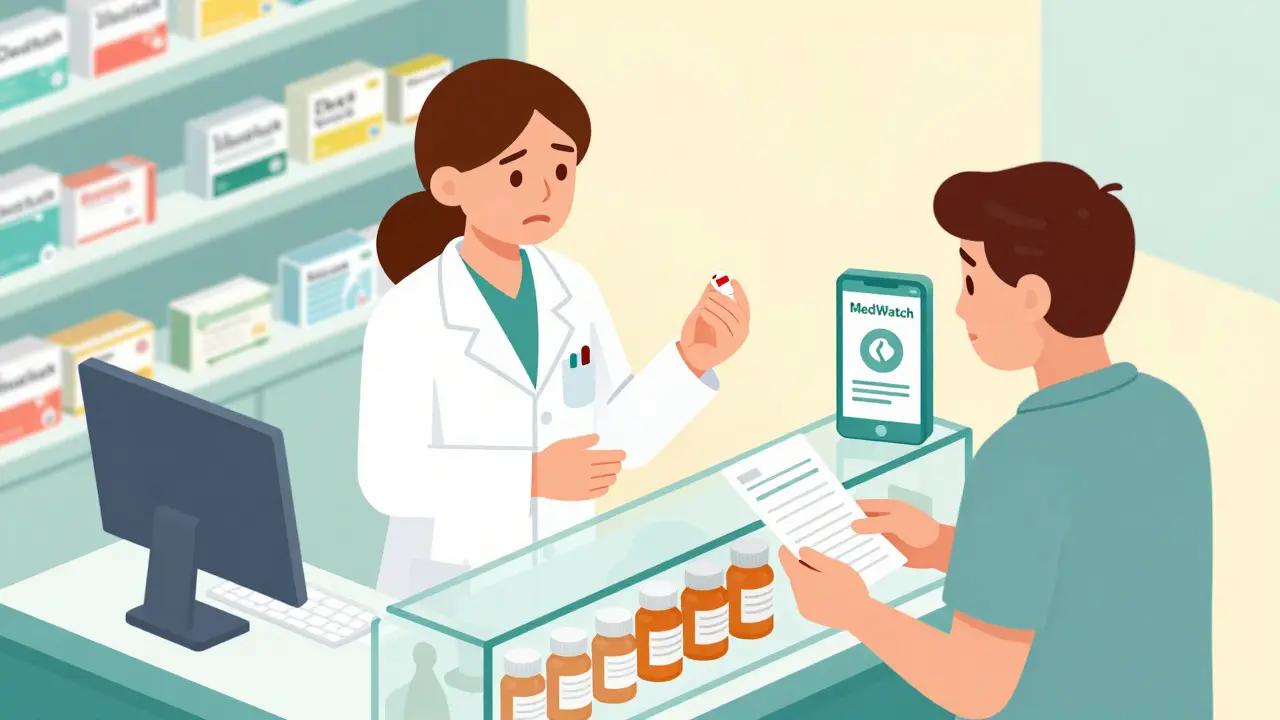
FDA’s MedWatch system received 1,842 adverse event reports in 2023 specifically mentioning generic drug quality issues. Of those, 327 involved visible tablet defects like chipping, cracking, or discoloration. These aren't isolated incidents; they are symptoms of a broken system where cost-cutting overrides patient safety.
Regulatory Response and Future Solutions
Is anything being done? Yes, but slowly. The FDA’s FY2024 Report on Pharmaceutical Quality showed that Current Good Manufacturing Practice (CGMP) deficiencies constituted 24% of all recall events. In response, the agency launched the Emerging Technology Program in 2023. So far, 47 generic manufacturers have implemented continuous manufacturing processes, which reduce defect rates by 65% compared to traditional batch processing (FDA, January 2024).
Continuous manufacturing allows for real-time monitoring and adjustment. Instead of making huge batches and hoping they pass tests at the end, manufacturers check every step along the way. Automated visual inspection systems can now detect defects as small as 0.1 mm at throughput rates of 600 tablets per minute, reducing human error from 30% to less than 2% (Overview.ai, 2023).
However, adoption is slow. The Generic Pharmaceutical Association estimates it would require $28.7 billion in infrastructure investment to bring all U.S. generic manufacturing facilities to modern quality standards. Current annual investment averages only $1.2 billion (GPhA White Paper, December 2023). Without substantial improvements, McKinsey & Company projects that 15-20% of generic manufacturers may exit the market within five years due to unsustainable recall and shortage costs.
What Can You Do?
As a patient, you have limited control over manufacturing practices, but you can advocate for yourself. If you notice changes in your medication’s appearance, texture, or effectiveness, talk to your pharmacist immediately. Don’t assume it’s just a new supplier. Ask for the National Drug Code (NDC) number to identify the specific manufacturer. If you experience adverse effects, report them through the FDA’s MedWatch program. Your voice helps regulators spot trends before they become widespread crises.
Healthcare providers should also remain vigilant. Consider sticking with proven manufacturers for high-risk medications. Support policies that incentivize quality over lowest price. The goal isn't to eliminate generics-they are essential for healthcare accessibility-but to ensure they meet the same rigorous standards as brand-name drugs.
Why do generic drugs have more quality defects than brand-name drugs?
Generic manufacturers operate under intense price pressure, allocating only 8-10% of production costs to quality assurance compared to 15-18% for branded manufacturers. This leads to older equipment, fewer inspections, and higher risks of cross-contamination in shared facilities.
What is tablet capping and why does it happen?
Tablet capping is when the top layer of a pill separates from the rest. It typically occurs when compression force is too high (>15 kN) and moisture content is too low (<2%) in hydrophobic formulations. Trapped air escapes during decompression, pushing the cap off.
Are generic injectables safer than oral generics?
No, generic injectables actually have significant quality issues, with an 8.7% defect rate primarily due to particulate contamination. They account for 78% of drug shortage cases because there are fewer manufacturers, so any quality failure disrupts the entire supply chain.
How can I tell if my generic medication has a quality defect?
Look for visible signs like crumbling, chipping, discoloration, or uneven coloring (mottling). Also monitor for changes in effectiveness or unexpected side effects. If you notice any issues, contact your pharmacist and report it via the FDA MedWatch program.
What is continuous manufacturing and how does it improve quality?
Continuous manufacturing is a modern process where drugs are produced in a steady stream rather than in large batches. It allows for real-time monitoring and adjustments, reducing defect rates by 65% compared to traditional batch processing by catching errors immediately.