When a brand-name drug loses its patent, patients often get switched to a cheaper generic version. But not all generics are the same. Some are authorized generics-medications made by the exact same company that produces the brand-name drug, using identical ingredients, in the same factory, with the same formula. The only difference? No brand name on the label. For many patients, this switch isn’t just about saving money-it’s about avoiding side effects, maintaining stability, and keeping treatment consistent. But switching isn’t automatic. It requires planning, communication, and understanding what’s really in your pill.
What Makes an Authorized Generic Different?
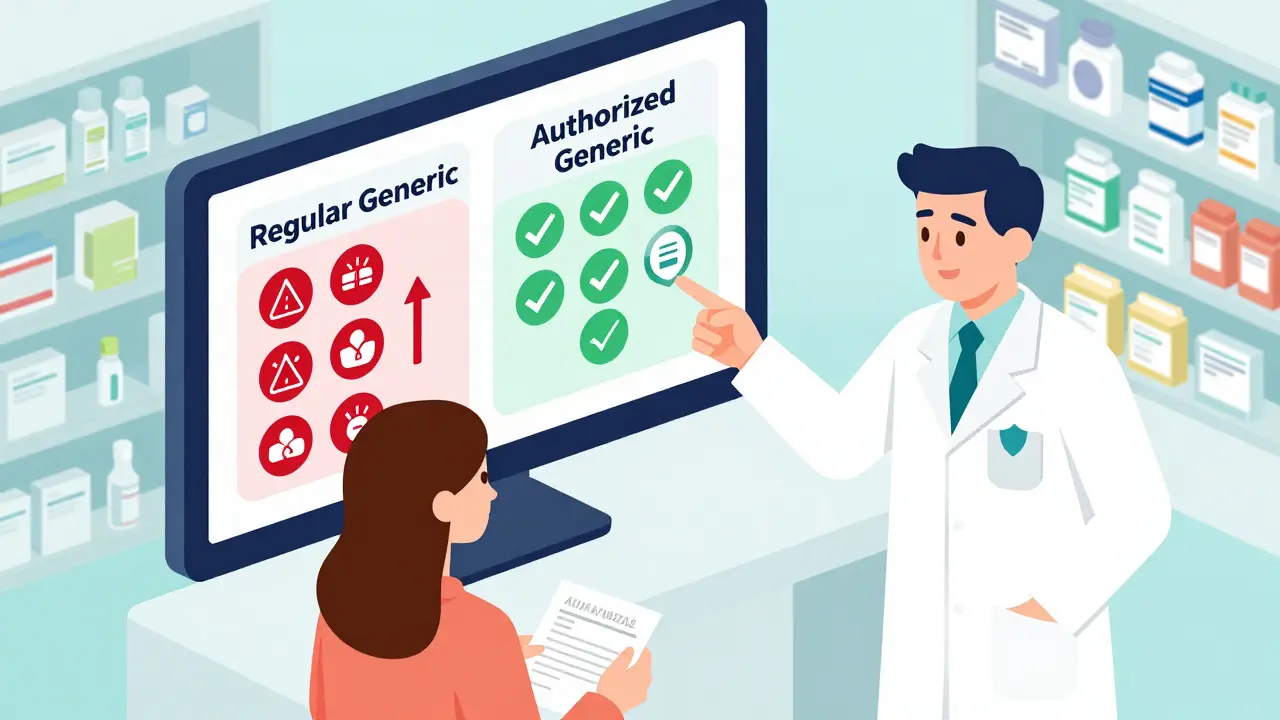
An authorized generic isn’t just another generic. Regular generics must prove they’re bioequivalent to the brand-meaning they deliver the same amount of active ingredient into your bloodstream. But they can use different inactive ingredients: fillers, dyes, preservatives, coatings. These might seem harmless, but for some people, they cause real problems. A 2023 GoodRx study found that 12.7% of patients switching to regular generics reported issues like rashes, stomach upset, or changes in how the medication worked-all tied to these extra ingredients.
Authorized generics skip that risk. They’re made by the brand company itself-or under its license-using the exact same formula. Same active ingredient. Same inactive ingredients. Same manufacturing process. Even the same tablet markings. That’s why, when you switch to an authorized generic, you’re essentially getting the same pill you were on, just without the brand name. The FDA recognizes this distinction: authorized generics are listed under the brand’s original New Drug Application (NDA), not a separate generic approval.
Why This Matters for Your Health
For drugs with a narrow therapeutic index-medications where the difference between a helpful dose and a dangerous one is small-this consistency is critical. Think blood thinners like warfarin, seizure drugs like phenytoin, or thyroid meds like levothyroxine. Even tiny changes in how the drug is absorbed can lead to serious outcomes: clots, seizures, or thyroid crashes.
A 2021 study in the Journal of Clinical Pharmacy and Therapeutics showed that patients switching to regular generics had an 18.4% chance of going back to the brand-name drug-often because they felt something was off. For those switched to authorized generics? Only 7.2% returned. That’s a 61% drop in switchbacks. Asthma patients, in particular, saw a 42% lower rate of stopping their medication when switched to authorized generics versus regular ones.
Patients notice the difference too. On community forums, 73% of users reported being satisfied with authorized generic transitions, compared to 58% for regular generics. One patient wrote: "Switched to the authorized generic of my blood thinner and haven’t had the bruising issues I experienced with the regular generic." Another said: "My doctor said it was the same, but I didn’t believe it-until I didn’t get the nausea anymore."
Cost Savings-But Not Always What You Expect
Authorized generics usually cost less than the brand-name drug. The Federal Trade Commission found they reduce retail prices by 4-8% and wholesale prices by 7-14%. But here’s the catch: your insurance might not treat them like a regular generic.
Some plans put authorized generics on a higher tier-like tier 3 (specialty)-even though they’re cheaper than the brand. Meanwhile, a regular generic might be on tier 2 with a lower copay. A 2022 Health Affairs study found 28% of commercial insurance plans did exactly this. That means you could pay $45 more a month for an authorized generic than for a regular one-even though they’re the same medication.
Before switching, always check your plan’s formulary. Call your insurer. Ask: "Is the authorized generic covered at the same tier as the regular generic?" Don’t assume lower price = lower cost. Sometimes, the brand-name version is cheaper than the authorized generic because of how your insurance tiers work.
How to Make the Switch Smoothly
Switching to an authorized generic isn’t something you do on your own. It’s a team effort between you, your doctor, and your pharmacist. Here’s how to make it work:
- Check availability. Not every brand has an authorized generic. As of Q3 2023, only 37.5% of brand drugs with generics also had an authorized version. Use the FDA’s Authorized Generic Finder tool in Drugs@FDA to see if yours is listed.
- Verify insurance coverage. Call your pharmacy or insurer. Ask: "What’s the copay for the authorized generic versus the regular generic and the brand?" Write it down.
- Get your prescriber on board. Your doctor needs to write a new prescription for the authorized generic. Don’t just ask the pharmacist to swap it-this isn’t a substitution. It’s a new prescription.
- Ask for patient education. Request printed materials from the manufacturer or FDA that explain the difference between authorized and regular generics. Many patients don’t know this option exists-41% of those surveyed in 2022 had never heard of authorized generics.
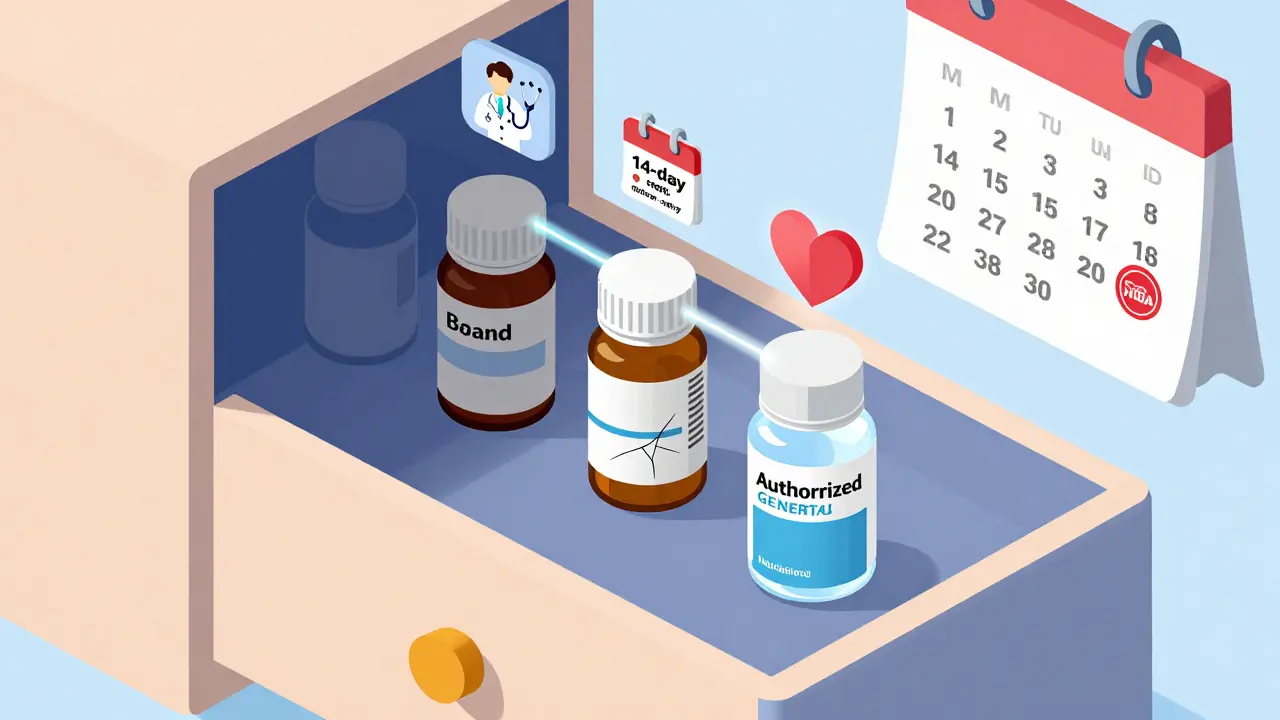
- Follow up. Schedule a check-in with your pharmacist 14 days after switching. If you’re on a narrow therapeutic index drug, your doctor should monitor you closely for the first 30 days.
Pharmacists report that counseling for authorized generic transitions takes only 3-5 minutes-half the time needed for regular generics-because there’s less explaining to do. You’re not switching to something "similar." You’re switching to the same thing.
Why Some Patients Still Get Left Behind
Despite the benefits, access remains uneven. Only about 15% of new generic drugs launched between 2010 and 2019 were authorized generics. Why? Because brand companies don’t always make them. Some delay launching an authorized version to extend their market control. Others don’t bother because they’re focused on new drugs.
Electronic health records (EHRs) also don’t help. A 2023 survey found that 63% of EHR systems don’t distinguish between authorized and regular generics. So when you switch doctors or go to the ER, your medication list might just say "warfarin"-and no one knows if you’re on the brand, the regular generic, or the authorized version. That’s risky.
And then there’s awareness. Most patients don’t know to ask. Most doctors don’t bring it up. The FDA is working on new labeling rules by 2025 to make authorized generics easier to identify. Until then, you have to be the one to ask.
What’s Changing in 2026
Things are moving. In 2022, Medicare Part D changed its rules to require plans to cover authorized generics at the same cost-sharing as the brand-name drug. That’s a big win for over a million seniors. The FTC’s 2023 report confirmed that authorized generics still drive 5.2-9.1% price drops without hurting competition from other generics.
And now, 37% of accountable care organizations (ACOs)-groups of doctors and hospitals that get paid for keeping patients healthy-are tracking authorized generic use as part of quality goals. Why? Because fewer side effects mean fewer hospital visits, fewer ER trips, fewer missed workdays.
The NIH is also funding a major study called TRANSITION, tracking 5,000 patients switching to authorized versus regular generics across 12 drug classes. Results are due in late 2024. If the data holds, we could see even stronger guidelines from the FDA and American Medical Association.
What You Can Do Today
If you’re on a brand-name drug and it’s gone generic, ask your pharmacist: "Is there an authorized generic?" If you’re on a regular generic and you’ve had side effects, ask: "Could I switch to the authorized version?" Don’t wait for your doctor to bring it up. Bring it up yourself.
Keep a list of your medications-not just the name, but the manufacturer and whether it’s authorized. If you’re on warfarin, levothyroxine, or any drug where consistency matters, this isn’t optional. It’s safety.
And if your insurance doesn’t cover it well? Talk to your doctor about a prior authorization. Some plans will cover the authorized generic if you prove it’s medically necessary. Many have done it.
You’re not just saving money. You’re protecting your health. And sometimes, the best generic isn’t the cheapest one. It’s the one that’s exactly the same as what you were on.
What’s the difference between an authorized generic and a regular generic?
An authorized generic is made by the same company that produces the brand-name drug, using the exact same ingredients, in the same facility, and with the same formula. A regular generic only needs to prove it delivers the same amount of active ingredient into your bloodstream-it can use different fillers, dyes, or coatings. That’s why authorized generics avoid side effects tied to inactive ingredients, which affect about 1 in 8 patients.
Are authorized generics as safe as brand-name drugs?
Yes. Authorized generics are identical to the brand-name drug in every way that matters: active ingredient, strength, dosage form, and inactive ingredients. The FDA considers them therapeutically equivalent. In fact, because they eliminate formulation variability, they’re often safer for patients sensitive to excipients or taking drugs with a narrow therapeutic index.
Why is my insurance charging me more for an authorized generic than a regular generic?
Some insurance plans mistakenly classify authorized generics as "specialty" drugs and put them on a higher tier. This is a formulary error, not a reflection of the drug’s value. Authorized generics are usually cheaper than the brand, and often cheaper than regular generics too. Call your insurer, ask for the formulary tier, and request a review. Many plans will adjust it once you provide evidence of identical composition.
How do I find out if my drug has an authorized generic?
Go to the FDA’s Drugs@FDA website and use the "Authorized Generic Finder" tool. Search by brand name. If an authorized generic exists, it will appear with a note saying "Authorized Generic" and list the manufacturer. You can also ask your pharmacist-they have access to manufacturer databases and can confirm availability.
Should I switch to an authorized generic if I’m on a blood thinner or seizure medication?
Yes, if it’s available. Drugs like warfarin, phenytoin, and levothyroxine have narrow therapeutic windows-small changes in how they’re absorbed can lead to serious problems. Authorized generics eliminate formulation differences that can cause therapeutic failure. Studies show a 28% lower rate of treatment failure when switching to authorized generics versus regular ones. Always consult your doctor before switching, but don’t hesitate to ask.
Dean Jones
March 1, 2026 AT 15:56Look, I get that authorized generics sound like a miracle cure on paper, but let’s not pretend this is some grand revelation. The system is rigged. Brand companies don’t release authorized generics because they care about patients-they do it when it’s profitable, and even then, they bury it in fine print. I’ve been on warfarin for 12 years. Switched to the authorized version last year. Paid $47 more a month than the regular generic. My pharmacist shrugged and said, ‘That’s just how the formulary is.’ No one’s auditing this. No one’s holding insurers accountable. We’re just supposed to be grateful we’re not getting the brand-name price tag. Meanwhile, the same company that makes the brand also makes the ‘authorized’ version-same factory, same workers, same QA logs. It’s a shell game with our health as the prize.
And don’t get me started on EHRs. My last ER visit? They listed my med as ‘warfarin.’ No manufacturer. No note. Just ‘warfarin.’ The doc didn’t even blink. I had to pull up my bottle and show them the imprint code. That’s not safety. That’s negligence dressed up as efficiency.
People think this is about cost. It’s not. It’s about control. The system wants you to be confused. The more you’re confused, the less you push back. And when you finally do, you’re told to ‘talk to your doctor.’ But your doctor didn’t even know this option existed until you brought it up. That’s the real failure here.
I’m not anti-generic. I’m pro-transparency. If it’s identical, call it identical. Don’t make me jump through bureaucratic hoops to get the same damn pill I’ve been taking for a decade. And stop pretending this is a patient-centered innovation. It’s a corporate cost-cutting maneuver with a fancy label.
And yes, I’ve read the studies. The 61% drop in switchbacks? That’s because the authorized version doesn’t make you feel like crap. But that’s not a study-it’s a lived experience. And lived experience doesn’t show up in insurance formularies.
We need a new classification. Not ‘brand’ vs ‘generic.’ Not ‘authorized’ vs ‘regular.’ Just ‘same as before’ and ‘different.’ Because that’s what matters. Not corporate jargon. Not tiered copays. Just: does this pill do the same thing as the one I was on? If yes, treat it like it’s the same. Simple.
Until then, I’ll keep printing out the FDA pages, showing them to every pharmacist, and calling my insurer every time they try to charge me more. Someone’s got to.
Gretchen Rivas
March 3, 2026 AT 12:34Just called my pharmacy. My levothyroxine has an authorized generic. Same manufacturer. Same pill. Copay is $3 cheaper than the brand. I switched today. No side effects. No drama. Just… better.
Jeff Card
March 4, 2026 AT 07:55I’ve been on phenytoin for 8 years. Switched from brand to regular generic three years ago. Had three seizure scares in six months. Didn’t connect it until I read this. Switched to the authorized version last month. Zero issues since. My neurologist didn’t even know the authorized version existed. I had to show him the bottle. He apologized. Said he’d start recommending it. That’s the problem-not the science. The awareness.
Betsy Silverman
March 5, 2026 AT 09:55This hit home for me. My mom’s on warfarin. She’s 78. Switched to a regular generic after her insurance dropped the brand. She started bruising like crazy-hips, arms, even her eyelids. We thought it was aging. Turns out, it was the dye in the generic. Found out the authorized version exists. Switched. Bruising stopped in 10 days. I wish we’d known sooner. I’m telling every person I know on chronic meds: ask about authorized generics. It’s not about being picky. It’s about survival.
Also, the FDA tool is actually easy to use. I made a little cheat sheet for my mom: brand name → search → authorized generic? Yes/No. Copay comparison. Manufacturer. I printed it. Laminated it. She carries it in her wallet. Small thing. Huge difference.
Megan Nayak
March 6, 2026 AT 08:31Let’s be real: this whole ‘authorized generic’ thing is a marketing ploy disguised as patient care. The FDA doesn’t need to ‘recognize’ it-it’s just the brand in disguise. The same company that made the brand now makes the ‘authorized’ version? Shocking. They’re not giving up anything. They’re just repackaging their monopoly under a new name. Insurance companies are stupid enough to put it on a higher tier? Good. They should. It’s not cheaper. It’s the same drug with a different label. Stop pretending this is some ethical breakthrough. It’s corporate strategy with a conscience makeover.
And don’t get me started on the ‘studies.’ 73% satisfaction? Who surveyed them? Patients who already knew they were getting the authorized version? Of course they’re happy. They weren’t switched to something new-they were switched to what they were on. No wonder they didn’t have side effects. They never left the real drug.
This isn’t innovation. It’s branding. And we’re all being played.
Matt Alexander
March 6, 2026 AT 21:27Simple version: if your pill looks and tastes the same as before, and you don’t feel weird after switching, it’s probably the authorized one. Ask your pharmacist: ‘Is this the same as the brand?’ If they say yes, ask who made it. If it’s the same company? You’re good. If it’s some random factory you’ve never heard of? Maybe not. Don’t overthink it. Just ask. It’s that easy.
Mike Dubes
March 7, 2026 AT 08:57I just switched my dad to the authorized generic of his blood pressure med. He’s 72, had a stroke last year. We were terrified to switch. But after reading this, we called his pharmacist. Turned out the authorized version was $12 cheaper than the brand and the same as the regular generic. He’s been on it for two weeks. No dizziness. No fatigue. Just… better. I’m telling everyone I know. This isn’t rocket science. It’s just asking the right question. ‘Is there an authorized version?’ That’s it.
Also, I didn’t know about the FDA tool. Found it. Super easy. Took me 2 minutes. I printed it out for my dad’s folder. He’s not tech-savvy. But he can read paper. Small win. Big difference.
Richard Elric5111
March 9, 2026 AT 01:18The philosophical underpinning of this issue lies in the ontological distinction between identity and equivalence. A generic drug, by definition, is not identical-it is merely bioequivalent. This is a metaphysical error of categorization: the assumption that functional equivalence implies ontological sameness. Authorized generics, by contrast, restore the original ontological integrity of the pharmaceutical entity. They are not ‘equivalent’-they are the same substance, reconstituted under a different nomenclature. This is not a regulatory nuance. It is a return to the essence of the therapeutic agent.
Moreover, the current tiering system reflects a deeper epistemological crisis in healthcare: the prioritization of economic abstraction over phenomenological reality. The patient’s lived experience-the nausea, the bruising, the tremor-is rendered invisible by algorithmic formularies. The authorized generic, then, is not merely a pharmacological solution-it is an epistemic correction. It restores the patient’s testimony as a valid datum in clinical decision-making.
One might argue that this is a trivial distinction. But consider: if two objects are indistinguishable in every measurable property, and one retains its original ontological source, then the distinction is not trivial. It is foundational. To deny the authorized generic is to deny the possibility of true therapeutic continuity. And in medicine, continuity is not a luxury. It is the precondition of safety.
Ivan Viktor
March 9, 2026 AT 11:43So let me get this straight. The same company makes the brand, then makes the ‘authorized’ version, and now we’re supposed to be thrilled because we’re not getting a ‘regular’ generic? Cool. So I’m paying more for the exact same pill, just because it has a different label? And you call this progress? I’m out.
Justin Rodriguez
March 10, 2026 AT 10:05I work in a community pharmacy. We get asked about authorized generics every week. Most patients don’t know what they are. Most pharmacists don’t know how to explain them. We need training. We need better EHR flags. We need to stop treating this like a side note. This isn’t about ‘choice.’ It’s about safety. Especially for seniors on warfarin or thyroid meds. I’ve seen the fallout when someone gets the wrong generic. It’s not pretty. If we can prevent even one hospitalization by making this clearer, it’s worth it.
Also, we need a sticker. Like ‘Same as Brand’ on the bottle. One line. That’s all it takes.
Raman Kapri
March 11, 2026 AT 14:28This is a classic Western capitalist illusion. You claim to be helping patients, but you are merely extending corporate control under the guise of safety. In India, generics are universally accepted without such distinctions. Why? Because we trust science, not branding. Your obsession with ‘identical’ pills is a symptom of over-medicalization. A pill is a pill. If it works, it works. Stop creating artificial categories to justify higher prices. The FDA’s role is to ensure safety-not to play marketing consultant for Big Pharma.
Zacharia Reda
March 13, 2026 AT 01:11Wow. This is the most important thing I’ve read all year. I’ve been on levothyroxine for 15 years. Switched to a regular generic last year. Started gaining weight, feeling foggy, getting cold. Thought it was stress. Then I read this. Asked my doctor. Found out the authorized version exists. Switched. Within two weeks, my energy came back. My TSH normalized. I didn’t even know this was a thing. I’m telling everyone I know. This isn’t about money. It’s about your body knowing what it’s supposed to feel like. Don’t wait until you’re sick. Ask now.
Helen Brown
March 14, 2026 AT 21:01I’ve been thinking about this. What if the authorized generic isn’t really the same? What if the brand company is secretly changing something? They control the whole process. They could be adding something subtle. Maybe a preservative that’s linked to autoimmune issues. Maybe the coating is different. The FDA doesn’t test every batch. What if this is all a lie? What if they’re just making us feel safe so we don’t sue them? I’m not switching. I’m staying on the brand. Even if it costs more. Better safe than sorry.
John Cyrus
March 15, 2026 AT 20:44If you’re not on the brand name you’re just gambling with your life. I don’t care what the FDA says. I don’t care about studies. I’ve seen people die from generics. I’m not taking chances. If you’re on a critical med, stay on the brand. Period. The rest of you are just being manipulated by corporate propaganda. You think you’re saving money? You’re risking your life. And don’t come crying to me when your INR spikes because you switched to some ‘authorized’ thing. You were warned.