When it comes to treating severe osteoporosis, not all medications are created equal. For people with very low bone density-especially those who’ve already broken a bone or are at high risk of doing so-drugs that build new bone are often the best option. That’s where teriparatide and abaloparatide come in. These aren’t just another pill you take daily. They’re injectable, anabolic agents that actually stimulate your body to make fresh bone tissue, unlike older drugs that only slow down bone loss. If you’re considering one of these treatments, here’s what really matters: how they work, how they compare, and what you can expect in real life.
How These Drugs Actually Build Bone
Teriparatide and abaloparatide are both synthetic versions of natural hormones that tell your bones to grow. Teriparatide is a piece of the parathyroid hormone (PTH), specifically the first 34 amino acids. It’s been around since 2002 and was the first drug of its kind approved in the U.S. Abaloparatide came later, in 2017, and is designed to mimic a related hormone called PTHrP, which is naturally found in bone and skin. The key difference? Abaloparatide binds more selectively to the receptor on bone cells. This means it triggers bone formation more strongly while causing less bone breakdown. Think of it like a targeted push versus a broader shove. That small difference in mechanism leads to noticeable differences in outcomes.
Fracture Prevention: The Numbers That Matter
The ACTIVE trial, which followed over 2,400 postmenopausal women with osteoporosis for 18 months, gave us some of the clearest data we have. Abaloparatide reduced new vertebral fractures by more than 90% compared to placebo. Teriparatide did the same, but abaloparatide edged it out slightly. More importantly, abaloparatide showed a 50% greater reduction in nonvertebral fractures-like hip, wrist, or rib breaks-than placebo. Teriparatide also reduced these, but not as dramatically. A 2024 analysis of over 43,000 patients confirmed this trend: those on abaloparatide had an 17% lower risk of hip fracture and an 12% lower risk of other nonvertebral fractures than those on teriparatide. For someone with a T-score below -3.0 at the hip, that difference could mean avoiding a life-changing break.
Bone Density Gains: Where Each Drug Excels
Both drugs increase bone mineral density (BMD), but where they improve it differs. Abaloparatide consistently outperforms teriparatide at the hip and femoral neck-the areas most vulnerable to fractures. In the ACTIVE trial, after 18 months, hip BMD increased by 3.41% with abaloparatide versus 2.04% with teriparatide. That’s a 1.37% difference, and it’s statistically significant. For the femoral neck, the gap was even wider: 2.93% vs. 1.49%. Lumbar spine gains were similar at 18 months, but abaloparatide showed faster early gains at 6 months. This matters because if you’re at high risk, faster improvement means quicker protection. A 2025 analysis found that over half of women starting with a hip T-score of -2.7 or lower reached a safer level (-2.5 or higher) with either drug. But if you’re starting even lower-say, -3.0 or below-abaloparatide gives you a better shot at getting there.

Safety: The Hidden Advantage of Abaloparatide
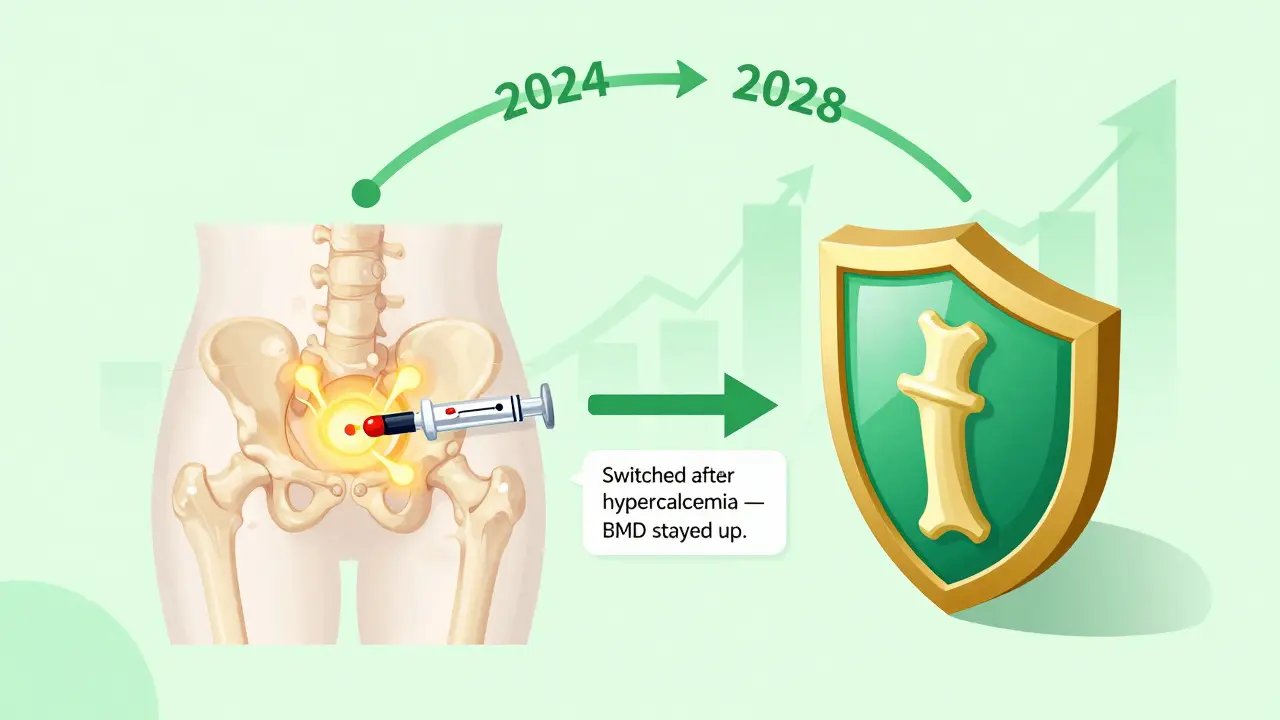
One of the biggest complaints with teriparatide is hypercalcemia-elevated calcium levels in the blood. It happens in about 6.4% of users. Abaloparatide? Only 3.4%. That’s nearly half the rate. Why? Because of that selective receptor binding. Teriparatide stimulates bone cells and kidney cells at the same time, which can push calcium into the bloodstream. Abaloparatide avoids that. Patients report fewer episodes of dizziness, nausea, or fatigue linked to high calcium. In patient surveys, 41% of teriparatide users reported dizziness, compared to 29% of abaloparatide users. And in real-world use, 32% of people stopped teriparatide within a year due to side effects, while only 24% quit abaloparatide. One Reddit user wrote: “Switched after persistent hypercalcemia. Calcium levels dropped within months, and my BMD stayed up.” That kind of feedback isn’t rare.
Cost and Access: The Real-World Hurdle
Here’s where things get messy. As of 2024, abaloparatide costs about $5,750 per month. Teriparatide, now available as a generic since January 2024, is closer to $4,200. That’s a 37% price difference. Insurance coverage is tighter for abaloparatide-44% of users report prior authorization issues versus 28% for teriparatide. For many, the cost isn’t just a number. It’s a barrier to starting treatment. A 2023 analysis of pharmacy claims showed that patients on abaloparatide were 20% more likely to discontinue early due to financial strain. But here’s the catch: if you have Medicare Part D or good private insurance, the out-of-pocket cost might be manageable. For others, teriparatide remains the more accessible option, even if it’s slightly less effective in key areas.
Who Gets Which Drug? Expert Guidelines
The American Association of Clinical Endocrinologists (AACE) 2023 guidelines say this clearly: if you have severe osteoporosis and your hip T-score is -3.0 or lower, abaloparatide is the preferred choice. Why? Because of its proven hip BMD boost and lower fracture risk. But if your main issue is your spine, or you’re cost-sensitive, teriparatide still holds its ground. The Endocrine Society recommends both, but emphasizes sequencing-meaning you take one for 18 months, then switch to a bone-preserving drug like alendronate. That’s because neither drug should be used longer than 2 years. After that, bone formation slows, and the risk of rare side effects (like osteosarcoma in rats, though never confirmed in humans) increases. So the strategy isn’t just which drug, but what comes after.
What Patients Actually Experience
Real life doesn’t always match clinical trials. On patient forums, injection site reactions are common with both drugs-redness, swelling, or pain where you inject. But teriparatide users report it more often: 68% vs. 52%. Many describe the daily injection as a chore. Both come in pre-filled pens, but the learning curve is real. You have to store them at 2-8°C (36-46°F), inject at the same time each day, and avoid injecting into muscle. A 2024 provider guide found that 78% of new users need help with technique in the first month. One user on a longevity forum wrote: “Teriparatide gave me a 12.3% spine boost, but I couldn’t handle the dizziness. Abaloparatide gave me 9.8%, but I could live with it.” For some, the trade-off is worth it.
The Future: What’s Coming Next
Both drugs are likely to evolve. Radius Health is testing a weekly version of abaloparatide-Phase 3 trials finished in late 2023, with results expected in late 2025. If approved, it could dramatically improve adherence. The FDA is also encouraging research into longer treatment durations beyond 18-24 months. Right now, the standard is a hard stop after two years. But new data from the ACTIVE-EXTEND trial shows that after 18 months of abaloparatide, switching to alendronate keeps bone density high for up to 3.5 years. That’s why sequential therapy is becoming the new standard. By 2028, experts predict over 60% of severe osteoporosis cases will follow this two-phase approach. The market for anabolic agents is growing fast-projected to hit $14.7 billion by 2028-driven by aging populations. In the U.S., 10.2 million people already have osteoporosis with T-scores ≤-2.5. That number will only climb.
What Should You Do?
If you’re considering one of these drugs, ask your doctor these questions:
- What’s my hip T-score? If it’s -3.0 or lower, abaloparatide may be the better choice.
- Have I had a nonvertebral fracture? If yes, abaloparatide’s lower nonvertebral fracture risk matters.
- Can I afford it? If cost is a barrier, generic teriparatide is still highly effective.
- Do I have a history of high calcium? If so, abaloparatide’s safety edge could be decisive.
- Am I ready for daily injections? Both require commitment. If you struggle with consistency, discuss alternatives.
There’s no one-size-fits-all answer. But with the right data-and the right conversation-you can pick the option that gives you the best chance to stay fracture-free.
Can I take teriparatide or abaloparatide forever?
No. Both drugs are limited to 18-24 months of use total. After that, bone formation slows, and the risk of rare side effects increases. The standard approach is to use one of these drugs for 1-2 years, then switch to a bone-preserving medication like alendronate or denosumab to maintain gains. This is called sequential therapy and is now the recommended strategy for severe osteoporosis.
Which one is better for the hip?
Abaloparatide has consistently shown greater improvements in hip and femoral neck bone density compared to teriparatide. In clinical trials, hip BMD increased by 3.41% with abaloparatide versus 2.04% with teriparatide after 18 months. It also reduces hip fracture risk more effectively, making it the preferred choice for patients with very low hip T-scores (≤-3.0).
Is abaloparatide worth the extra cost?
It depends. Abaloparatide costs about 37% more than generic teriparatide. If you’re at high risk for hip fractures or have had prior nonvertebral breaks, the added protection may justify the cost. But if your main concern is spine fractures and cost is a major barrier, teriparatide remains a very effective and more affordable option. Insurance coverage also plays a big role-abaloparatide has higher denial rates.
Do these drugs cause hypercalcemia?
Yes, but less so with abaloparatide. Teriparatide causes high blood calcium in about 6.4% of users, leading to dizziness, nausea, or fatigue. Abaloparatide causes this in only 3.4% of users, thanks to its more targeted action on bone cells. Patients with a history of high calcium or kidney issues should discuss this risk carefully with their doctor.
How do I know if the drug is working?
Your doctor will typically order a DXA scan at 6 and 18 months. A 3% or greater increase in lumbar spine BMD at 6 months is a good sign of response. At 18 months, hip BMD gains of over 2% suggest the treatment is effective. If there’s little improvement, your doctor may consider switching therapies or checking for other issues like vitamin D deficiency or poor adherence.
Ray Foret Jr.
March 8, 2026 AT 21:54Janelle Pearl
March 9, 2026 AT 00:27Samantha Fierro
March 10, 2026 AT 05:27Robert Bliss
March 10, 2026 AT 09:56APRIL HARRINGTON
March 11, 2026 AT 19:24rafeq khlo
March 13, 2026 AT 17:13Judith Manzano
March 14, 2026 AT 09:39Peter Kovac
March 16, 2026 AT 03:56Morgan Dodgen
March 17, 2026 AT 04:43Philip Mattawashish
March 18, 2026 AT 05:31Leon Hallal
March 19, 2026 AT 17:49