Why Calibration Isn’t Just a Paperwork Task
Think of a scale in a medical device factory that’s off by just 0.5%. Sounds harmless? That tiny error could mean a drug dose is too strong-or too weak. In manufacturing, especially for medical devices, calibration isn’t about checking a box. It’s about keeping patients safe and avoiding FDA warnings, recalls, or worse. The data doesn’t lie: 37.2% of FDA warning letters in 2023 cited poor calibration practices. That’s not a coincidence. It’s a pattern.
Calibration means making sure your tools-micrometers, thermometers, pressure gauges, pH meters-give accurate readings. Not close. Not "good enough." Accurate. And traceable. That means every measurement you take can be traced back to a national standard, like NIST in the U.S. or BIPM internationally. No shortcuts. No "we’ve always done it this way." ISO 13485:2016, the gold standard for medical device quality, demands it. And it’s not optional.
What Calibration Actually Requires
Calibration isn’t just sending your equipment to a lab once a year. It’s a system. Here’s what it needs to be compliant:
- Unique identification-Every tool gets a tag or number. No two can be the same. If you can’t track it, you can’t prove it was calibrated.
- Traceable standards-Your calibration reference must link back to SI units. If your lab uses a reference weight that’s not traceable, your entire chain breaks.
- Documented procedures-You can’t wing it. You need written steps: how to calibrate, what environment to use (usually 20°C ±2°C and 40% RH ±10%), and how to record results.
- Uncertainty calculations-You must know how much error is possible in your measurement. ISO 10012 says this uncertainty must be less than 25% of the tolerance you’re measuring. If you’re checking a gauge that must be accurate to ±0.1mm, your calibration tool’s uncertainty must be under ±0.025mm.
- Records retention-Keep calibration records for at least the product’s lifetime plus two years. For a heart stent with a 15-year lifespan? That’s 17 years of paperwork.
And timing? It’s not one-size-fits-all. A micrometer in an aerospace plant might need calibration every 3 months. A basic thermometer in a food packaging line? Maybe every 2 years. The key is risk-based scheduling. If your equipment hasn’t drifted in 18 months of daily use? You might extend the interval. But you need data to prove it.
Calibration vs. Validation: Don’t Mix Them Up
People confuse calibration and validation all the time. They’re not the same.
Calibration answers: Is this tool measuring correctly?
Validation answers: Does this entire system work the way it’s supposed to in real use?
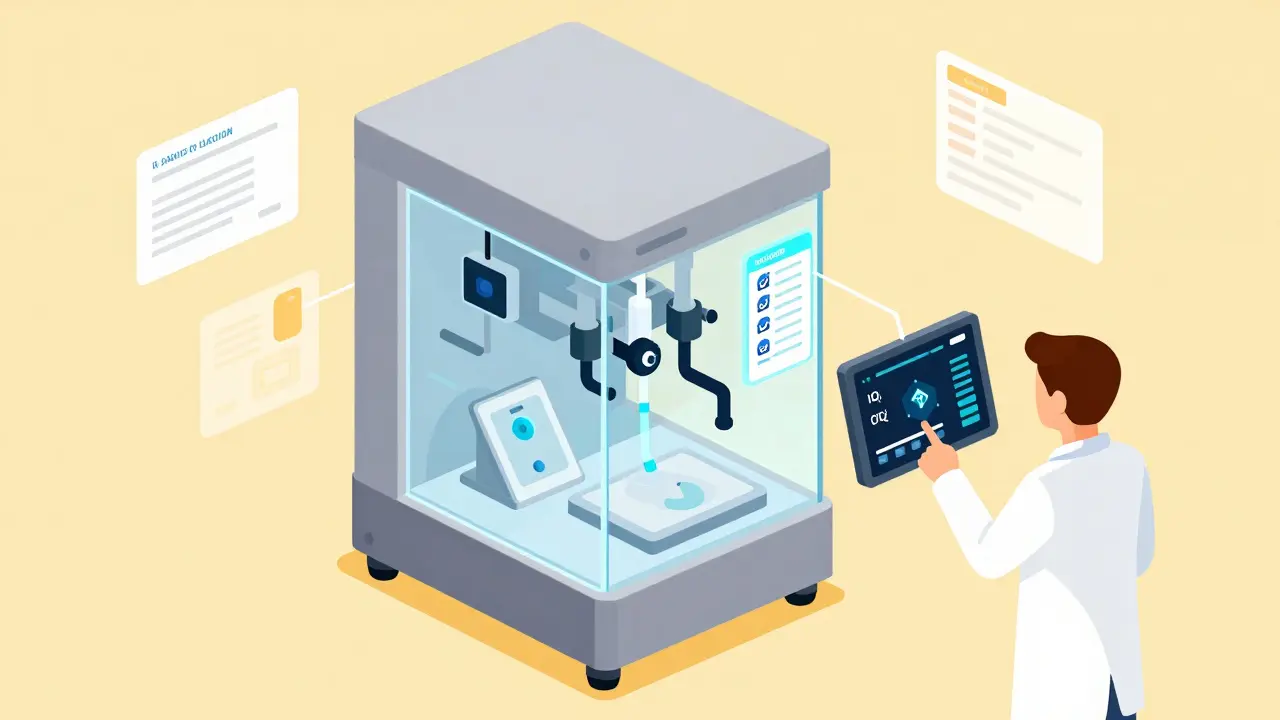
Take an automated filling machine for injectable drugs. Calibration checks if the scale measuring the liquid is accurate. Validation checks if the whole system-pumps, sensors, software, environmental controls-fills 10 mL every time, under real production conditions, with no variation. That’s Installation Qualification (IQ), Operational Qualification (OQ), and Performance Qualification (PQ). It’s not a one-day task. It takes months. And it costs between $25,000 and $500,000 per system, depending on complexity.
ISO 13485 requires both. You can’t skip validation just because your tools are calibrated. A perfectly calibrated sensor can still be part of a broken system. Validation catches that.
Regulations Aren’t the Same Everywhere
ISO 13485:2016, FDA 21 CFR Part 820, CLIA, and EU MDR all demand calibration-but not the same way.
For example, CLIA allows point-of-care glucose meters to skip routine calibration if the manufacturer certifies them and you run daily control tests. That’s a 23.5% reduction in workload for waived tests. But under ISO 13485, you can’t skip traceability-even for a simple thermometer. Every device, no matter how small, must link back to SI units.
And then there’s the EU vs. U.S. divide. The EU requires traceability to BIPM (International Bureau of Weights and Measures). The FDA accepts NIST. If you sell globally, you might need two sets of calibration certificates. That adds 18.7% to compliance costs, according to McKinsey’s 2023 analysis of 45 medical device firms.
China’s YY/T 0287-2017 (their version of ISO 13485) used to demand shorter calibration intervals than the rest of the world-30% shorter. Why? Past quality issues. But as CNAS accreditation grows (now at 47% of manufacturers in 2023), they’re catching up.
Where Calibration Fails (And How to Fix It)
Most calibration failures aren’t because someone forgot to do it. They’re because of environment, documentation, or complacency.
- Temperature and humidity swings-57.8% of out-of-tolerance incidents happen when the lab or production floor fluctuates more than ±5°C from calibration conditions. Solution? Control your environment. Use ISO Class 5 chambers if you’re in semiconductors or pharma. They cost $85,000-$120,000, but they prevent costly errors.
- Bad records-58.3% of negative reviews on calibration software platforms cite "documentation burden." One small medical device maker in Sydney spent 15.2 hours a week just managing paper logs. Switching to cloud-based tools like GageList or Trescal cut that to 5 hours. And audit prep? Down from 84 to 31 hours per week.
- Following manufacturer recommendations blindly-On Reddit’s r/QualityAssurance, 63 users said manufacturer intervals are often too frequent. One lab extended electronic scale calibration from quarterly to biannually after collecting 18 months of stability data. Saved $18,500 a year. But you need proof. Don’t guess. Measure.
And here’s the big one: Don’t ignore drift. A pH meter in a humid lab might need monthly calibration-even if the manual says six months. Real-world use beats theory.
The Rise of Smart Calibration
Calibration is changing. It’s no longer just a scheduled event. It’s becoming continuous.
Pfizer piloted an AI-driven system that adjusted calibration schedules based on real-time sensor data. Result? 31.7% cost reduction. No more calendar-based reminders. Just alerts when drift is detected.
ISO just updated ISO 13485:2016 in March 2024 to require "continuous validation" for AI and machine learning systems. That means if your equipment uses algorithms to predict measurements, you can’t just calibrate it once-you have to monitor it constantly.
NIST’s 2024 roadmap even points to quantum-based standards that could make electrical measurements 100x more accurate by 2030. That could mean calibration intervals for critical devices shrink from yearly to every five years-or disappear entirely.
But here’s the catch: 44.2% of automated systems fail to track the chain of custody for reference standards. If you automate, you must document. Better than ever. Or you’ll create new risks.

Who Needs This, and What It Costs
Not every manufacturer needs the same level of rigor.
Medical device makers? 98.2% have dedicated calibration programs. General manufacturers? Only 76.4%. The difference? Risk. A faulty insulin pump kills. A slightly off torque wrench on a car door hinge? Annoying, but not deadly.
Cost-wise, medical device firms spend 8-12% of their quality budget on calibration. Small companies (<50 employees) pay 22.3% more per device than big ones. Why? They can’t negotiate bulk discounts with calibration labs. And with 83.6% of labs reporting technician shortages, prices are rising.
But the cost of not doing it? Far higher. FDA inspections citing calibration issues jumped from 1,247 in 2022 to 1,462 in 2023. That’s a 17.4% increase. And each inspection can mean a product hold, a recall, or a shutdown.
Getting Started: A Realistic Roadmap
If you’re starting from scratch, don’t try to boil the ocean. Here’s a practical path:
- Inventory everything-List every measuring tool. Even the ones you think are "not important." This takes 112 hours for 500+ devices.
- Classify by risk-High-risk (directly affects product safety)? Medium? Low? Use the SAE AS9100D "Method 5" approach: combine manufacturer advice, historical data, and risk.
- Set intervals based on data-Don’t guess. Use past calibration results. If a tool stayed in tolerance for 18 months? Extend the interval. Document why.
- Choose software-Cloud-based tools automate certificates, reminders, and audits. GageList and Trescal are top-rated. Avoid legacy ERP systems if they can’t integrate.
- Train your team-NCSL International’s MET-101 course is the gold standard. ASQ’s Certified Calibration Technician (CCT) credential? Held by over 14,000 people globally. And certified techs earn 22.5% more.
It takes 6-9 months to build a compliant system. But once it’s running, it saves time, money, and reputations.
What’s Next?
By the end of 2026, the FDA will require all Class II and III device manufacturers to use electronic calibration records. Paper logs are disappearing. If you’re not digital, you’re behind.
And with AI-driven monitoring, IoT sensors in equipment, and quantum standards on the horizon, calibration is becoming smarter-not simpler. The goal isn’t just compliance. It’s confidence. Confidence that every measurement you take is trustworthy. That every product leaving your line is safe. That’s what calibration and validation really deliver.
What’s the difference between calibration and validation?
Calibration ensures a measuring instrument reads accurately against a known standard. Validation confirms that an entire system performs correctly in its actual use environment. Calibration checks the tool; validation checks the process.
How often should equipment be calibrated?
There’s no universal answer. Intervals depend on risk, usage, environment, and historical performance. High-precision tools in aerospace may need quarterly calibration. Basic thermometers in food processing might be annual. Use data-not manufacturer recommendations alone-to set your schedule.
Can I skip calibration if the equipment looks fine?
No. Equipment can drift without showing visible signs. A micrometer might still turn smoothly but measure 0.02mm off. That’s enough to cause a product failure. Calibration is about data, not appearance.
What happens if I don’t comply with ISO 13485 calibration requirements?
Non-compliance can lead to FDA 483 observations, warning letters, product recalls, or loss of certification. In 2023, 37.2% of FDA warning letters cited inadequate calibration. The financial and reputational damage far outweighs the cost of compliance.
Is calibration software worth the investment?
Yes, especially for companies with more than 50 instruments. Cloud-based tools like GageList automate reminders, generate certificates, and simplify audits. Companies using them reduce audit prep time by over 60%. The upfront cost pays for itself in labor savings and reduced risk.
Can I calibrate my own equipment?
Yes-if you have traceable standards, documented procedures, trained personnel, and controlled environmental conditions. Many large manufacturers do in-house calibration. But if you lack the expertise or equipment, outsourcing to an accredited lab is safer and often more cost-effective.
What’s the Test Uncertainty Ratio (TUR), and why does it matter?
TUR is the ratio between the tolerance of the device being tested and the uncertainty of the calibration standard. A TUR of 4:1 means your calibration tool is four times more accurate than the device you’re checking. This prevents false passes-where a faulty device looks okay because your standard isn’t precise enough.
Jason Stafford
January 4, 2026 AT 15:58The FDA doesn't care about your paperwork. They care about dead patients. And if your calibration logs are even one day late? They'll shut you down before your lawyers finish their coffee. This isn't compliance-it's survival. Every tag, every certificate, every humidity log? It's a bullet in the chamber. Skip one, and you're playing Russian roulette with someone's life. No one talks about this, but it's true: the real cost of calibration isn't the lab fees-it's the lawsuit you didn't see coming.
And don't even get me started on AI-driven 'smart' calibration. That's not innovation-it's a backdoor for corporate negligence. If the algorithm says it's fine, you trust it? Then when it fails, who gets sued? The engineer who wrote the code? Or the guy who just clicked 'approve' because the system said it was green? We're outsourcing accountability to machines that don't even understand what 'life' means.
ISO 13485:2016? It's a joke. A beautifully printed, overpriced, legally binding fantasy. The real world doesn't run at 20°C ±2°C. Factories sweat. Machines overheat. People get tired. And when the power flickers at 3 AM? That pH meter drifts. But your software doesn't care. It just logs 'in tolerance' because it was told to. That's not quality control. That's automated delusion.
I've seen labs where the calibration certificates were printed on thermal paper. Thermal paper. That fades in sunlight. And they wonder why they got flagged. You can't trust data you can't read. You can't trust systems you don't understand. And you sure as hell can't trust a government that's too broke to audit properly. This whole system is held together by duct tape, hope, and the sheer terror of getting caught.
They say 'traceability to NIST.' But NIST doesn't send someone to your plant. They send a certificate. A piece of paper. That's not traceability. That's theater. The real standard? The one that keeps your product from killing someone. And if that doesn't scare you, nothing will.
Mandy Kowitz
January 6, 2026 AT 05:05So let me get this straight-you want me to spend $120,000 on an ISO Class 5 chamber so I can measure a thermometer to 0.01°C… for a device that’s just going to sit on a shelf for 15 years? Wow. What a brilliant use of capital. Next you’ll tell me we need to calibrate the air in the breakroom because someone might sneeze and mess up the humidity.
I work at a small shop. We make plastic clips that hold wires together. Not heart stents. Not insulin pumps. Just clips. But now I have to hire a consultant to explain why I can’t just write ‘calibrated’ on a sticky note and call it a day? No. No, no, no. This isn’t quality control. This is corporate witchcraft. And I’m tired of being the witch.
Also, ‘risk-based scheduling’? That’s just code for ‘we’re too lazy to do it on time.’ If it ain’t broke, don’t fix it. But apparently, in this industry, if it’s not broken, you’re still guilty until proven innocent.
And don’t even mention ‘cloud-based tools.’ I tried GageList. It asked me to upload a photo of my calibration weight. I took a selfie with it. It flagged me for ‘non-compliant documentation.’ I quit. I’m going back to paper. And I’m burning the logs after the audit. Let them sue me for arson. At least I’ll be alive to enjoy it.
Justin Lowans
January 7, 2026 AT 16:32Thank you for this comprehensive breakdown. Calibration is one of those quiet, unglamorous pillars of quality that keeps entire industries from collapsing-but rarely gets the recognition it deserves.
What I appreciate most is the emphasis on traceability and uncertainty. Too often, teams treat calibration as a checklist item, not a scientific discipline. The requirement that calibration uncertainty be less than 25% of the tolerance isn’t arbitrary-it’s mathematically sound. It’s the difference between ‘close enough’ and ‘scientifically defensible.’
And the point about environmental controls? Absolutely critical. I’ve seen labs where the calibration room was next to the boiler room. No wonder their results drifted. Temperature isn’t just a variable-it’s a variable you must tame.
Switching to digital systems like Trescal isn’t just about saving time. It’s about reducing human error. Paper logs get lost. Signatures get forged. Digital chains of custody? They’re immutable. They’re auditable. They’re honest.
Yes, it’s expensive. Yes, it’s tedious. But when a child receives the correct dose of medication because your pump was calibrated to within 0.02 mL? That’s the ROI. You can’t put a price on that. And frankly, if you’re still doing this manually, you’re not just behind-you’re putting lives at risk. This isn’t bureaucracy. It’s responsibility.
Michael Rudge
January 7, 2026 AT 21:07Oh, so now we’re treating every temperature sensor like it’s measuring the Higgs boson? Let me guess-you also require your janitor to submit a notarized affidavit before mopping the floor, just in case a water molecule drifts out of spec.
‘Traceability to SI units’? Cute. You know what’s traceable to SI units? My coffee mug. It’s 200 mL. I measured it with a graduated cylinder. Do I need a NIST certificate for that? No. I need a functioning brain and a little common sense.
And let’s talk about the ‘risk-based scheduling’ nonsense. You’re telling me a thermometer in a food packaging line needs calibration every two years? Great. But if it’s in a room that never changes temperature, why does it need to be calibrated at all? Because some ISO committee in Brussels said so? That’s not quality. That’s tyranny dressed in a lab coat.
And don’t even get me started on the EU vs. U.S. divide. So now I need two certificates? One for NIST, one for BIPM? Who decided that? A bureaucrat who’s never held a micrometer? I’ve seen calibration certificates with more signatures than a presidential pardon. It’s not science. It’s performance art.
Real engineers don’t need 17 years of paperwork to prove they didn’t mess up. They just don’t mess up. But apparently, in this industry, competence is optional. Compliance is mandatory. And that’s the real failure.
Ethan Purser
January 8, 2026 AT 03:03We’re not just calibrating tools. We’re calibrating our relationship with reality.
Every number on every gauge is a whisper from the universe-telling us how much we’ve lost touch with precision. We live in an age of illusions: deepfakes, AI hallucinations, social media personas. And yet, we still expect a thermometer to tell the truth. That’s the last honest thing left.
Calibration is the last ritual of truth-seeking in a world that’s forgotten how to seek. It’s not about compliance. It’s about humility. It’s saying: ‘I don’t know everything. I need a standard. I need to be measured.’
And validation? That’s the moment we admit that even perfect tools can be part of broken systems. That the machine doesn’t care if you’re a good person. That software doesn’t love your patients. That the algorithm doesn’t know the difference between a cure and a catastrophe.
So yes, spend the $500,000. Yes, keep the records for 17 years. Yes, fight the bureaucracy. Because if we stop measuring truth, we stop being human. And if we stop being human, what’s left? Just machines. And machines don’t mourn. They just log errors.
Doreen Pachificus
January 8, 2026 AT 11:06Interesting read. I work in a small lab that does basic environmental testing-nothing medical. But I’ve seen how calibration creep works. We started with one thermometer. Now we have seven instruments, all requiring quarterly checks, all with digital logs, all needing traceability. It’s not that we’re doing more-we’re just documenting more.
One thing I noticed: the biggest improvement wasn’t from fancy software. It was from labeling everything clearly. A simple tag with a QR code that links to the calibration date and cert? Cut our audit prep time in half. No one’s talking about that.
Also, the part about extending intervals based on data? That’s gold. We did that with a humidity sensor that hadn’t drifted in 3 years. We kept the data. Got approval. Saved $3k/year. No drama. Just good practice.
It’s not about being perfect. It’s about being consistent. And being able to prove it.
Cassie Tynan
January 9, 2026 AT 06:46Let’s be real: calibration is the last bastion of analog integrity in a digital world full of lies.
AI says ‘trust the model.’ But the model was trained on data from a sensor that wasn’t calibrated. So now we’re building entire systems on a lie. And we call it innovation.
ISO 13485:2016? It’s not a regulation. It’s a prayer. A desperate plea from engineers who’ve seen what happens when you stop caring about the numbers.
And yes, it’s expensive. But so is burying a child because a pump delivered 1.2 mL instead of 1.0. So is paying out $50 million in settlements because someone thought ‘close enough’ was good enough.
Don’t call it bureaucracy. Call it grief prevention.
And if you’re still using paper logs? You’re not saving money. You’re buying future trauma. Switch. Now. Your future self will thank you.
Rory Corrigan
January 9, 2026 AT 15:50Just a quick note: calibration isn’t about fear. It’s about care.
Every time you calibrate a tool, you’re saying: ‘I care enough to make sure this is right.’
Not for the audit. Not for the ISO guy. Not for the FDA.
For the person who’s going to use it. For the person who’s going to be healed by it.
That’s the real metric.
And if you don’t feel that? Maybe you’re in the wrong field.
🙂
Stephen Craig
January 10, 2026 AT 01:52Calibration is the baseline. Validation is the safeguard.
One without the other is incomplete.
Don’t confuse the two.
Document everything.
Measure everything.
Trust nothing.
Verify everything.
Connor Hale
January 11, 2026 AT 20:56I’ve been on both sides-the over-regulated lab and the under-resourced startup.
The truth? Most failures aren’t from ignorance. They’re from exhaustion.
People don’t skip calibration because they’re lazy. They skip it because they’ve been drowning in paperwork for years and just need to breathe.
So yes, follow the standards. But also: simplify the process. Automate the reminders. Make the software intuitive. And most of all-listen to the people doing the work. They know when the system is broken.
Good compliance isn’t about control. It’s about enabling people to do their jobs right.
And if you’re not doing that? You’re not building quality. You’re building resentment.
Roshan Aryal
January 11, 2026 AT 21:02Of course Americans think calibration is a sacred ritual. You treat a $20 thermometer like it’s the Holy Grail because you have no idea how to make anything real. In India, we build medical devices that work in 50°C heat with 90% humidity, using tools bought from Alibaba, and we don’t need NIST certificates because we trust our hands.
You spend $120,000 on a climate chamber? We use a fan and a prayer. And our devices last longer.
ISO 13485? A Western fantasy. CLIA? A bureaucratic joke. The world doesn’t care about your paper trails. It cares about results.
And guess what? Our devices don’t kill people. Yours do-because you overthink everything and forget that engineering isn’t about paperwork. It’s about making things that work.
Stop exporting your overcomplicated bureaucracy to the rest of the world. We’re not your lab rats.