Drug Safety Alert Checker
Check Safety Alerts for Your Medication
Compare how different global regulatory agencies view the safety of medications. Safety alerts vary significantly between countries due to different risk assessment approaches.
Safety Alerts for
U.S. FDA
EU EMA
Canada Health Canada
Australia TGA
When you take a pill, you assume it’s safe. But that safety isn’t guaranteed by one global rulebook. It’s shaped by where you live. The same drug approved in the U.S. might carry a different warning in Europe, be delayed in Australia, or not be available at all in parts of Africa. This isn’t a glitch-it’s the reality of how 200+ countries manage drug safety, each with its own rules, speed limits, and priorities.
How the U.S. FDA Approves Drugs: Fast, Centralized, and Clear
The U.S. Food and Drug Administration (FDA) is the single gatekeeper for prescription drugs in America. If a drug wants to be sold here, it goes through the FDA’s centralized review system. No other agency gets a vote. This structure means decisions are consistent-no confusing patchwork of state-level rules. In 2022, the FDA approved new drugs in an average of 10.2 months, faster than most other major regulators.
Doctors and pharmacists in the U.S. report high clarity in FDA communications. A 2022 survey found that 83% of clinicians found FDA safety alerts timely and actionable. The agency also publishes over 300 guidance documents, with 92% rated as clear by industry users. But this speed comes with trade-offs. The FDA’s strict focus on clinical trial data can slow down access to drugs that show promise in early studies. During the pandemic, FDA review times jumped 37% because of the flood of emergency applications.
One major shift happened in 2022 with the FDA Modernization Act 2.0. It removed the legal requirement for animal testing in certain cases, allowing more reliance on computer models and human cell-based tests. This change is expected to cut approval times by 18 to 24 weeks. The FDA also started using AI to handle routine manufacturing inspections-43% of those were processed by algorithms in 2022, not human inspectors.
The European Union’s Hybrid System: Flexibility with Complexity
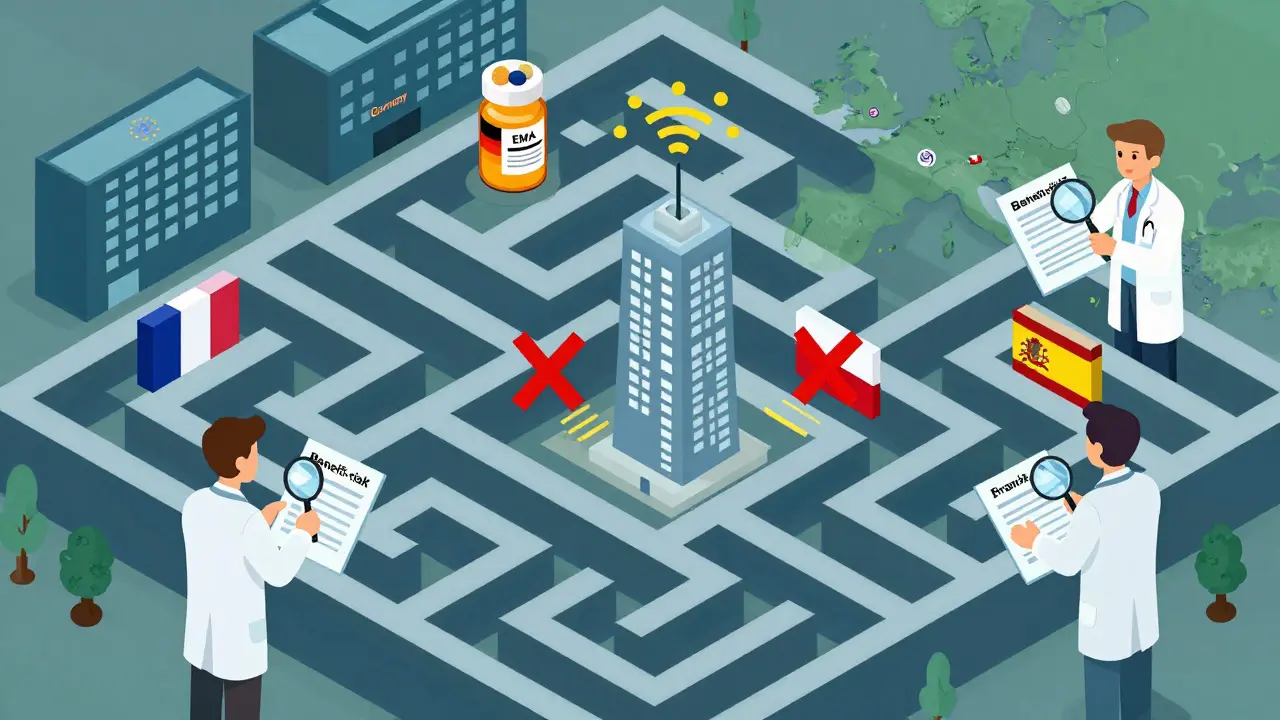
Unlike the U.S., the European Union doesn’t have one boss. It has a network. The European Medicines Agency (EMA) handles new, complex drugs like cancer treatments and gene therapies through a centralized process. But for older, generic medicines, each country-Germany, France, Spain, Poland-makes its own call. That means a drug can be approved in one EU country and still face delays or rejections elsewhere.
This system gives nations more control, but it creates headaches for drugmakers. A 2021 survey found that 68% of European pharmaceutical companies struggled with the maze of national requirements. The EMA’s approval process takes longer-12.7 months on average in 2022. But there’s a reason companies tolerate it: transparency. European doctors rate EMA benefit-risk reports as more comprehensive and understandable than FDA documents, with 71% saying they’re clear, compared to 63% for the FDA.
The EU’s rules are written into binding law called Eudralex Volume IV. All 27 member states must follow them. Inspections happen both by national agencies and the EMA. In 2022, 98.7% of EU-based drug factories met Good Manufacturing Practice (GMP) standards. The EU also leads in approving new cancer drugs-12.7% more than the FDA in 2022-because it’s more willing to approve drugs based on early signs of benefit, even if long-term data is still being collected.
Canada: The Bridge Between the U.S. and Europe
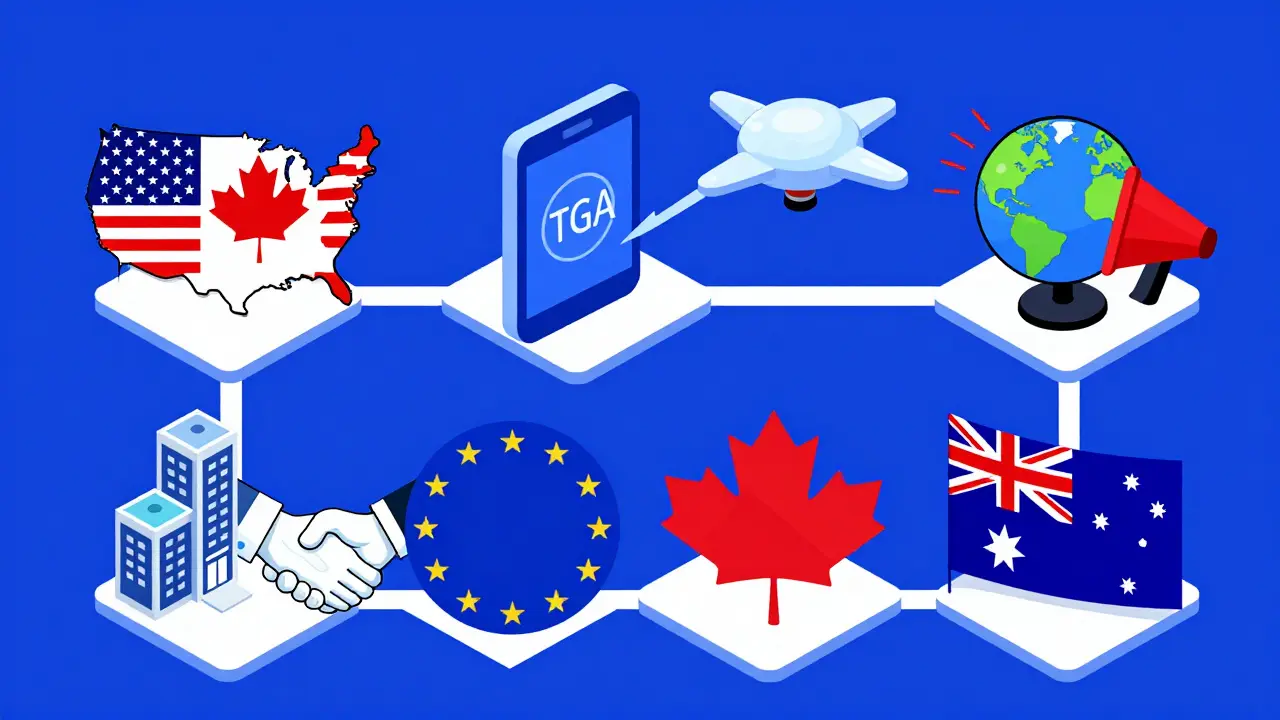
Canada’s Health Canada sits in the middle. It follows a system similar to the U.S. in structure-centralized, single agency-but has built strong ties with the EU. Since 2019, Canada and the EU have had a Mutual Recognition Agreement (MRA) that lets them accept each other’s inspections and manufacturing certifications. That means a drug factory in Germany can be inspected once and approved by both Health Canada and the EMA.
This partnership has paid off. After the MRA, Canada’s safety decisions aligned with the EU’s on 87% of major drug warnings. But Canada still leans toward U.S. standards in approval speed and data requirements. It approved 18.3% more rare disease drugs than the EU in 2022, mirroring the FDA’s focus. Unlike the U.S., Canada doesn’t require animal testing for all drugs, and it allows faster access to drugs under special programs for life-threatening conditions.
Health Canada’s rules are enforced under the Food and Drugs Act. Its review times are slightly slower than the FDA’s but faster than the EU’s, averaging 11.5 months in 2022. It’s also one of the few countries that publicly releases full assessment reports for every approved drug-something patients and doctors rely on.
Australia’s TGA: Pragmatic, Independent, and Data-Driven
Australia’s Therapeutic Goods Administration (TGA) doesn’t follow either the U.S. or EU model exactly. It’s smaller, more independent, and heavily focused on real-world evidence. The TGA approves drugs under the Therapeutic Goods Act 1989, and while it’s influenced by international standards, it doesn’t automatically follow them.
In 2022, the TGA matched the FDA on 79% of safety decisions, but only 63% with the EMA. That shows it’s closer to American standards but still makes its own calls. Australia is also ahead in digital health. The TGA fast-tracked over 50 digital therapeutics in 2022-apps and software that treat conditions like depression or diabetes-using the same approval pathways as pills.
One unique feature: Australia doesn’t wait for full global approval before acting. If a drug shows a serious safety issue in another country, the TGA can issue a warning within days, even if the drug hasn’t been formally reviewed yet. This proactive stance has helped avoid several avoidable harm events. However, with a population of just 26 million, the TGA has fewer resources than the FDA or EMA, and its approval timelines can be unpredictable.
Why Global Safety Alerts Don’t Match Up
Here’s the most startling fact: when major countries issue safety warnings about the same drug, they agree only 10.3% of the time. A 2019 study looked at 120 safety alerts across the U.S., Canada, the UK, and Australia-and only 12 of them matched. One drug, a common diabetes medication, was flagged for heart risks in the U.S. but not in Europe. Another painkiller was pulled in Australia but kept on shelves in Canada.
Why? Because each system weighs risk differently. The FDA tends to act only when evidence is overwhelming. The EU is more likely to act on early signals. Canada uses a mix. Australia often acts first. This isn’t incompetence-it’s philosophy. The U.S. fears false alarms that scare patients away from useful drugs. The EU fears missing a hidden danger. Neither is wrong. But when patients travel or buy drugs online, this mismatch becomes dangerous.
Dr. Thomas Frieden, former CDC director, put it bluntly: “The 10.3% concordance rate represents a dangerous fragmentation that puts patients at risk when medications are used across borders.” A patient in Germany taking a drug approved in the U.S. might not know it was flagged in Australia. A pharmacist in Brazil might not even know the warning exists.
What’s Being Done to Fix the Gaps
Not everyone accepts this chaos. The International Council for Harmonisation (ICH) has been working since the 1990s to align rules across the U.S., EU, Japan, Canada, and Switzerland. By 2023, 89% of major countries adopted ICH E6(R3) guidelines, which simplified clinical trial paperwork by 22%. That’s progress.
WHO’s Global Benchmarking Tool, updated in 2023, now measures how strong a country’s drug agency is-on 89 different indicators. By the end of 2022, 67 countries reached “Maturity Level 3,” meaning they had functional systems. But in Africa, only 37% of drug facilities meet basic safety standards. In India, new GMP rules in 2022 led to a 40% jump in inspections.
The future is digital. The FDA’s AI tools now handle routine inspections. The EMA uses machine learning to spot safety signals in patient reports faster. By 2027, experts predict AI could cut approval times by 30-40%. But technology won’t fix the philosophical divide. As long as one regulator sees a 1 in 10,000 risk as unacceptable and another sees it as acceptable, patients will face uncertainty.
What This Means for You
If you’re a patient: know your country’s drug regulator. Check if your medication has been flagged elsewhere. Don’t assume approval in one country means safety everywhere. Use official sites-FDA.gov, EMA.europa.eu, HealthCanada.gc.ca, TGA.gov.au-to check alerts.
If you’re a traveler: carry your prescription and the generic name. A drug called “Lipitor” in the U.S. might be sold as “Atorvastatin” in Europe. Some countries don’t allow certain ingredients at all.
If you’re a healthcare provider: understand that your patient might be taking a drug approved under different rules. Ask where they got it and if they’ve had side effects others didn’t report.
Global medication safety isn’t about one perfect system. It’s about understanding that safety is local, shaped by culture, politics, and history. The goal isn’t uniformity-it’s awareness. The more you know about how your country’s rules compare to others, the safer you’ll be.
Why do drug safety warnings differ between countries?
Each country’s regulator weighs risk differently. The U.S. FDA often waits for strong, repeated evidence before acting, while the EU’s EMA may act on early signals to prevent harm. Canada and Australia use a mix of both. These differences come from legal frameworks, public health priorities, and available data-not from one being right and another wrong.
Is a drug approved in the U.S. automatically safe in Europe?
No. A drug approved by the FDA may not be approved by the EMA, or it may have different warnings. For example, some painkillers and antidepressants carry stronger caution labels in Europe due to different risk assessments. Always check the label and local regulatory site before taking a drug imported from another country.
How long does it take to get a new drug approved globally?
It can take 5 to 8 years to get a drug approved in all major markets. The FDA takes about 10 months on average, the EU 12-14 months, Canada 11-12 months, and Australia varies widely. Submitting to multiple agencies at once can reduce delays, but each requires separate paperwork, inspections, and fees-adding up to over $1.2 million in compliance costs per company.
Can I trust drugs from developing countries?
Some are safe, many are not. Countries like India and Brazil have improved their standards, but only 58% of drug facilities in India and 29% in parts of Africa meet basic safety requirements. The WHO estimates 1 in 10 medicines in low-income countries are substandard or fake. Always buy from licensed pharmacies and avoid online sellers without clear regulatory markings.
What’s the role of the World Health Organization in drug safety?
The WHO doesn’t approve drugs or enforce rules. Instead, it sets global standards-like Good Manufacturing Practices (GMP)-that over 150 countries use as a reference. It also tracks drug safety globally and helps weaker regulators build capacity. But since its guidelines aren’t legally binding, countries can ignore them. That’s why national agencies still matter most.
What Comes Next?
The push for AI-driven approvals, digital health tools, and harmonized guidelines will keep changing how drugs are reviewed. But the core tension won’t disappear: how fast should we act when lives are on the line? The answer depends on where you are. The best protection isn’t a global law-it’s knowing your own system, asking questions, and staying informed.
Damario Brown
January 14, 2026 AT 16:51so the fda just lets anything through bro like i took that weight loss pill last year and my heart felt like it was gonna explode but hey at least it was fast right? 🤡
sam abas
January 16, 2026 AT 16:16look i get it the eu is all about 'transparency' but 12.7 months? that's just bureaucratic inertia dressed up as caution. if you're waiting for perfect data when people are dying you're not being careful you're being negligent. the fda's speed isn't a flaw it's a feature. also why does everyone keep acting like 'early signals' are some kind of mystical insight? correlation isn't causation and the eua proved that.
John Pope
January 17, 2026 AT 03:35we're not just regulating drugs we're regulating fear. the fda fears the panic of a false alarm the eu fears the silence of a hidden killer. canada's just trying not to get caught in the crossfire and australia? australia's playing 4d chess with a population smaller than los angeles. this isn't science it's existential theater. every warning label is a mirror held up to a nation's soul. who do we trust? the numbers? the bureaucrats? or the quiet voice whispering 'what if?' in the dark?
Clay .Haeber
January 18, 2026 AT 21:41oh wow the fda uses AI now? next they'll be letting chatgpt write the labels. 'this drug may cause spontaneous enlightenment or death. results not typical.' the eu's 'comprehensive reports' are just 300-page novels written by people who think 'risk-benefit analysis' is a yoga pose. meanwhile australia's over here acting like a lone wolf with a clipboard and a caffeine addiction. i'm just glad my pharmacy doesn't have a 'trust the system' sign above the counter.
James Castner
January 19, 2026 AT 15:32the fragmentation of global pharmaceutical regulation represents a profound failure of collective governance. when human health is subordinated to national sovereignty and institutional inertia, we are not merely witnessing bureaucratic inefficiency-we are witnessing a moral crisis. the 10.3% concordance rate in safety alerts is not a statistical anomaly; it is a systemic betrayal of the social contract. we must transcend the paradigms of regulatory nationalism and embrace a unified, evidence-based, ethically grounded international framework. this is not a technical problem-it is a civilizational imperative.
Adam Rivera
January 20, 2026 AT 10:09just wanted to say thanks for writing this. my cousin in germany got prescribed the same med i take in texas and she had to switch because of a warning we never got here. crazy how much you don't know until it hits your family. maybe we need a global drug alert app or something? just a thought.
lucy cooke
January 20, 2026 AT 11:54how can anyone take the fda seriously when they approved that opioid crisis drug for 18 years before finally admitting it was a disaster? the 'speed' you praise is just a euphemism for negligence. and don't get me started on how the eu's 'transparency' is just marketing for their endless paperwork. this whole system is a theater of the absurd. we're not regulating medicine-we're regulating ego.
Trevor Whipple
January 22, 2026 AT 10:54if you're dumb enough to trust a drug just because it's approved you deserve what you get. i saw a guy on reddit take a canadian version of a drug and end up in the er. you think the label says 'may cause spontaneous organ failure'? nope. it says 'may cause mild drowsiness'. that's the whole problem.
Scottie Baker
January 23, 2026 AT 02:49you people are acting like this is some kind of mystery. it's not. the fda's got pharma lobbyists in its back pocket. the eu's got bureaucrats who think 'risk' is a word they can spell but not define. australia's just mad their population's too small to matter. and canada? canada's just trying to look cool by nodding at europe while stealing fda data. this isn't science-it's corporate warfare with pills.
Anny Kaettano
January 23, 2026 AT 19:31as someone who works in clinical trials, i can say this: harmonization is possible. the iCH guidelines are a start. but real change needs patient voices. we need global registries where people can report side effects across borders. not just regulators talking to regulators-patients talking to patients. if we build that bridge, the systems will follow. we're not just talking about drugs-we're talking about trust.
Diana Campos Ortiz
January 25, 2026 AT 13:00my grandma took a med in mexico that wasn't approved here. she was fine. but i still check every label. i don't trust the system. i trust myself. and i always look up the generic name. learned that the hard way.
Jesse Ibarra
January 27, 2026 AT 02:45the fact that you're even debating this shows how broken everything is. the fda isn't 'fast'-it's lazy. the eu isn't 'thorough'-it's paralyzed. and australia? they're just the guy who yells 'fire!' in a crowded theater and then leaves. this isn't regulation-it's a hostage situation and we're all hostages.
laura Drever
January 28, 2026 AT 23:54the only thing worse than drug warnings is the people who ignore them. and the regulators who pretend they matter. just give me a pill and shut up.