Theophylline Clearance Risk Calculator
This calculator helps you understand how common medications might affect your theophylline levels and risk of toxicity. Theophylline has a narrow therapeutic range (10-20 mcg/mL), and even small changes in clearance can lead to dangerous buildup.
Results
When you’re on theophylline for asthma or COPD, even a small change in your other meds can push your blood levels into the danger zone. This isn’t just a theoretical risk-it’s a real, life-threatening issue that happens more often than most doctors realize. Theophylline has a razor-thin safety margin: 10 to 20 mcg/mL is the sweet spot. Go above that, and you risk seizures, irregular heartbeat, or even death. And the most common reason levels spike? Theophylline clearance getting shut down by other drugs you’re taking.
Why Theophylline Is So Sensitive
Theophylline doesn’t just float around in your body. It’s actively broken down-mostly in your liver-by an enzyme called CYP1A2. About 90% of each dose gets metabolized this way. The rest leaves your body unchanged in urine. That’s why even minor changes to CYP1A2 activity can cause big problems. If the enzyme slows down, theophylline piles up. A 15% drop in clearance can push someone from 15 mcg/mL to 22 mcg/mL in just a few days. No dose change. No new symptoms at first. Just a silent, slow climb toward toxicity.
And here’s the kicker: theophylline doesn’t clear linearly. At therapeutic doses, its metabolism becomes saturated. That means doubling the dose doesn’t double the blood level-it might quadruple it. Add a drug that blocks CYP1A2, and you’re playing with fire. One 2021 study found that nearly 3 out of 10 older patients on theophylline were also taking something that slowed its clearance. Only 37% of them had their dose adjusted.
Medications That Slow Theophylline Clearance
Some drugs are quiet killers when paired with theophylline. They don’t scream danger. They’re common, often prescribed for other conditions. Here’s what actually matters:
- Fluvoxamine (an antidepressant): This one is the worst. It can slash theophylline clearance by 40-50%. The European Respiratory Society says to avoid this combo entirely. There’s a 12.7-times higher risk of serious side effects.
- Cimetidine (for heartburn): Used to be everywhere. Still shows up in older patients. Reduces clearance by 25-30%. A real-world case from 2023 showed a patient’s theophylline level jumping from 15.2 to 24.7 mcg/mL within 72 hours after starting cimetidine. Nausea, tremors, rapid heartbeat-classic signs.
- Allopurinol (for gout): Many don’t realize this one interacts. High doses (600 mg/day) cut clearance by about 20%. Lower doses (300 mg) are safer, but still risky if the patient is already near the top of the therapeutic range.
- Erythromycin and clarithromycin (antibiotics): These macrolides aren’t the main offenders-they hit CYP3A4 more than CYP1A2-but they still reduce clearance by 15-25%. That’s enough to tip someone over the edge.
- Furosemide (water pill): The data is mixed. Some studies show a 10-15% drop in clearance; others show nothing. Still, if someone’s on the edge, it’s not worth the gamble.
On the flip side, drugs like rifampicin, phenytoin, and phenobarbital speed up theophylline clearance. That means levels drop, and your asthma control can vanish. But the bigger danger is the slowdown. You don’t notice it until you’re already in trouble.
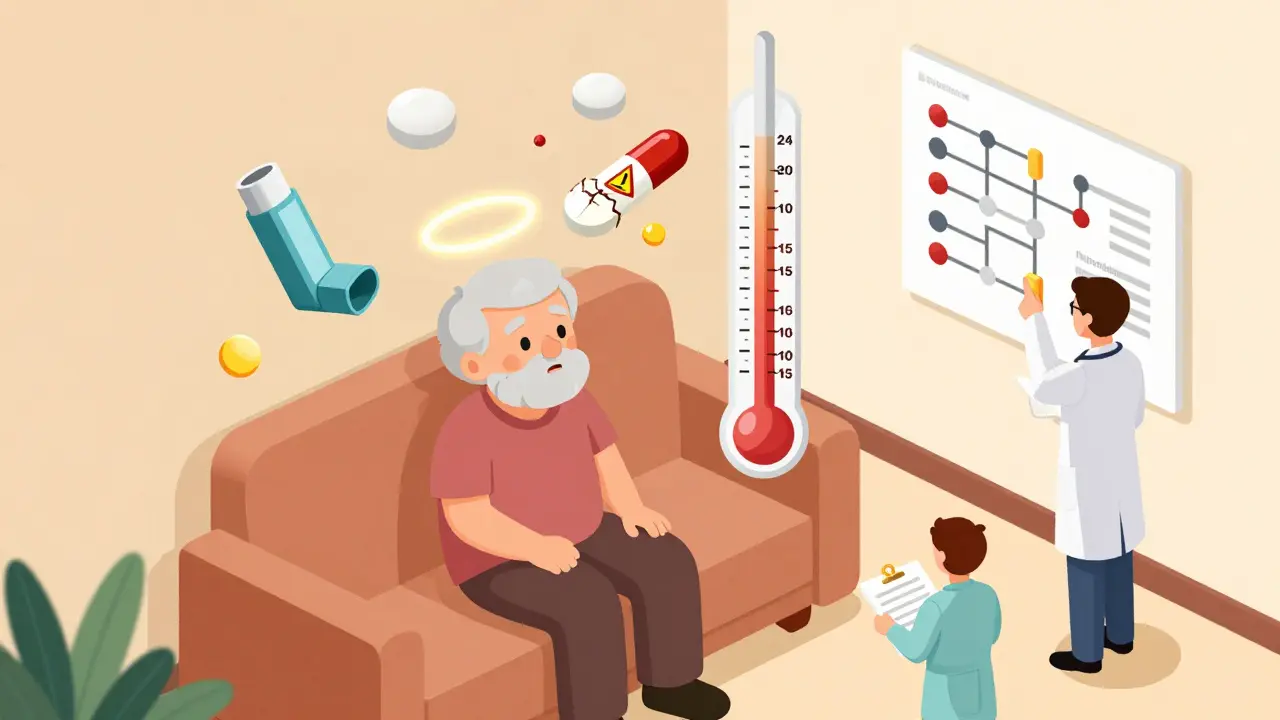
Who’s at Highest Risk?
It’s not just about the drugs. It’s about who’s taking them. Elderly patients with COPD are the most vulnerable. They’re often on multiple meds: allopurinol for gout, cimetidine for acid reflux, fluvoxamine for depression. Their livers don’t metabolize as well. Their kidneys are slower. Their muscle mass is lower, so the drug distributes differently. A 2022 study found that 45% of theophylline-related hospitalizations in this group were tied to just two drugs: allopurinol and cimetidine.
Smokers used to clear theophylline faster because smoking boosts CYP1A2. But when they quit? Clearance drops 30-50% within two weeks. That’s a double whammy if they’re also on cimetidine or fluvoxamine. One patient I read about stopped smoking and started fluvoxamine. Within 10 days, he had a seizure. His theophylline level? 31 mcg/mL.
What Doctors Should Do
There’s no excuse for missing this. The American Thoracic Society, the FDA, and the European Respiratory Society all say the same thing: monitor levels. Adjust doses. Avoid bad combos.
Here’s the practical checklist:
- Check theophylline levels before starting any new drug that might affect CYP1A2.
- If you must start a CYP1A2 inhibitor, reduce theophylline dose by 25-50% right away. Fluvoxamine? Go for 50%. Cimetidine? 30%.
- Recheck serum levels 48-72 hours after starting or stopping the interacting drug.
- Never start fluvoxamine in someone on theophylline. Period.
- If a patient quits smoking, assume clearance will drop. Reassess theophylline dose within two weeks.
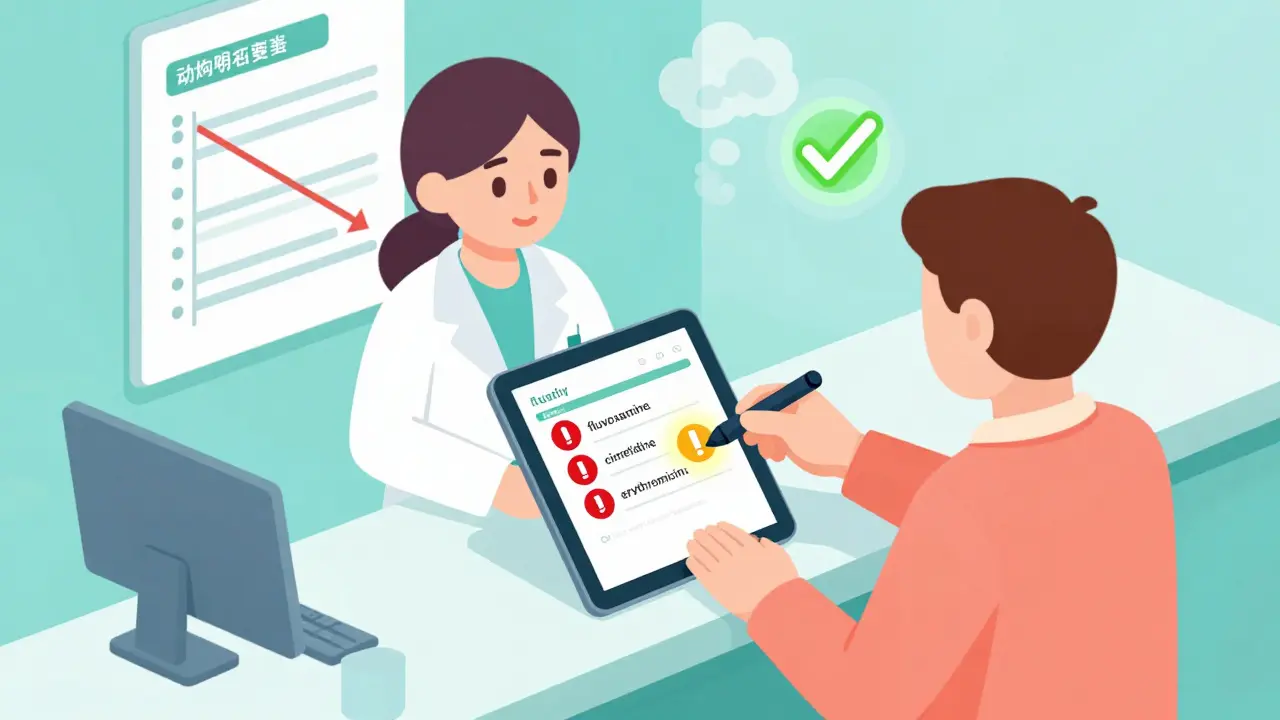
And here’s what hospitals are starting to do: pharmacist-led drug reviews. A 2023 trial showed that having a pharmacist audit theophylline prescriptions in Medicare patients cut hospitalizations by 37%. Why? Because pharmacists catch what doctors miss. They see the full list of meds. They know the interactions.
Why This Still Matters in 2025
Theophylline isn’t the first-line treatment anymore. Newer inhalers are safer, more effective. But it’s still used-especially in places where newer drugs are expensive or unavailable. Globally, it’s still part of 3.2% of COPD treatment. In parts of Asia and Africa, that number jumps to over 12%. In the U.S., it’s down to 1.7%, but the people still on it? They’re often older, sicker, on more meds. And they’re at higher risk than ever.
Even though overall use has dropped 62% since 2000, the number of theophylline-related ER visits due to drug interactions has gone up 5.3% per year since 2020. Why? Because the remaining users are the most fragile. And their meds are more complex.
The FDA calls theophylline a “sensitive substrate” of CYP1A2. That’s medical jargon for: “This drug is fragile. Tiny changes break it.”
What You Can Do
If you’re on theophylline:
- Keep a full list of every medication you take-prescription, OTC, supplements-and bring it to every appointment.
- Ask your doctor or pharmacist: “Could this new pill affect my theophylline?”
- Know the signs of toxicity: nausea, vomiting, headache, fast heartbeat, shaking, confusion. If you feel this way, get your levels checked immediately.
- Don’t stop or change your dose without talking to your doctor-even if you feel fine.
If you’re a clinician: Don’t assume your patient’s meds are safe. Use a drug interaction checker. Don’t rely on memory. And if you’re prescribing cimetidine or fluvoxamine to someone on theophylline-you’re not just being cautious. You’re putting them at risk.
Theophylline isn’t going away. But its use is shrinking to a narrow group of patients who need it most-and who need the most protection. The difference between safety and disaster isn’t always a big dose change. Sometimes, it’s just one forgotten pill.
Can I take ibuprofen with theophylline?
Yes, ibuprofen does not significantly affect theophylline clearance. It doesn’t inhibit CYP1A2 or interfere with liver metabolism in a way that raises theophylline levels. Most guidelines consider it safe to use together. Still, always monitor for side effects, especially if you’re elderly or have kidney issues.
Does coffee affect theophylline levels?
Caffeine is chemically similar to theophylline and is also metabolized by CYP1A2. Heavy coffee consumption (more than 5 cups a day) can compete for the same enzyme, potentially lowering theophylline levels slightly. But in most cases, this effect is too small to matter. The bigger concern is if you suddenly stop drinking coffee-your clearance drops, and theophylline levels can rise. Consistency matters more than quantity.
How long does it take for theophylline levels to stabilize after stopping an interacting drug?
It depends on the drug. For cimetidine or fluvoxamine, it takes about 5-7 days for CYP1A2 activity to return to normal after stopping. Theophylline levels will start dropping within 24-48 hours, but full stabilization can take up to a week. Always recheck serum levels before adjusting the dose back up.
Is theophylline still used today?
Yes, but much less than before. It’s mostly used for severe COPD or refractory asthma when newer inhalers don’t work or aren’t affordable. In the U.S., only about 1.7% of COPD patients use it. In parts of Asia and Africa, it’s still common-up to 12%-because it’s cheap and effective. But because of its narrow safety window, it’s only used when the benefits clearly outweigh the risks.
What should I do if I accidentally took cimetidine while on theophylline?
Call your doctor or pharmacist right away. Don’t wait for symptoms. Even if you feel fine, your theophylline level could be rising. You may need a blood test within 24-48 hours. In the meantime, avoid caffeine, alcohol, and other drugs that might stress your liver. Do not stop theophylline suddenly-this can cause rebound breathing problems.
Managing theophylline isn’t about memorizing every drug interaction. It’s about knowing the big ones-and treating the drug with the respect it demands. A single pill can change everything.
Colin L
December 30, 2025 AT 21:20Man, I had a friend on theophylline who started taking cimetidine for his acid reflux and ended up in the ER with a seizure. No one told him it was dangerous. His doctor just assumed he knew. I swear, if you’re on this stuff, you gotta be your own damn advocate. I’ve seen too many elderly people on 7 different meds and no one’s connecting the dots. It’s like everyone’s just going through the motions. Theophylline isn’t some casual pill-it’s a landmine wrapped in a prescription bottle.
Henry Ward
January 1, 2026 AT 13:54Let’s be real-this isn’t a medical issue, it’s a systemic failure. Doctors are lazy. They don’t use interaction checkers. They don’t read the damn labels. And pharmacists? Most are just cashiers with white coats. This post is basically a 2000-word scream into the void. The fact that fluvoxamine is still being prescribed to people on theophylline proves the entire system is broken. You think this is rare? It’s not. It’s just not reported until someone dies. And even then, it’s chalked up to ‘unforeseen complications.’
Sandeep Mishra
January 2, 2026 AT 18:10Thank you for this. 🙏 I’m a respiratory therapist in Delhi, and we still use theophylline daily because newer inhalers are out of reach for most. I’ve seen patients come in with tremors and palpitations, and when we check their meds, it’s always cimetidine or allopurinol. We now have a printed checklist we hand out-it’s simple: ‘Are you taking anything for heartburn, gout, or depression?’ If yes, we pause and call the doctor. Small changes, big saves. Let’s not forget: medicine isn’t just about science-it’s about care.
Joseph Corry
January 4, 2026 AT 04:48Interesting, but the framing here is overly alarmist. Theophylline has been around since the 1920s. If it were truly as perilous as this post suggests, it would’ve been withdrawn decades ago. The real issue isn’t the drug-it’s the lack of pharmacokinetic literacy among prescribers. Also, the statistic about 3 out of 10 older patients is cherry-picked. What’s the baseline prevalence of CYP1A2 inhibitors in the geriatric population? Without context, this reads like fearmongering dressed as education.
Hayley Ash
January 5, 2026 AT 07:57So let me get this straight-you’re telling me we can’t give someone a Tums with their asthma pill anymore? 😂 Meanwhile, the entire medical industry is selling $1000 inhalers and calling it progress. Meanwhile, grandma’s on theophylline because it’s 50 cents a pill and her insurance won’t cover the ‘new fancy stuff.’ You want to save lives? Fix the pricing. Not lecture people about cimetidine.
kelly tracy
January 5, 2026 AT 20:15Everyone’s acting like this is new news. Newsflash: theophylline toxicity has been a known hazard since the 80s. The fact that doctors are still screwing this up is embarrassing. And don’t even get me started on the ‘ask your pharmacist’ advice. Most pharmacists are overworked and underpaid. They don’t have time to audit every script. This post reads like a PSA written by someone who thinks the world runs on good intentions. It doesn’t. It runs on systems. And this system is broken.
srishti Jain
January 6, 2026 AT 23:34fluvoxamine + theophylline = bad news. dont do it. i saw it happen. end of story.
Cheyenne Sims
January 7, 2026 AT 14:36The assertion that cimetidine reduces theophylline clearance by 25–30% is substantiated by multiple peer-reviewed studies, including those published in the Journal of Clinical Pharmacology and the European Respiratory Journal. Furthermore, the FDA’s labeling for theophylline explicitly warns against concomitant use with CYP1A2 inhibitors. Any deviation from these guidelines constitutes a breach of the standard of care. This is not a matter of opinion-it is a matter of clinical protocol.
Shae Chapman
January 9, 2026 AT 02:36THIS IS SO IMPORTANT 🥹 I’ve been on theophylline for 12 years and I had NO IDEA about the fluvoxamine thing. My therapist just prescribed it for my anxiety and I took it without thinking. I’m literally shaking right now. I’m calling my doctor tomorrow. Thank you for sharing this-seriously, this could’ve killed me. I’m sharing this with everyone I know. 💙
Nadia Spira
January 9, 2026 AT 21:28It’s fascinating how theophylline’s pharmacokinetics exemplify the epistemological fragility of biomedical reductionism. The CYP1A2 enzyme isn’t merely a metabolic pathway-it’s a symbolic nexus of pharmaceutical hubris. We reduce complex physiological systems to binary interactions, then act surprised when they implode. Theophylline toxicity isn’t a drug interaction-it’s a metaphysical failure of medical epistemology. We treat molecules like Lego blocks, forgetting they’re alive in their own way. And yet, we wonder why people die.
henry mateo
January 10, 2026 AT 03:14hey i just wanted to say thank you for this post. i was on theophylline and started taking clarithromycin for a sinus infection and felt weird but i thought it was just the antibiotic. i didnt know it could do this. i went to the er and they checked my levels and they were high. i’m alive because i went. please if you’re on this med, dont ignore the signs. i’m sorry i didn’t know before. thanks again