Grapefruit Medication Interaction Checker
Check if your medication interacts dangerously with grapefruit juice. One glass of grapefruit juice can turn a safe medication into a dangerous one. This tool helps you determine if your medication is affected by grapefruit.
How It Works
Grapefruit contains furanocoumarins that block the CYP3A4 enzyme in your gut. This enzyme normally breaks down medications before they enter your bloodstream. When blocked, drug levels can soar to dangerous levels.
Once CYP3A4 is blocked, it takes 24-72 hours to recover. Even if you take your pill in the morning and drink juice at night, the interaction still occurs.
Why This Matters
Over 85 medications interact with grapefruit. For some, it's life-threatening. For statins like simvastatin, just 200ml of juice can triple drug levels. For immunosuppressants, it can cause organ rejection risk.
One small glass of grapefruit juice can turn a safe medication into a dangerous one. It’s not a myth. It’s not a warning you can ignore if you only drink it once in a while. For people taking certain prescriptions, grapefruit-even a single glass-can send drug levels soaring, leading to muscle damage, kidney failure, or even a heart attack. And the worst part? You won’t feel it coming.
Why Grapefruit Changes How Your Medication Works
Grapefruit doesn’t interact with medications because it’s acidic or sugary. It’s because of chemicals called furanocoumarins, mainly bergamottin and 6',7'-dihydroxybergamottin. These compounds attack an enzyme in your gut called CYP3A4, which normally breaks down drugs before they enter your bloodstream. When this enzyme is blocked, your body absorbs way more of the drug than it should.This isn’t a temporary effect. Once CYP3A4 is shut down, it stays down for 24 to 72 hours. That means even if you take your pill at 8 a.m. and drink grapefruit juice at 6 p.m., you’re still at risk. The damage is done. Your body can’t rebuild the enzyme fast enough to keep up. So timing doesn’t help. The only safe move is to avoid grapefruit entirely while you’re on these meds.
Other citrus fruits like Seville oranges (the kind used in marmalade), pomelos, and even some limes have the same chemicals. Pomegranate juice has shown similar effects in early studies. But regular oranges, tangerines, and lemons? Safe. You can still have those.
Statins: The Most Dangerous Group
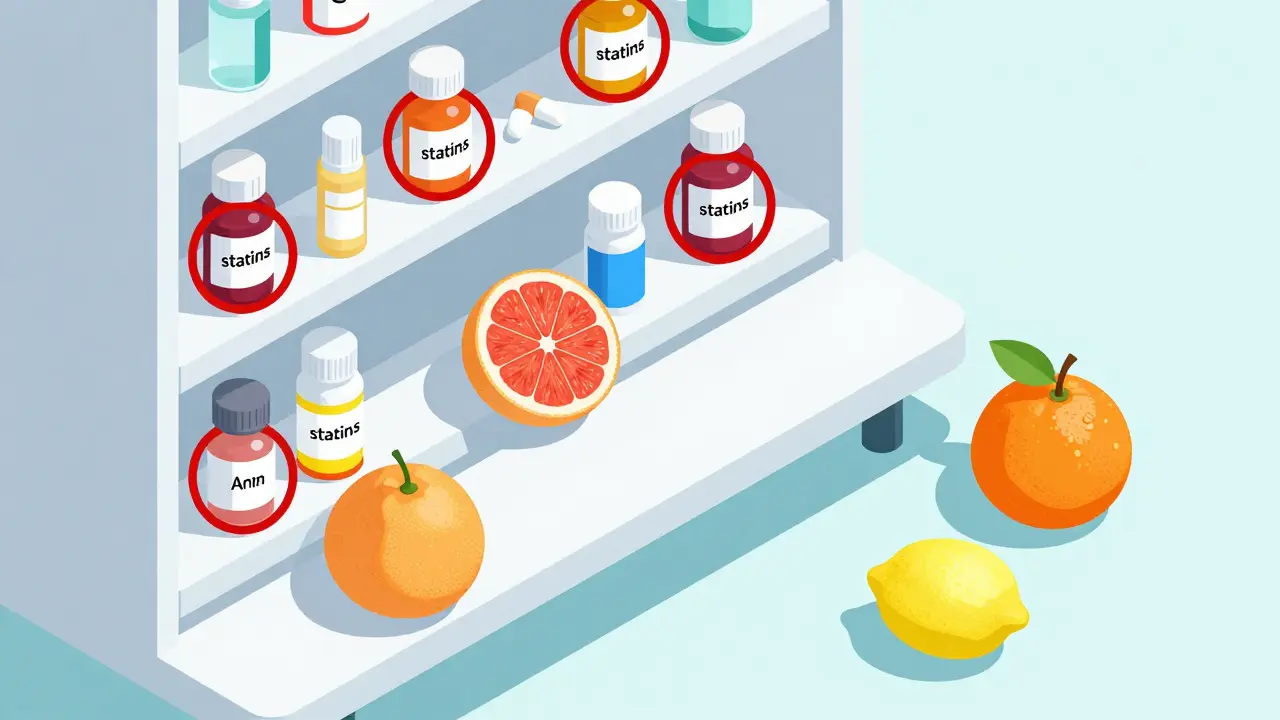
If you’re on a statin to lower cholesterol, grapefruit could be the quiet killer in your kitchen. Three statins-simvastatin, lovastatin, and atorvastatin-are especially risky.With simvastatin (Zocor), just 200 milliliters (about 6.7 ounces) of grapefruit juice taken daily for three days can triple your drug levels. That’s not a small bump. That’s from 15 ng/mL to 45 ng/mL in your blood. This dramatically raises your risk of rhabdomyolysis-a condition where muscle tissue breaks down, floods your kidneys with toxic proteins, and can lead to kidney failure or death.
Atorvastatin (Lipitor) isn’t as bad, but it still increases drug exposure by 80%. Lovastatin (Mevacor) sees a staggering 1,500% increase in absorption. That’s not a typo. It’s 15 times more drug in your system than intended.
The good news? Pravastatin (Pravachol) and rosuvastatin (Crestor) don’t interact with grapefruit. They use different pathways to get processed. If you love grapefruit and need a statin, ask your doctor about switching. It’s not just possible-it’s often the best choice.
Calcium Channel Blockers: Blood Pressure Gone Wild
Many people take calcium channel blockers to control high blood pressure. Grapefruit makes these drugs too strong. Too strong means your blood pressure can drop dangerously low. Your heart may struggle. You could faint, fall, or suffer organ damage from poor circulation.Felodipine (Plendil) is one of the most affected. One study showed grapefruit juice increased its blood levels by 355%. Nifedipine (Procardia) jumped 274%. Amlodipine (Norvasc) saw a 150% increase. These aren’t minor numbers. They’re clinical red flags.
Some manufacturers tried to fix this by changing how the drug is released-like Pfizer’s Adalat CC version of nifedipine. But even those reformulated versions still carry warnings. Don’t assume a “new” version is safe. Always check.
Immunosuppressants: A Silent Threat After Transplants
If you’ve had a kidney, liver, or heart transplant, you’re on drugs like cyclosporine, tacrolimus, or sirolimus to keep your body from rejecting the new organ. These drugs have a very narrow safety window. Too little, and your body attacks the transplant. Too much, and your immune system crashes.Grapefruit makes this balance impossible. Cyclosporine levels can rise 50-60%. Tacrolimus? Up to 500% higher. Sirolimus? A 1,100% increase. That’s not just risky-it’s life-threatening. Infections, kidney damage, high blood pressure, and even cancer risk go up with these spikes.
There’s no safe amount. No “once a week” loophole. No “I’ll just sip a little.” If you’re on these meds, grapefruit is off the table. Period.
What About Other Medications?
It’s not just statins and blood pressure drugs. Over 85 medications are known to interact with grapefruit, and 43 of them can cause life-threatening reactions. Here’s a quick look at other high-risk categories:- Anti-anxiety meds: Buspirone (Buspar) levels can double.
- Anti-arrhythmics: Amiodarone (Cordarone) can cause dangerous heart rhythms.
- Pain meds: Oxycodone and fentanyl may become more potent, increasing overdose risk.
- Antihistamines: Fexofenadine (Allegra) absorption drops, making it less effective.
- Erectile dysfunction drugs: Sildenafil (Viagra) can cause dangerously low blood pressure.
- Anticoagulants: Warfarin isn’t affected, but newer drugs like rivaroxaban (Xarelto) are still being studied.
The FDA has mandated warning labels on 17 prescription drugs for grapefruit interactions. But many more carry warnings in their prescribing info. If your pill bottle says “avoid grapefruit,” don’t assume it’s just a formality. It’s a medical order.
What Should You Do?
If you’re on any prescription, especially if you’re over 45, take these steps:- Check your meds. Look at the patient information leaflet. Search your drug name + “grapefruit interaction” online. Use trusted sources like the FDA or UCLA Health’s published list.
- Ask your pharmacist. They’re trained to catch this. In 2022, nearly 80% of community pharmacists routinely screen for grapefruit interactions during medication reviews.
- Ask your doctor. If you love grapefruit, ask: “Is there a similar drug that doesn’t interact with it?” For statins, pravastatin or rosuvastatin are safe alternatives. For blood pressure, diltiazem or verapamil often work without the risk.
- Be honest. Don’t say “I only have it once a week.” That’s not enough. The enzyme stays blocked for days. One glass can do damage.
Why This Matters More Than Ever
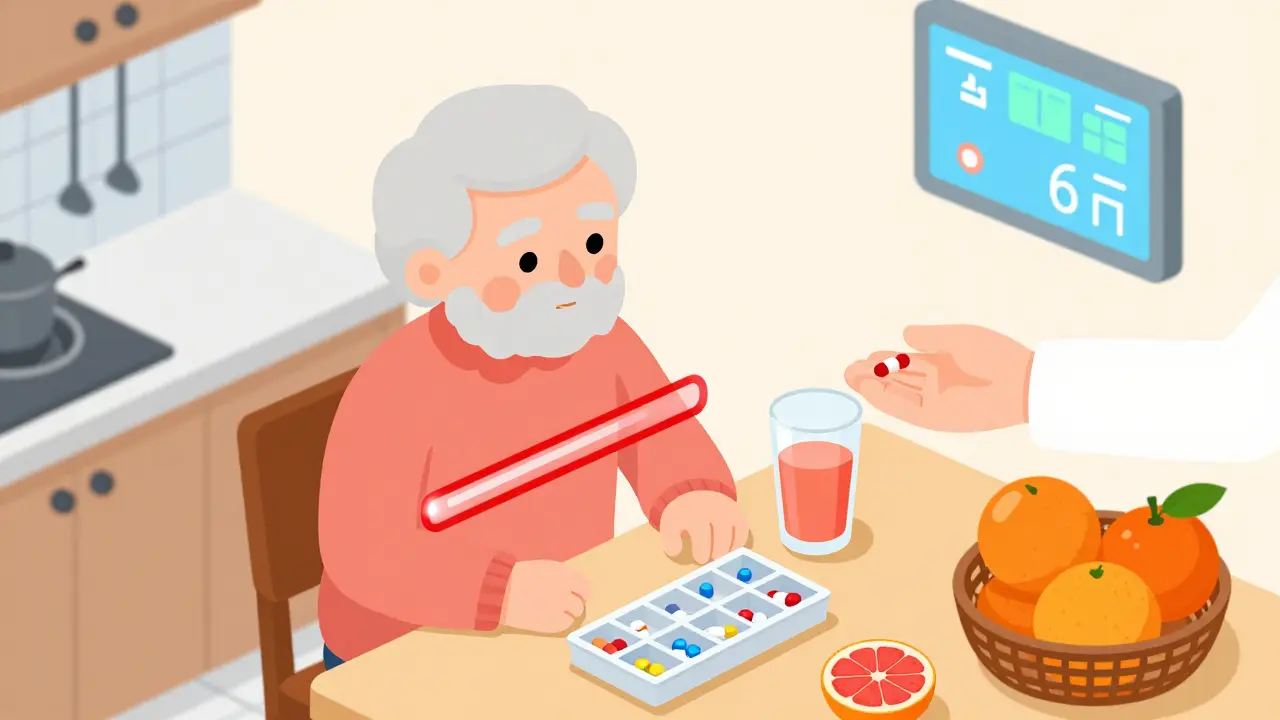
The problem is growing. In 2021, over half of Americans over 65 were taking five or more prescription drugs. That’s a recipe for hidden dangers. Grapefruit-drug interactions cause an estimated 10,000 adverse events in the U.S. every year. Most are preventable.Older adults are especially vulnerable. They’re more likely to take multiple meds. They’re more likely to drink grapefruit juice for its “health benefits.” And their bodies process drugs slower, making them more sensitive to spikes.
Hospitals now use electronic alerts in their systems. Epic Systems, used by 92% of U.S. hospitals, flags grapefruit interactions when a doctor prescribes a risky drug. But that system only works if the patient tells their doctor they’re drinking grapefruit juice. If they don’t, the alert doesn’t trigger.
Alternatives and Hope on the Horizon
You don’t have to give up citrus forever. Oranges, tangerines, and lemons are safe. You can still get vitamin C and flavor without the risk.Scientists are working on solutions. Some grapefruit varieties are being bred to have 85-90% less furanocoumarin. Early trials show promise. But until those are widely available and proven safe, the advice remains the same: avoid it.
The American Heart Association says it clearly: “Complete avoidance remains the only recommended strategy.” There’s no safe middle ground. No compromise. Not for people on high-risk meds.
Final Advice: When in Doubt, Skip It
If you’re not sure whether your medication interacts with grapefruit, assume it does. It’s not worth the risk. A few sips of juice won’t ruin your day. But a trip to the ER, a hospital stay, or a life-altering side effect? That’s forever.Keep a list of your meds. Show it to your pharmacist every time you refill. Ask the three questions the FDA recommends: Does my drug interact with grapefruit? How much, if any, can I safely drink? What other fruits or juices should I avoid?
Your health isn’t about willpower. It’s about smart choices. And sometimes, the smartest choice is the one you never have to make again.
Can I drink grapefruit juice if I take my medication at a different time of day?
No. The chemicals in grapefruit permanently disable the CYP3A4 enzyme in your gut, and it takes 24 to 72 hours for your body to make new enzymes. Even if you take your pill in the morning and drink juice at night, the damage is already done. Timing doesn’t prevent the interaction. Only complete avoidance does.
Are all citrus fruits dangerous with medications?
No. Only grapefruit, Seville oranges (used in marmalade), pomelos, and possibly limes contain high levels of furanocoumarins. Regular oranges, tangerines, and lemons are safe. Pomegranate juice has shown similar effects in some studies, so it’s best to avoid it if you’re on high-risk meds until more data is available.
What should I do if I accidentally drank grapefruit juice while on a risky medication?
If you only had one small glass and feel fine, monitor yourself for unusual symptoms like muscle pain, weakness, dizziness, or irregular heartbeat. Don’t panic, but call your doctor or pharmacist to discuss your specific medication. If you’re on a statin or immunosuppressant and experience severe muscle pain or dark urine, seek emergency care immediately-these could be signs of rhabdomyolysis.
Can I switch to a different medication to keep drinking grapefruit juice?
Yes, for many drugs, there are safe alternatives. For statins, pravastatin and rosuvastatin don’t interact with grapefruit. For blood pressure, diltiazem or verapamil are often good substitutes. For erectile dysfunction, tadalafil (Cialis) has less interaction risk than sildenafil. Talk to your doctor about alternatives. It’s not about giving up grapefruit-it’s about finding a safer way to manage your health.
Why do some people say grapefruit juice helps their medication work better?
Some people mistake the increased drug levels for “better results.” But that’s dangerous. Higher levels don’t mean better outcomes-they mean more side effects. For example, higher statin levels don’t lower cholesterol more effectively-they just raise your risk of muscle damage. Medications are dosed precisely for safety and effectiveness. Grapefruit throws that balance off, and the consequences can be severe.
Is grapefruit juice interaction the same for everyone?
No. Genetics play a role. Some people have a variation in the CYP3A4 gene (called CYP3A4*22) that makes them more sensitive to grapefruit’s effects. Older adults, people with liver or kidney disease, and those taking multiple medications are also at higher risk. But because you can’t know your genetic risk without testing, the safest approach is the same for everyone: avoid grapefruit if your drug is on the interaction list.
Brian Furnell
December 22, 2025 AT 01:05Let’s be real-this isn’t just about grapefruit. It’s about the entire pharmacokinetic ecosystem being hijacked by a single citrus fruit. Furanocoumarins? They’re not just inhibitors; they’re molecular saboteurs targeting CYP3A4 like a precision-guided drone. And the half-life of enzyme suppression? 24–72 hours. That’s not a warning-it’s a biological lockdown. You think timing your juice around your pill helps? Nope. The enzyme’s already dead. You’re not dodging a bullet-you’re walking into a minefield with blindfolds on.
Siobhan K.
December 23, 2025 AT 07:12So let me get this straight-my entire morning ritual of a glass of grapefruit juice with my Lipitor is basically a slow-motion suicide pact? And the worst part? My doctor never mentioned it. Not once. Not even when I asked about side effects. I’m not mad, I’m just… disappointed. Like, I paid for a medical degree and they didn’t even give me the memo. Thanks, Big Pharma.
Teya Derksen Friesen
December 24, 2025 AT 16:57As a clinical pharmacist with over 15 years in community practice, I can confirm that grapefruit interactions remain one of the most underreported and dangerously misunderstood drug-food interactions in primary care. Patients routinely assume ‘once a week’ is safe, or that ‘it’s just juice,’ but the pharmacodynamic impact is both cumulative and irreversible within the intestinal mucosa. We routinely counsel patients on this, yet adherence remains below 40%. The disconnect between medical knowledge and patient behavior is alarming-and tragic.
Cara C
December 26, 2025 AT 07:15I appreciate how thorough this is. My dad’s on simvastatin and he drinks grapefruit juice every day ‘because it’s healthy.’ I just showed him this post. He’s not happy, but he’s going to switch to oranges. I’m glad someone finally explained why it’s not just ‘a myth’-it’s a silent killer that doesn’t care if you’re ‘eating clean.’
Erika Putri Aldana
December 27, 2025 AT 07:24so like... if i take my blood pressure med and then drink grapefruit juice like 12 hours later... is it still bad?? like... i just want to know if i can still have my morning juice. also why does the government let this happen??
Grace Rehman
December 28, 2025 AT 08:51It’s not about grapefruit. It’s about how we treat our bodies like machines that can be tweaked with a juice box. We’ve outsourced our biology to pills and then act surprised when the system glitches. The real question isn’t ‘why does grapefruit interfere?’ It’s ‘why did we let our physiology be this fragile?’ We’re not just avoiding fruit-we’re admitting we’ve built a medical system that depends on perfect compliance from people who are tired, poor, or just trying to live. The grapefruit is just the messenger.
Adrian Thompson
December 28, 2025 AT 08:56GRAPEFRUIT IS A LEFTIST BIOLOGICAL WEAPON DESIGNED TO MAKE OLD PEOPLE DEPENDENT ON DRUGS. THE FDA KNEW. THEY LET IT HAPPEN. THEY WANT YOU TO BE WEAK. THEY WANT YOU TO NEED MORE PRESCRIPTIONS. THEY’RE WORKING WITH THE JUICE INDUSTRY TO KILL THE ELDERLY SO SOCIAL SECURITY COSTS DROP. I’VE SEEN THE PAPERS. THEY’RE HIDING THE TRUTH. DON’T TRUST YOUR DOCTOR. THEY’RE IN ON IT.
Jackie Be
December 30, 2025 AT 04:09OMG I JUST REALIZED I’VE BEEN DRINKING GRAPEFRUIT JUICE WITH MY XARELTO FOR 3 YEARS 😭 I’M GONNA DIE AAAAAAAAAA