When a hospital decides to switch from a brand-name drug to a generic, it’s not just a simple cost-cutting move. It’s a clinical decision wrapped in economics, regulation, and real-world patient outcomes. Behind every generic drug on a hospital shelf is a rigorous evaluation process led by a Pharmacy and Therapeutics (P&T) committee - a group of pharmacists, physicians, and nurses who weigh safety, effectiveness, and price before approving a drug for use. In 2025, with generic drugs making up 89% of hospital drug purchases by volume but only 28% of total spending, the pressure to get this right has never been higher.
What Is a Hospital Formulary, Really?
A hospital formulary isn’t just a list of approved drugs. It’s a living system that determines which medications can be ordered, how they’re prescribed, and who gets them. Unlike retail pharmacies that focus on outpatient convenience, hospital formularies are built for controlled environments: IV bags administered by nurses, injectables given in ICUs, and oral meds dosed by clinical staff who monitor patients hourly. The American Society of Health-System Pharmacists (ASHP) calls this a "sound drug formulary system," and it’s been evolving since the 1950s. Most hospitals use a closed or partially closed formulary, meaning only drugs on the approved list can be used unless a doctor gets special permission. About 78% of academic medical centers operate this way, compared to just 42% of commercial health plans. Why? Because hospitals need tight control over medication use to reduce errors, prevent waste, and manage budgets.The Three Pillars of Generic Selection
When a new generic drug hits the market, the P&T committee doesn’t just look at the price tag. They evaluate three non-negotiable factors:- Product efficacy - Does it work as well as the brand? Not just in lab studies, but in real hospital patients with complex conditions like kidney failure or sepsis.
- Safety concerns - Are there hidden risks? For drugs with narrow therapeutic indices - like warfarin or phenytoin - even tiny differences in absorption can lead to toxicity or treatment failure.
- Cost considerations - What’s the net cost after rebates, discounts, and service fees? The lowest list price doesn’t always win.
Tiered Formularies: How Hospitals Structure Drug Costs
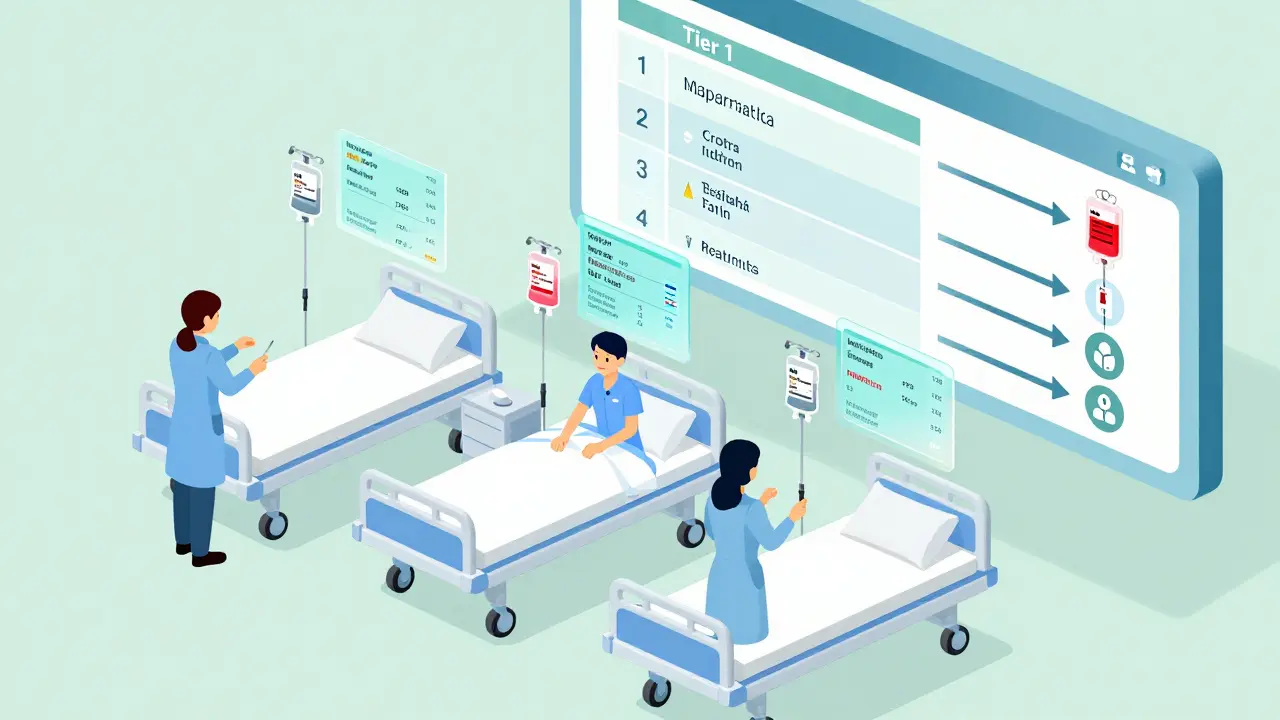
Most hospital formularies use a tiered system to guide prescribing and manage out-of-pocket costs for patients who pay part of the bill. The typical structure looks like this:| Tier | Drug Type | Cost to Patient | Example |
|---|---|---|---|
| Tier 1 | Preferred generics | Lowest copay ($5-$10) | Metformin 500mg, Lisinopril 10mg |
| Tier 2 | Non-preferred generics or preferred brands | Moderate copay ($15-$25) | Atorvastatin 20mg (generic), Amlodipine 5mg |
| Tier 3 | Non-preferred brands | Higher copay ($30-$50) | Brand-name Lipitor, Pradaxa |
| Tier 4-5 | Specialty drugs | Coinsurance (20-40%) | Enbrel, Humira, specialty oncology drugs |
Rebates, Discounts, and the Hidden Cost of "Cheap" Generics
The economic calculus for generics has gotten messy. What used to be simple - pick the lowest-priced generic - is now a labyrinth of manufacturer rebates, distribution fees, and service agreements. Dr. Emily Chen at Massachusetts General Hospital points out that some generics with the lowest list price actually cost more after rebates are factored in. Why? Because manufacturers pay hospitals to favor their product, and those payments aren’t always transparent. The ASHP’s 2021 white paper warned against "rebate-driven formulary decisions" - where financial incentives override clinical judgment. This is especially dangerous with high-risk drugs like anticoagulants, anti-seizure meds, and chemotherapy agents. A hospital might save $10 per dose on a generic, but if it leads to an extra day of hospitalization due to a dosing error, the real cost jumps to $3,000.Real-World Successes - And Failures
Some hospitals have nailed it. Mayo Clinic’s program to switch cardiovascular drugs to generics saved $1.2 million annually - a 23.7% reduction in drug spend - without a single increase in adverse events. How? They didn’t just swap drugs. They created a therapeutic interchange protocol: pharmacists reviewed each patient’s history, monitored lab values, and trained nurses on subtle differences in drug appearance or dosing. Cleveland Clinic cut generic acquisition costs by 18.3% using a similar approach. Meanwhile, other hospitals have struggled. A 2023 survey found that 84% of hospital pharmacists experienced at least one critical generic shortage in the last quarter. When a generic runs out, hospitals are forced to buy the brand-name version - sometimes at 10x the price - or scramble to find an alternative that’s not on formulary. That means more paperwork, more delays, and more risk.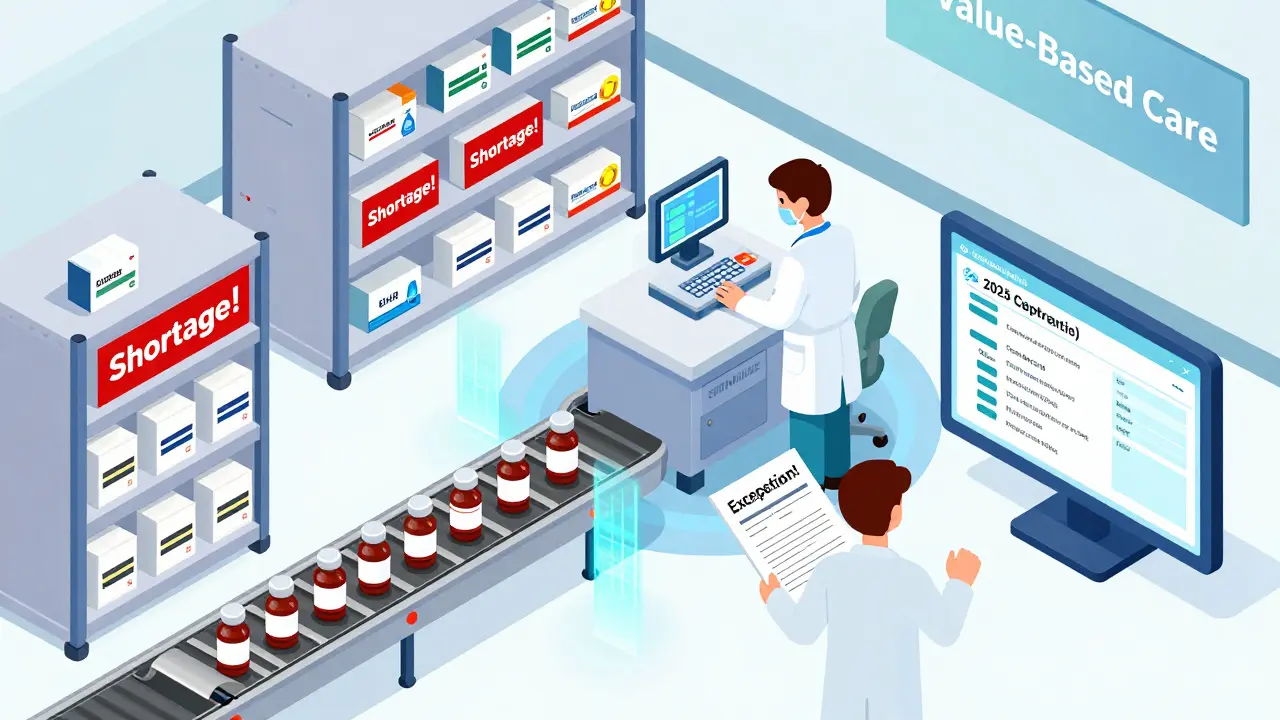
The Rise of Complex Generics and Regulatory Gaps
The FDA approved 88% of standard generics on first submission in 2023. But for complex generics - think inhalers, injectables, or topical gels - the approval rate dropped to 62%. Why? Because proving equivalence is harder. A generic inhaler must deliver the same particle size, lung deposition, and duration of action as the brand. Small differences in propellant or device design can change clinical outcomes. The FDA’s Generic Drug User Fee Amendments (GDUFA) III, which took effect in October 2022, is trying to fix this. It’s investing $4.3 million annually to help manufacturers meet higher standards. But until those standards are fully implemented, many complex generics sit on the shelf - not because they’re unsafe, but because hospitals won’t take the risk without solid data.What Hospitals Need to Get This Right
Successful formulary systems require more than just a committee meeting every quarter. They need:- At least 50% clinical pharmacist representation on the P&T committee - not just administrators.
- Formal AMCP dossiers for every new generic submission - including clinical studies, pharmacokinetic data, and cost analyses.
- Integration with EHR systems - Only 37% of hospitals have automated alerts that flag non-formulary prescriptions. Without it, doctors order off-list drugs by accident.
- Therapeutic interchange protocols - Step-by-step guides for switching patients safely, with monitoring plans.
What’s Next for Hospital Formulary Economics?
Three big changes are coming:- Price transparency laws - The 2023 Consolidated Appropriations Act requires manufacturers to disclose rebates starting January 2025. Hospitals will finally see the true net cost of generics.
- Pharmacogenomics - 28% of academic hospitals now consider genetic test results when choosing generics for drugs like clopidogrel or warfarin, where patient metabolism affects response.
- Value-based contracts - 47% of academic centers now tie payments to outcomes. If a generic doesn’t reduce readmissions or ER visits, the hospital doesn’t pay the full price.
Choosing generics isn’t about picking the cheapest option. It’s about finding the right balance between safety, effectiveness, and affordability - in a system where a $0.05 difference in drug cost can mean a $3,000 difference in patient care. The hospitals that win are the ones treating formulary decisions as clinical judgments, not accounting exercises.
Why don’t hospitals just use the cheapest generic available?
Hospitals avoid the cheapest generic if it hasn’t been proven safe and effective in their specific patient population. A drug might be FDA-approved, but if it causes more side effects in ICU patients or requires extra monitoring, the hidden costs can outweigh the savings. Clinical outcomes matter more than list price.
How often do hospital formularies change?
Most hospital P&T committees meet monthly or quarterly to review new drugs, shortages, and clinical data. New generics are evaluated within 90 days of FDA approval. Changes aren’t made lightly - each addition or removal requires documented evidence of safety, efficacy, and cost benefit.
What’s the difference between hospital and retail formularies?
Hospital formularies focus on inpatient care - drugs given by nurses, in controlled settings, with immediate monitoring. Retail formularies are designed for patients to self-administer at home, so they prioritize convenience, packaging, and refill rates. Hospitals also use closed formularies more often and can enforce prior authorization and step therapy more strictly.
Do rebates really affect which generics hospitals choose?
Yes - and it’s a growing concern. Some manufacturers offer large rebates to hospitals in exchange for exclusive formulary placement. But if those rebates come from hidden discounts or service fees, the true cost isn’t clear. The 2025 price transparency rules will force more disclosure, which could shift decisions back toward clinical value.
Can a hospital use a drug that’s not on the formulary?
Yes, but only with special approval. Doctors can request an exception if the formulary drug isn’t appropriate for a patient - say, due to an allergy or failed trial. The request must be documented, and the drug is usually only approved for that single patient. Overuse of exceptions can trigger audits and undermine cost-control goals.
How do drug shortages impact formulary decisions?
Shortages force hospitals to make emergency swaps - often to more expensive or less preferred drugs. In 2023, 84% of hospitals reported at least one critical shortage of a generic. This leads to budget overruns and clinical disruptions. Many hospitals now maintain backup formularies and multi-source sourcing agreements to reduce risk.
Peyton Feuer
January 4, 2026 AT 09:33man i never realized how wild it is that a $0.05 drug difference can cost thousands in extra hospital days. my cousin’s nurse told me they had to switch a guy off a generic anticoagulant because his INR went nuts and they had to keep him for 3 extra days. cost more than the brand. wild.
Angie Rehe
January 5, 2026 AT 08:55let’s be real-this whole formulary system is a corporate shell game. P&T committees? More like P&T *corporate* committees. The real decision-makers aren’t the pharmacists-they’re the reps with the rebate envelopes. FDA bioequivalence is a joke for injectables. I’ve seen generics with different pH levels that clotted IV lines. This isn’t clinical judgment-it’s procurement theater.
And don’t get me started on the ‘therapeutic interchange protocols.’ That’s just a fancy way of saying ‘we’re swapping meds without telling the patients.’
Meanwhile, the FDA’s GDUFA III? A $4.3 million Band-Aid on a hemorrhage. They approve 88% of simple generics but choke on inhalers because the tech is proprietary. Big Pharma owns the device design. The generics can’t replicate it. So they get stuck in purgatory while brand-name prices stay inflated. This isn’t about safety-it’s about market control.
And yes, 84% of hospitals had a critical generic shortage last quarter. Of course they did. The entire supply chain is outsourced to two manufacturers in India and China. One factory shuts down for a power outage? Poof. No more metformin. Hospitals scramble to buy brand-name Lipitor at $12 a pill. You call that cost savings? It’s a rigged system.
And now they want pharmacogenomics? Great. Now we’re going to test everyone’s DNA before giving them a $0.10 pill. Meanwhile, the guy who can’t afford his copay is still skipping doses because the ‘preferred’ generic isn’t stocked. This isn’t innovation. It’s complexity for complexity’s sake.
Siobhan Goggin
January 6, 2026 AT 01:41This is such an important conversation. Hospitals are caught between impossible pressures-budgets, patient safety, regulatory hurdles, and supply chains. The fact that they’re even trying to balance clinical outcomes with economics deserves recognition. The Mayo and Cleveland Clinic examples show it’s possible when you prioritize thoughtful implementation over quick savings. We need more of that.
Shanna Sung
January 6, 2026 AT 21:50They’re lying to you. The FDA doesn’t test generics in real ICU patients. They test them on healthy volunteers. That’s why the bleeding events happen. That’s why the seizures come back. The manufacturers pay the FDA to fast-track approval. The P&T committees are told ‘it’s bioequivalent’ and they believe it. But the data? It’s cooked. The real cost? Dead patients. And no one’s问责.
And the rebates? They’re bribes. The same companies that make the brand drugs own the generics. Same factory. Same chemists. Just a different label. You think they’re giving you a discount? They’re just moving money from one pocket to another while you pay for the ER visits.
And now they want pharmacogenomics? That’s the next scam. They’ll make you pay $500 for a genetic test so they can say ‘it’s personalized medicine’ while they keep pushing the same cheap generics that don’t work. This isn’t healthcare. It’s a financial engineering project with a stethoscope.
mark etang
January 7, 2026 AT 23:00It is imperative to underscore that the structural integrity of hospital formularies is predicated upon a multidisciplinary, evidence-based paradigm that transcends mere fiscal considerations. The integration of clinical pharmacists, EHR-driven alerts, and AMCP-compliant dossiers constitutes a non-negotiable standard of care. To prioritize cost efficiency at the expense of therapeutic fidelity is not merely fiscally myopic-it is ethically indefensible. The data from the University of Michigan study is unequivocal: 15-20% formulary violations represent a systemic failure of governance, not an administrative oversight.
josh plum
January 9, 2026 AT 03:20Of course the cheap generics cause problems. Big Pharma and the FDA are in bed together. You think they want you to know that the same company that makes Lipitor also makes the ‘generic’ atorvastatin? Same factory. Same formula. Different label. They just charge you more for the brand so they can ‘give you a discount’ on the generic. It’s a scam. And now they want you to pay for genetic testing so they can say ‘we’re being precise’ while the drug still doesn’t work. Wake up.
And don’t even get me started on the ‘therapeutic interchange protocols.’ That’s just code for ‘we’re switching your meds without telling you.’ Your blood pressure med changed? Your seizure med changed? You didn’t sign anything. You didn’t consent. They just did it because the rebate was better. This isn’t medicine. It’s fraud.
John Ross
January 11, 2026 AT 01:04As someone who’s worked in ICU pharmacy across three continents, let me tell you: this isn’t just a U.S. problem. In the UK, Germany, and Japan, the same dynamics play out-just with different acronyms. The real issue is that bioequivalence standards were designed for outpatient oral meds. They don’t account for critical illness, polypharmacy, or altered organ function. A generic phenytoin that works fine for a healthy 40-year-old? In a septic 72-year-old with renal failure? It’s a time bomb.
And the rebate system? It’s global. Manufacturers bribe formulary committees everywhere. The difference here is that U.S. hospitals are more transparent about it. In other countries, they just quietly swap the drug and nobody asks why the INR is off.
The solution isn’t more regulations-it’s real-world pharmacovigilance. Hospitals need to track outcomes, not just costs. Track readmissions. Track adverse events. Track nursing time. That’s the only way to know if a generic is truly better.
Clint Moser
January 11, 2026 AT 07:48they dont want you to know that the same company makes the brand and the generic and they just change the label and charge more for the brand then give you a rebate on the generic its all a lie the fda approves it because they get paid by the companies and the p&t committees are just puppets the real cost is patients dying from bleeding or seizures because the generic wasnt tested on sick people only healthy ones and now they want to make you pay for genetic tests so they can say its personalized medicine but the drug still dosent work its all a scam
Ashley Viñas
January 13, 2026 AT 01:15Let’s be honest-this entire system is a performance for the public. Hospitals pretend they’re making clinical decisions, but they’re just following rebate contracts written by pharmaceutical sales reps in suits. The ‘P&T committee’? A rubber stamp. The ‘therapeutic interchange protocol’? A cover story. The ‘FDA approval’? A marketing brochure. And now they want us to believe pharmacogenomics is the answer? Please. It’s just another way to charge patients more while the real problem-the consolidation of generic manufacturers into three global oligopolies-remains untouched. You think a $0.05 drug difference matters? It doesn’t. What matters is that the same three companies control 80% of the generic market. That’s not economics. That’s monopolistic control dressed up as healthcare.