Have you ever stared at a bottle of liquid medicine, squinting at the small print, wondering if "5 mL" is the same as a teaspoon? You are not alone. Misreading these labels is one of the most common causes of medication errors in households across the United States. According to the FDA, these mistakes lead to approximately 1.3 million injuries annually. It sounds scary, but it is entirely preventable if you know what to look for.
The days when pharmacists wrote instructions in teaspoons and tablespoons are officially over-or at least, they should be. Thanks to strict new guidelines from the National Council for Prescription Drug Programs (NCPDP), modern labels rely on the metric system. Specifically, the milliliter. Understanding this shift is your first step toward keeping yourself or your child safe.
The Golden Rule: Milliliters Are King
If you take away only one thing from this guide, let it be this: ignore any mention of teaspoons or tablespoons on the label itself. The current standard, mandated by the FDA since 2016, requires that all oral liquid medication doses be expressed in milliliters (mL).
Why the change? Because kitchen utensils are unreliable. A study by Consumer Reports found that household teaspoons can vary by up to 20-30% in volume. One spoon might hold 4 mL, while another holds 7 mL. That difference can mean the gap between an effective dose and an overdose. In contrast, a calibrated syringe or dosing cup marked in mL is precise every time.
When you pick up your prescription, look for the unit "mL" next to the number. If you see "tsp" or "tbsp," ask your pharmacist to update the label immediately. This isn't just about preference; it's about safety. Research shows that parents using mL-only devices make significantly fewer errors than those relying on household spoons.
Decoding the Numbers: Zeros and Decimals Matter
It is not just about the unit; it is about how the numbers are written. Small formatting choices can lead to big mistakes. For example, did you know that writing ".5 mL" instead of "0.5 mL" can cause a tenfold dosing error? The human eye often skips the leading zero, seeing "5 mL" instead.
To prevent this, standardized labels follow two critical rules:
- Always use a leading zero: For any dose less than 1 mL, write "0.5 mL," never ".5 mL."
- Never use a trailing zero: For whole numbers, write "5 mL," never "5.0 mL." That extra zero can be mistaken for a decimal point, turning a 5 mL dose into a dangerous 50 mL dose.
Also, pay attention to spacing. There should always be a space between the number and the unit (e.g., "5 mL," not "5mL"). This simple visual break helps your brain process the information correctly under stress, like when a child has a fever at 2 AM.
Understanding Concentration vs. Total Volume
This is where most people get tripped up. A prescription label usually displays three key pieces of numerical data, and confusing them is a major source of error.
- Total Container Volume: This is the amount of medicine in the entire bottle (e.g., 100 mL, 240 mL). Do not confuse this with your dose.
- Concentration: This tells you how much active drug is in a specific volume. It looks like "240 mg / 5 mL." This means there are 240 milligrams of medicine in every 5 milliliters of liquid.
- Dosage Instruction: This is what you actually give. It will say something like "Take 5 mL twice daily."
Here is a common pitfall: A parent sees "240 mg / 5 mL" and thinks they need to measure out 240 mL. Or they see "5 mL" in the concentration line and assume that is their dose, even if the instruction says "Take 2.5 mL." Always read the line that starts with "Sig" or "Directions" for your actual dose. The concentration is just background info for the pharmacist and doctor.
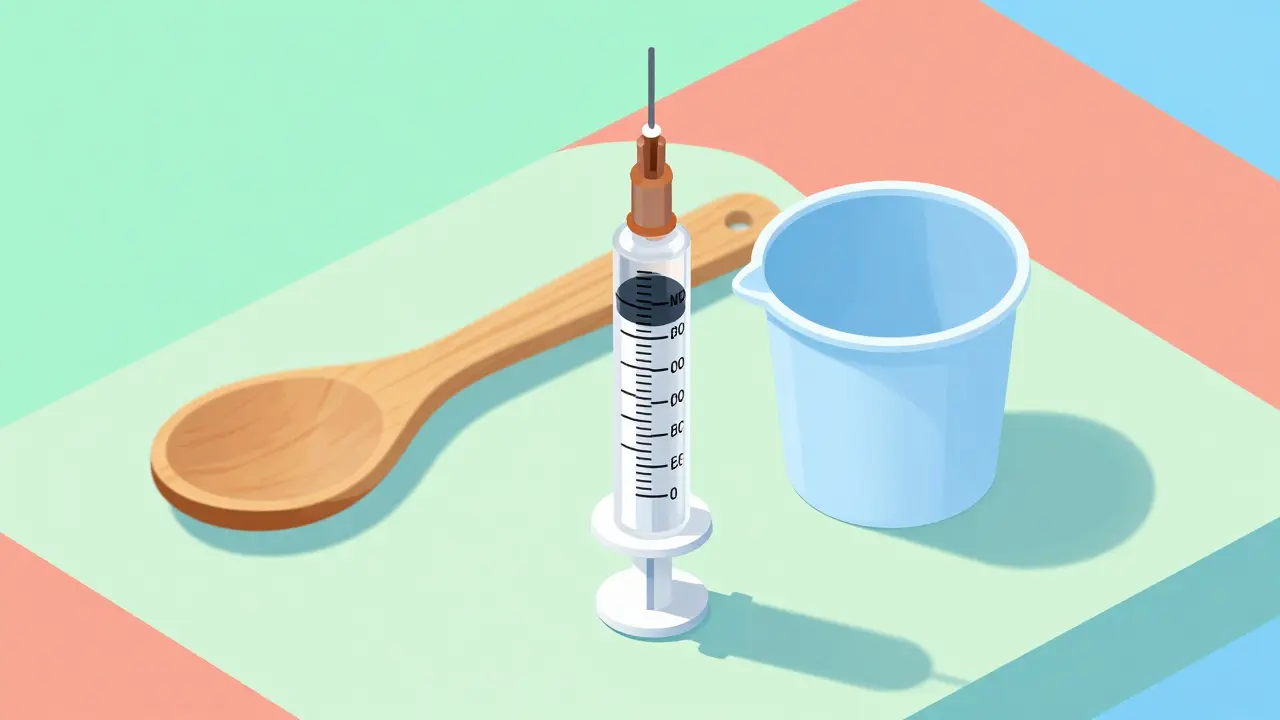
Choosing the Right Measuring Device
Your pharmacy should provide a measuring device that matches the label's units. If your label says mL, you must use a device marked in mL. Using a teaspoon scoop for a milliliter prescription is a recipe for disaster.
| Device Type | Accuracy | Best For | Risk Level |
|---|---|---|---|
| Oral Syringe | High (±0.1 mL) | Infants, small doses (<5 mL) | Low |
| Dosing Cup | Moderate (±0.5 mL) | Older children, larger doses (>5 mL) | Medium |
| Kitchen Spoon | Poor (Varies wildly) | Cooking only | Very High |
Syringes are generally the gold standard for precision, especially for infants. They allow you to measure tiny amounts like 0.8 mL accurately. Cups are easier for older kids who can drink from them, but they are less precise for small volumes. Never use a kitchen spoon unless you have absolutely no other choice, and even then, understand you are guessing.
The "Teach-Back" Method: Don't Be Shy
Pharmacists are busy, but they are also your best resource. When you pick up a liquid prescription, ask for a demonstration. Show the pharmacist how you plan to measure the dose. This is called the "teach-back" method, and studies show it reduces medication errors by 63%.
If the label is unclear, or if the measuring device doesn't match the instructions, speak up. You might hear phrases like "half a teaspoon" in conversation, but insist on seeing the mL equivalent on the label. Remember, health literacy varies, and only 12% of U.S. adults have proficient health literacy. It is okay to ask for help. Your pharmacist wants you to succeed.

What About Older Prescriptions?
If you have an old bottle with teaspoon markings, do not try to convert it yourself in your head. Bring the bottle back to the pharmacy. Ask them to reprint the label with current NCPDP standards. Many pharmacies still use legacy systems, but most major chains like CVS and Walgreens have updated their software to comply with federal guidelines. If your independent pharmacy hasn't updated, politely request a compliant label. It costs them nothing and could save your life.
Red Flags to Watch For
As you become more familiar with reading labels, keep an eye out for these warning signs:
- Missing Units: If the label says "Take 5" without saying "mL," call the pharmacy immediately.
- Faded Print: Ensure the numbers are legible. Faded ink can turn a "1" into a "7" or hide a decimal point.
- Inconsistent Devices: If the label says mL but the cup only has tsp marks, return it for a proper device.
- Confusing Abbreviations: Avoid labels that use ambiguous abbreviations. Clear text is always better.
Reading liquid prescription labels is a skill that improves with practice. By focusing on milliliters, checking for proper zero usage, and verifying your measuring device, you eliminate the guesswork. Stay vigilant, ask questions, and always prioritize precision over convenience.
Is 5 mL the same as a teaspoon?
Yes, 5 mL is medically equivalent to 1 teaspoon. However, household teaspoons vary in size, so you should always use a calibrated measuring device marked in mL rather than a kitchen spoon to ensure accuracy.
Why do some labels still say teaspoons?
Some older prescriptions or non-compliant pharmacies may still use teaspoons due to outdated software or lack of awareness. Federal guidelines mandate milliliters, so you should ask your pharmacist to update any label that uses non-metric units.
What does "240 mg / 5 mL" mean?
This indicates the concentration of the medication. It means that every 5 milliliters of liquid contains 240 milligrams of the active drug. This is not your dose; your dose is specified separately in the directions.
Should I use a syringe or a cup?
Use a syringe for small doses (under 5 mL) or for infants, as it offers higher precision. Use a dosing cup for larger doses or for older children who can drink easily. Always choose the device provided by your pharmacy that matches the label's units.
Can I convert mL to teaspoons myself?
While 5 mL equals 1 teaspoon, manual conversion increases the risk of error. It is safer to rely on the mL measurement directly using a calibrated device. If you are unsure, consult your pharmacist for clarification.