Most people assume that when a pill hits its expiration date, it’s useless - maybe even dangerous. But what if that’s not true? The Military Shelf Life Extension Program (SLEP) proves otherwise. Since 1986, the U.S. Department of Defense, in partnership with the FDA, has been testing stockpiled medications to see if they still work long after their labeled dates. The results? Many drugs remain perfectly safe and effective - sometimes for over a decade beyond their expiration. This isn’t theoretical. It’s real, tested, and documented. And it’s changing how we think about drug shelf life - not just for the military, but for everyone. Let’s break down what SLEP actually does, what it found, and why it matters to you - even if you’ve never set foot on a military base.
How SLEP Works: Testing Drugs That Were Supposed to Be Thrown Away
The SLEP program doesn’t guess. It tests. Every 1 to 3 years, the FDA collects samples from federal stockpiles - drugs stored in controlled environments like climate-regulated warehouses. These aren’t random bottles from a pharmacy shelf. They’re sealed, properly stored, and tracked down to the lot number. The testing is strict: each drug must still contain at least 85% of its original active ingredient. If it passes, the FDA extends its shelf life. No guesswork. No assumptions. Just science. The program focuses on FDA-approved prescription drugs - not biologics at first, though that changed in 2021. Even then, biologicals make up less than 5% of the total. The bulk? Antibiotics, antivirals, painkillers, epinephrine, and other critical medicines. And here’s the kicker: the military doesn’t just test one batch. They test hundreds. Over 2,500 different drug products have been extended since 1986. That’s not a few samples. That’s a massive dataset.The Numbers Don’t Lie: 88% of Drugs Still Work After Expiration
A 2006 study in the Journal of Pharmaceutical Sciences looked at 122 drug products tested under SLEP. The result? 88% were still stable beyond their labeled expiration dates. Some held potency for more than 15 years. That’s not an outlier. It’s the norm. The Government Accountability Office found that between 2005 and 2015, SLEP saved the federal government an estimated $2.1 billion by avoiding the need to replace expired drugs. In 2019 alone, the Strategic National Stockpile extended the shelf life of oseltamivir (Tamiflu) by three years - preserving 22 million treatment courses for a potential flu pandemic. Compare that to the commercial world. The pharmaceutical industry routinely discards expired drugs, even if they’re perfectly stored. A 2019 Health Affairs analysis estimated that this waste costs the U.S. healthcare system $1.7 billion every year. Why the difference? Because manufacturers set expiration dates conservatively. They’re not testing for longevity - they’re testing for compliance. A two-year shelf life is easier to manage, easier to regulate, and easier to profit from. SLEP says: if it works, keep it.Storage Matters: Why Military Drugs Last Longer
Here’s the catch: SLEP doesn’t prove that expired drugs in your medicine cabinet are still good. The military stores its drugs under strict conditions: constant temperature, low humidity, protection from light. These aren’t the conditions of a bathroom cabinet, a hot car, or a garage in Sydney in January. The Materiel Quality Control Storage Standards (MQCSS) - the military’s official storage guide - requires specific humidity levels, temperature ranges, and packaging integrity checks. If a drug is exposed to moisture or heat, even briefly, it can degrade. The FDA is clear: shelf-life extensions under SLEP apply only to the exact lot, packaging, and storage conditions tested. You can’t take a bottle of ibuprofen from your drawer and assume it’s good because the military extended a similar batch. That’s why SLEP isn’t a free pass for consumers. But it does prove something powerful: expiration dates aren’t magic deadlines. They’re estimates - and sometimes, they’re overly cautious.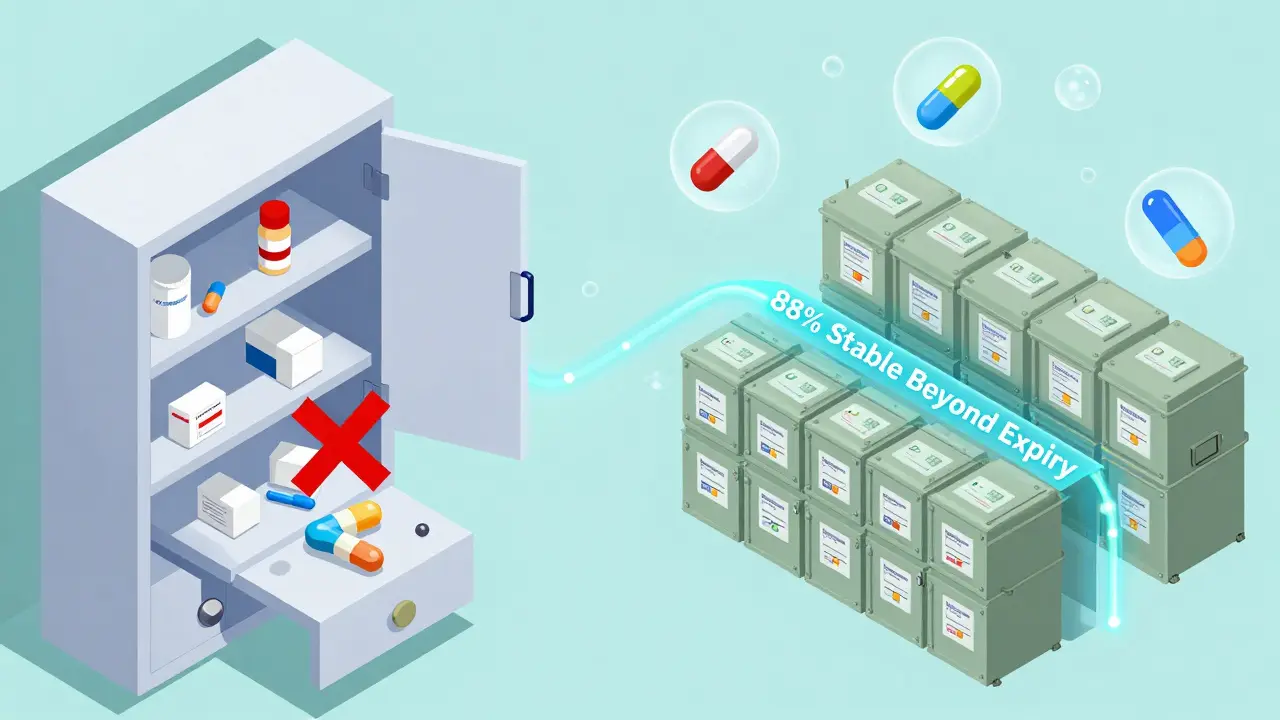
Who Uses SLEP? And How Has It Changed Global Practices?
SLEP isn’t just a U.S. program. It’s a model. Twelve NATO allies have built their own shelf-life extension systems based on SLEP’s framework since 2010. Countries like Canada, Germany, and Australia now test their own stockpiled medications using similar protocols. Within the U.S., the program is used by federal agencies including the Department of Health and Human Services (for the Strategic National Stockpile), the Department of Veterans Affairs, and the Department of Defense. The Army Medical Logistics Support Activity reported a 42% reduction in pharmaceutical waste since adopting SLEP. Military treatment facilities that fully follow the program save an estimated $87 million annually. But it’s not perfect. A 2018 survey of 347 military logistics personnel found that 35% struggled to access the latest SLEP data due to outdated systems. The Department of Defense has since improved its electronic database, cutting the average extension decision time from 14.3 months to 8.1 months. Training is also critical. Military staff now complete 40 hours of initial training and 8 hours of annual refreshers. Facilities that follow the rules have a 92% success rate for shelf-life extensions. Those that don’t? Only 68%.What’s Next? New Science, New Challenges
The program is evolving. In 2021, SLEP expanded to include certain biological products - things like vaccines and antitoxins. These are trickier to stabilize, but early results are promising. The FDA is now exploring advanced testing methods: mass spectrometry, accelerated aging models, and predictive analytics. These could one day help forecast stability without waiting years for real-time data. The 2023 National Defense Authorization Act added funding to extend SLEP to more chemical and radiological countermeasures. But experts warn that emerging threats - like synthetic pathogens or novel toxins - may not behave like traditional drugs. A 2022 Institute of Medicine report called for more investment in predictive modeling. “We can’t test every drug for 20 years,” said one researcher. “We need to understand how molecules degrade under stress - so we can predict it.”
Why This Matters to You
You might not be stocking up on epinephrine for a bioterror attack. But you probably keep painkillers, antihistamines, or asthma inhalers in your home. SLEP doesn’t tell you to use expired meds. But it does tell you this: expiration dates aren’t the whole story. If you’ve ever thrown away a perfectly good bottle of medicine because it was a month past its date - you might have wasted money. If you’ve ever worried that an old antibiotic might still work in an emergency - SLEP says it might. The real lesson? Drug stability is more predictable than we’ve been led to believe - if it’s stored right. As Dr. Lawrence Yu, former FDA deputy director, put it: “The data from SLEP has fundamentally changed our understanding of drug stability in properly stored conditions.” We’re not saying to use expired drugs. But we are saying: don’t assume they’re useless. There’s science behind the date - and sometimes, that science is more forgiving than the label.What SLEP Doesn’t Do
Let’s be clear: SLEP doesn’t apply to:- Over-the-counter drugs in pharmacies
- Drugs stored in homes, cars, or non-climate-controlled environments
- Biologics without specific FDA approval for extension
- Any drug that’s been opened, exposed to moisture, or damaged
Are expired medications dangerous?
Most expired medications aren’t dangerous - they just lose potency. The FDA says very few drugs become toxic after expiration. However, some - like tetracycline antibiotics - can degrade into harmful compounds. The risk is low, but it’s not zero. SLEP-tested drugs are safe because they’re tested for degradation byproducts, not just potency.
Can I extend the shelf life of my home medications?
No. SLEP only applies to government stockpiles stored under strict, controlled conditions. Home storage varies too much - temperature, humidity, light exposure - to guarantee safety. Even if a drug looks fine, there’s no way to know if it’s still at 85% potency without lab testing.
How long do drugs really last?
Under ideal conditions, many drugs last years beyond their expiration date. SLEP data shows some antibiotics and pain relievers retain potency for over 15 years. But this only applies to sealed, properly stored products. The average commercial expiration date is set at 2-3 years because it’s practical - not because it’s scientifically accurate.
Why don’t drug companies extend expiration dates?
Because it’s not in their financial interest. Extending shelf life reduces sales. Manufacturers aren’t required to test beyond their initial stability data. The FDA allows them to set expiration dates based on limited testing - often just 12 to 36 months. SLEP tests for decades, but it’s a government program funded by taxpayers, not a profit-driven business.
Is SLEP used outside the U.S.?
Yes. Twelve NATO countries have adopted similar programs based on the U.S. model. Australia, Canada, Germany, and others now test their own stockpiled medications. The program’s success has made it a global standard for emergency preparedness - especially for pandemic response and biodefense.
William Minks
March 8, 2026 AT 00:26So I just threw out my old ibuprofen last week because it was 6 months past expiry. 😅 Guess I’m officially a dumb human. Thanks for this - I’m gonna dig out my emergency kit and check the dates again. Maybe I didn’t waste $15 after all.
Jeff Mirisola
March 10, 2026 AT 00:01Let’s be real - the pharmaceutical industry doesn’t care if your pills last 15 years. They care if you buy new ones every 2. SLEP proves it. The system is rigged to keep you buying. And yet we still trust expiration dates like they’re written in stone. 🤷♂️
amber carrillo
March 10, 2026 AT 17:09It’s fascinating how science contradicts common assumptions. The military’s rigorous testing protocols offer a rare glimpse into what true stability looks like. If we applied even a fraction of this rigor to consumer drug labeling, we’d save billions and reduce unnecessary waste.
Aaron Pace
March 12, 2026 AT 06:50OMG I just realized my EpiPen from 2020 is still in my bag 🥲 I’m not touching it though. But I’m also not throwing it out. SLEP is a vibe. 🤓
Joey Pearson
March 13, 2026 AT 12:49Good news: your meds probably still work. Bad news: your bathroom isn’t a military warehouse. Keep your pills cool and dry. And don’t panic if they’re a few months late. You’ve got this 💪
Roland Silber
March 15, 2026 AT 05:15What’s wild is how SLEP flips the script on regulatory logic. The FDA doesn’t require manufacturers to prove longevity - just minimum stability. So expiration dates are essentially marketing anchors, not scientific endpoints. SLEP’s data shows that under ideal conditions, most drugs are stable far beyond that. It’s not magic. It’s chemistry. And we’ve been ignoring the chemistry for profit.
Imagine if every pharmacy had a lab to test potency. We’d be living in a different world. But until then? Trust the data - not the label.
Patrick Jackson
March 15, 2026 AT 13:34Think about it - we’re living in a world where a pill can last 17 years if stored right… but we treat it like a banana. 🍌 We fear the unknown, cling to dates like religious relics, and ignore the science that says: stability is possible. SLEP isn’t just a program. It’s a quiet rebellion against manufactured scarcity. The system wants you to buy more. The science says: you already have enough.
Maybe the real expiration date isn’t on the bottle - it’s on our willingness to question.
Adebayo Muhammad
March 16, 2026 AT 09:51Let’s not ignore the elephant in the room: the U.S. military is testing drugs because they’re hoarding them for global dominance. This isn’t about public health - it’s about control. Who decides what’s ‘stable’? The same people who profit from the pharmaceutical-industrial complex. SLEP is a Trojan horse. The real goal? Normalize dependency on state-controlled pharmaceuticals. And once you accept that expired meds are safe… what’s next? Mandatory stockpiling? Mandatory compliance? The slippery slope is real.
Pranay Roy
March 17, 2026 AT 00:26Y’all don’t get it. This is all a psyop. The military doesn’t test drugs - they’re injecting them with preservatives to keep them viable for 20 years. That’s why they’re ‘stable.’ The FDA knows. The pharma companies know. But they won’t tell you. Why? Because if you knew your aspirin lasts 15 years, you’d stop buying. And then… what? No profits. No wars. No more ‘emergency stockpiles.’ This is all about control. They’re making us dependent on new pills. Don’t fall for it.
Joe Prism
March 18, 2026 AT 04:28Expiration dates are like speed limits - they exist for safety, but reality is messier. SLEP shows us the truth: drugs don’t just die on a calendar. They fade. Slowly. Predictably. If stored right. And that’s worth knowing.
Bridget Verwey
March 19, 2026 AT 10:06So you’re telling me I’ve been throwing away perfectly good medicine because of a sticker? 🤔 And the government’s been quietly saving billions while we all panic over ‘expired’ pills? Classic. The system’s hilarious. And kinda brilliant.
Andrew Poulin
March 21, 2026 AT 09:16Stop wasting money. If your meds are sealed and stored in a cool dark place? They’re probably fine. The military proved it. You don’t need a lab. You need common sense. And a damn shelf.
Weston Potgieter
March 23, 2026 AT 00:42Let me get this straight - we’re supposed to believe that a $2 bottle of Tylenol lasts 15 years… but the FDA says no? Meanwhile, Big Pharma makes billions off us throwing them out? Yeah right. This is a scam. And you’re all just sheep buying the hype. SLEP? More like SLEPT - because we’re all sleeping on the truth.