Medication safety isn't just about keeping pills out of reach-it's about teaching kids how to think about medicine before they ever pick one up. Every year, more than 50,000 children under age five end up in emergency rooms because they accidentally swallowed something they thought was candy. These aren’t rare accidents. They happen in homes where medicine sits on a nightstand, in schools where a child grabs a bottle from a backpack, or at a grandparent’s house where pills are tucked into a purse. The good news? Kids as young as three can learn how to stay safe-and they do, when given clear, consistent messages.
Why Kids Mistake Medicine for Candy
It’s not that children are curious or reckless. It’s that medicine often looks like candy. Bright colors, sweet flavors, and small shapes make pills and syrups easy to confuse with treats. A 2021 FDA study found that 78% of toddlers under age three copied adults who took medicine in front of them-even if the adult wasn’t sick. That’s imitation, not mischief. When parents say, "This will help you feel better," while taking a pill with a glass of juice, kids hear: "This is something good you eat." And if you call it "medicine candy" to get them to take it? You’re creating a dangerous association. Research from the Rocky Mountain Poison and Drug Center shows this increases accidental ingestion by 220%.What Kids Should Learn by Age
Teaching medication safety isn’t a one-time talk. It’s a step-by-step process that grows with the child.- Age 3: Teach them to give any found pill to a grown-up. No tasting. No putting it in their pocket. Just hand it over. Practice with pretend pills during playtime.
- Age 5: Help them label their own medicine bottles with stickers that say their name. Teach them that medicine must always be kept up and away-never on the counter or bedside table. If they feel worse after taking medicine, they should tell a parent right away.
- Age 6: Start reading labels together. What’s the name? Who is it for? When do they take it? Let them help set a timer for doses. Encourage them to ask doctors simple questions like, "Why do I need this?"
- Age 7: They should understand school rules. Medicines stay in the nurse’s office. Never take medicine in front of younger kids-it might look like fun. Learn to check the label against what Mom or Dad told them.
- Age 8: Know their own weight. Dosing isn’t "a spoonful"-it’s based on pounds. A child who weighs 50 pounds needs a different amount than one who weighs 30. Using kitchen spoons leads to errors up to 98% of the time. Always use an oral syringe.
These aren’t abstract lessons. They’re survival skills. A 2021 study from Nationwide Children’s Hospital showed kids who went through structured safety training were 47% better at telling medicine apart from candy than those who didn’t.
Home Storage: The Real Danger Zone
Most poisonings happen at home. And most homes aren’t storing medicine safely. The CDC found that 67% of incidents involving kids aged 1-4 could be prevented with proper storage. But here’s what parents don’t realize:- 18% keep pills on nightstands-easy for a toddler to reach.
- 15% leave them on kitchen counters while cooking.
- 8% store them in purses, backpacks, or coat pockets.
Even "child-resistant" caps aren’t enough. A child who’s watched an adult open a bottle can figure it out in minutes. The solution? Lock boxes. Look for ones that meet ASTM F2057-22 standards. Keep them up high, out of sight. And never leave medicine unattended-even for a minute. A 2023 CDC report showed 86% of parents who used locked storage kept medicine safe. Only 29% did when relying on caps alone.
Grandparents? They’re a blind spot. A nationwide survey found 79% don’t follow safety rules when kids visit. Sixty-three percent keep pills in suitcases or purses. Talk to them. Give them a small lock box for visits. Make it easy.
What Schools Are Doing (And What They’re Missing)
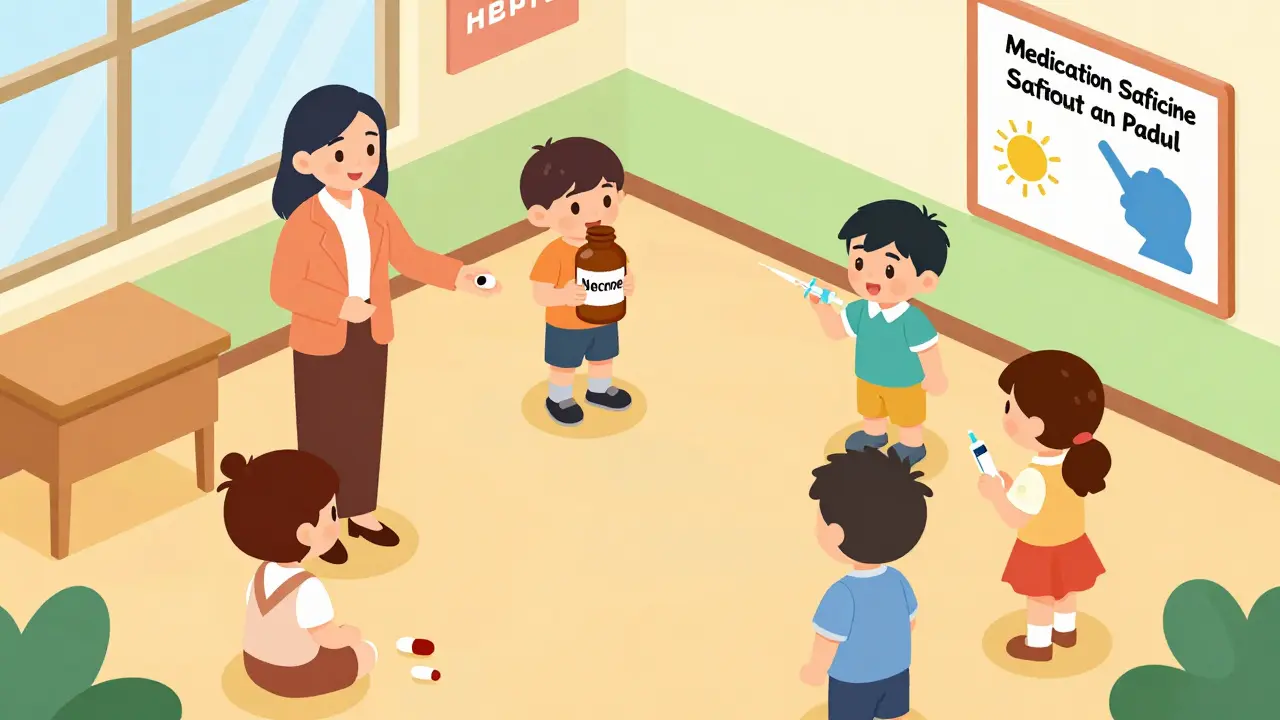
Schools play a huge role. Programs like Generation Rx’s "Medication Safety Patrol" teach kids through role-playing. Kids act out scenarios: "What do you do if you find a pill on the floor?" "What if your friend says it tastes like candy?" The program works. In Columbus City Schools, it cut medication-related incidents by 34% over two years. Eighty-nine percent of students could correctly identify medicine versus candy after the lessons.But not every school has this. Only 39% of U.S. schools have a full-time nurse. In rural areas, that number drops to 32%. Many teachers get no training. A 2023 survey found 76% of rural educators had no printed materials. Forty-four percent had never been taught how to handle medication at school.
Head Start programs are stricter. All staff must complete 8 hours of initial training and 2 hours every year. They learn 12 competencies: how to label, how to document, how to spot allergic reactions, how to dispose of expired pills. But even they struggle. Thirty-two percent of errors happen during transitions-when kids move between classrooms or caregivers.
Tools That Actually Work
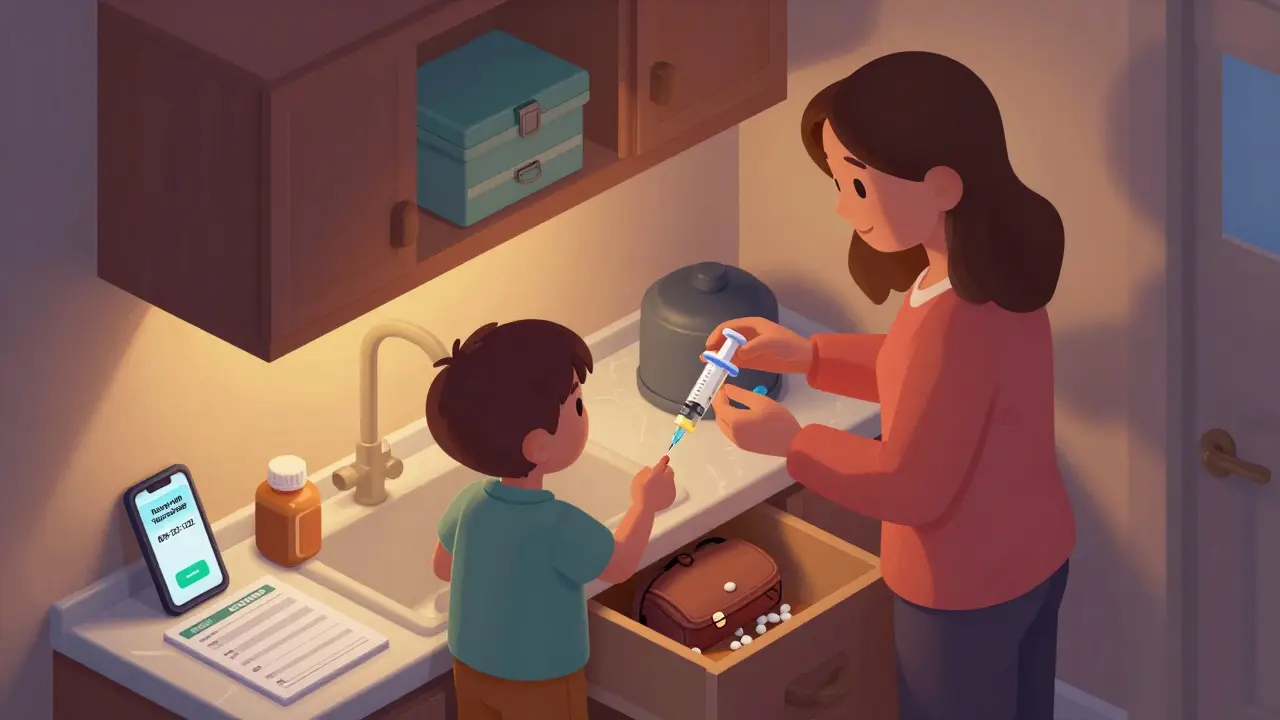
You don’t need fancy gadgets. Just a few simple tools make a big difference.- Oral syringes: Free at most pharmacies. They’re marked in milliliters. No guessing. No spoons.
- Lock boxes: Under $20. Keep them high. Use them every time.
- Poison Help number: Save 800-222-1222 in every phone in the house. Program it into your home phone, your work phone, your tablet. Ninety-one percent of calls about child poisonings happen within one hour. Speed matters.
- Medication log: Write down when the dose was given, who gave it, and if there were side effects. Eighteen percent of errors come from bad records.
The Bigger Gap: Teens and Prescription Misuse
Most programs stop at age 10. But the real danger comes later. Prescription misuse peaks at age 16. Teens are taking pills from their parents’ medicine cabinets-not because they’re curious, but because they think it’s safe. The CDC reports it’s the second-leading cause of unintentional injury death for 15- to 19-year-olds. Yet no major program teaches teens how to handle their own prescriptions, how to recognize dependence, or how to safely dispose of unused pills.Experts are pushing for change. The CDC plans to expand its PROTECT Initiative to include teen-focused school programs starting in 2024. The American Academy of Pediatrics will update its guidelines in 2024 to include telehealth and adolescent risks. But right now, there’s a gap. Kids who learned "medicine is not candy" at age five still need to learn "medicine can be dangerous if you take it wrong" by age 13.
What Parents and Teachers Can Do Today
Start now. Don’t wait for school to teach it. Here’s how:- Practice 10-15 minutes a week with your child. Use pretend pills. Role-play finding medicine on the floor.
- Use the phrase: "Medicine is not candy." Say it every time you give a pill. Say it when you take one.
- Store all medicine in a locked box, up and away. Even vitamins. Even OTC pain relievers.
- Use an oral syringe. Always. No spoons.
- Teach your child their weight. Let them help measure doses.
- Call the Poison Help number and save it everywhere. Know where it is before you need it.
- Ask your child’s school: "Do you have a medication safety program?" If not, bring them Generation Rx’s free toolkit.
Medication safety isn’t about fear. It’s about empowerment. Kids who know what medicine is-and what it isn’t-can protect themselves. And they can protect their younger siblings too.
Can a 3-year-old really understand medication safety?
Yes. A 3-year-old can learn to give found pills to an adult, never taste unknown substances, and say "I need to tell Mom or Dad" when they see medicine. These are simple, repeated behaviors-not complex concepts. The American Academy of Pediatrics confirms that children at this age can begin learning safety rules when presented in age-appropriate ways, like through play and routine.
Is it safe to store medicine in a child-resistant cap?
Not by itself. Child-resistant caps are designed to slow down older children and adults, not toddlers. A determined child can open them in under a minute. The CDC found that 86% of parents who used locked storage kept medicine safe, while only 29% did so relying only on caps. Always use a lock box in addition to child-resistant packaging.
Why shouldn’t I call medicine "candy" to get my child to take it?
Because it creates a deadly association. A 2019 study of 1,200 poisoning cases found that when parents called medicine "candy," the risk of accidental ingestion jumped by 220%. Children don’t distinguish between the two. If medicine tastes sweet and you call it candy, they’ll try to find more. Always say "medicine"-even if it’s flavored.
Can I use a kitchen spoon to measure medicine?
No. Kitchen spoons vary in size and aren’t marked for accuracy. Studies show using them leads to measurement errors between 40% and 98%. Always use an oral syringe, which is marked in milliliters and gives you precise doses. Most pharmacies give them out for free.
What should I do if my child swallows medicine by accident?
Call Poison Help immediately: 800-222-1222. Don’t wait for symptoms. Don’t try to make them vomit. Don’t give them anything to drink unless told to. Keep the medicine container handy-the label has important info. Ninety-one percent of calls happen within one hour of ingestion, so speed saves lives.
Brandie Bradshaw
February 28, 2026 AT 08:31Martin Halpin
March 2, 2026 AT 07:38Eimear Gilroy
March 2, 2026 AT 21:54Ajay Krishna
March 4, 2026 AT 04:56Noah Cline
March 4, 2026 AT 09:17Lisa Fremder
March 4, 2026 AT 12:47Sophia Rafiq
March 6, 2026 AT 00:31Full Scale Webmaster
March 6, 2026 AT 23:33Byron Duvall
March 7, 2026 AT 14:20Justin Ransburg
March 9, 2026 AT 05:12