When your heart arteries are clogged, you have two main options: a stent or bypass surgery.
It’s not a simple choice. One isn’t better than the other across the board. What works best depends on your heart’s specific condition, your overall health, and what matters most to you-whether that’s getting back to work fast, avoiding another procedure, or living longer.
For decades, PCI (percutaneous coronary intervention) and CABG (coronary artery bypass grafting) have been the two go-to treatments for severe coronary artery disease. PCI is the less invasive route: a catheter threaded through an artery in your wrist or groin, a tiny balloon inflated to open the blockage, and a metal mesh stent left behind to keep it open. CABG is open-heart surgery: surgeons take a healthy blood vessel from your leg, arm, or chest and graft it around the blocked artery, creating a new path for blood to flow.
Both work. Both save lives. But they’re not interchangeable.
How PCI Works: A Quick, Minimally Invasive Fix
PCI, often called angioplasty with stenting, is done in a cath lab, not an operating room. You’re awake but sedated. A thin tube (catheter) is inserted into an artery-usually in your wrist-and guided to your heart using real-time X-ray imaging. Once it reaches the blockage, a small balloon is inflated to crush the plaque against the artery wall. Then, a metal stent, often coated with medicine to prevent re-blocking, is placed to hold the artery open.
The whole procedure takes about 1 to 2 hours. Most people go home the next day. You can usually return to light activity within a few days. That’s why it’s so popular: it’s fast, it’s low-risk in the short term, and it relieves chest pain quickly.
Modern drug-eluting stents have improved outcomes dramatically. Ten years ago, nearly 1 in 3 patients needed another procedure within five years. Now, that number is closer to 5% to 10%. Still, even with the best stents, the artery can narrow again. And if it does, you may need another stent-or eventually, bypass surgery anyway.
How CABG Works: The Bigger, Longer-Term Solution
CABG is major surgery. You’re under general anesthesia. Surgeons open your chest, stop your heart temporarily (or sometimes keep it beating), and connect a graft-usually the left internal mammary artery from your chest wall-to your coronary artery beyond the blockage. This creates a detour for blood to flow freely, bypassing the clogged section.
The surgery itself takes 3 to 6 hours. Recovery isn’t quick. You’ll spend 5 to 7 days in the hospital. Full recovery? Six to eight weeks, sometimes longer. You’ll have a long scar down your chest. Your breastbone is wired back together, and it takes months to feel fully strong again.
But here’s the trade-off: CABG grafts last. Arterial grafts, like the one taken from your chest, stay open in 85% to 90% of cases after 10 years. Vein grafts from your leg are less durable-about 60% to 70% patency at 10 years. That’s why CABG is often the better choice for long-term survival, especially if you have multiple blockages or diabetes.

It’s Not Just About the Blockage-It’s About Your Whole Picture
Doctors don’t pick PCI or CABG based on a single scan. They look at your whole heart. Three big factors decide which path is better:
- SyNTAX Score: This is a scoring system based on the number, location, and complexity of your blockages. A score under 22? PCI is usually fine. Over 32? CABG is strongly recommended. Between 22 and 32? That’s where things get personal.
- Diabetes: If you have diabetes and multivessel disease, CABG cuts your risk of dying by nearly half compared to PCI. The FREEDOM trial showed 16.4% of diabetic patients died within five years after PCI, but only 10% after CABG.
- Left Main Disease: If the main artery feeding your heart is narrowed, your options shift. The EXCEL trial found that for low-to-moderate complexity cases, PCI and CABG had similar outcomes at three years. But by five years, CABG had the edge-fewer heart attacks and repeat procedures.
Left ventricular function matters too. If your heart is already weak, CABG tends to offer better long-term protection. A strong heart can handle the stress of surgery. A weak one benefits more from the durable blood flow CABG provides.
Survival, Repeated Procedures, and Stroke Risk
A large meta-analysis of 11 randomized trials involving over 11,000 patients showed a clear pattern: over five years, CABG reduces your risk of death, heart attack, and repeat procedures compared to PCI.
- Death: 10.1% after CABG vs. 12.1% after PCI.
- Heart attack: 3.5% after CABG vs. 5.2% after PCI.
- Repeat procedure: 11% after CABG vs. 21.5% after PCI.
But there’s a catch: CABG carries a higher risk of stroke in the first 30 days-1.7% compared to 1.0% with PCI. That’s why the decision isn’t just about long-term survival. It’s about balancing immediate risk with long-term gain.
For someone who’s 70, has diabetes, and three blocked arteries? The long-term survival advantage of CABG outweighs the small increase in stroke risk. For a 50-year-old with one blocked artery and no other health issues? PCI makes more sense.
Quality of Life: Fast Recovery vs. Lasting Relief
People often think, "I just want to feel better." But how long do you want to feel better?
PCI wins in the short term. In the ROSETTA trial, 78% of PCI patients were back to normal daily activities within 30 days. Only 52% of CABG patients could say the same. And in the VA CART registry, 87% of PCI patients returned to work within two weeks. For CABG patients? Just 32%.
But over time, the tide turns. At one year, CABG patients reported better quality of life. More of them were completely free of chest pain. By six months, both groups were back at work at similar rates. The difference wasn’t in returning to work-it was in how well your heart held up.
Many PCI patients eventually face recurrent angina. One in five need another procedure within a few years. CABG patients may have sternal pain for months, but fewer report ongoing chest discomfort. One Reddit user put it simply: "6 weeks of recovery was tough, but 2 years later I’m hiking again with no chest pain."
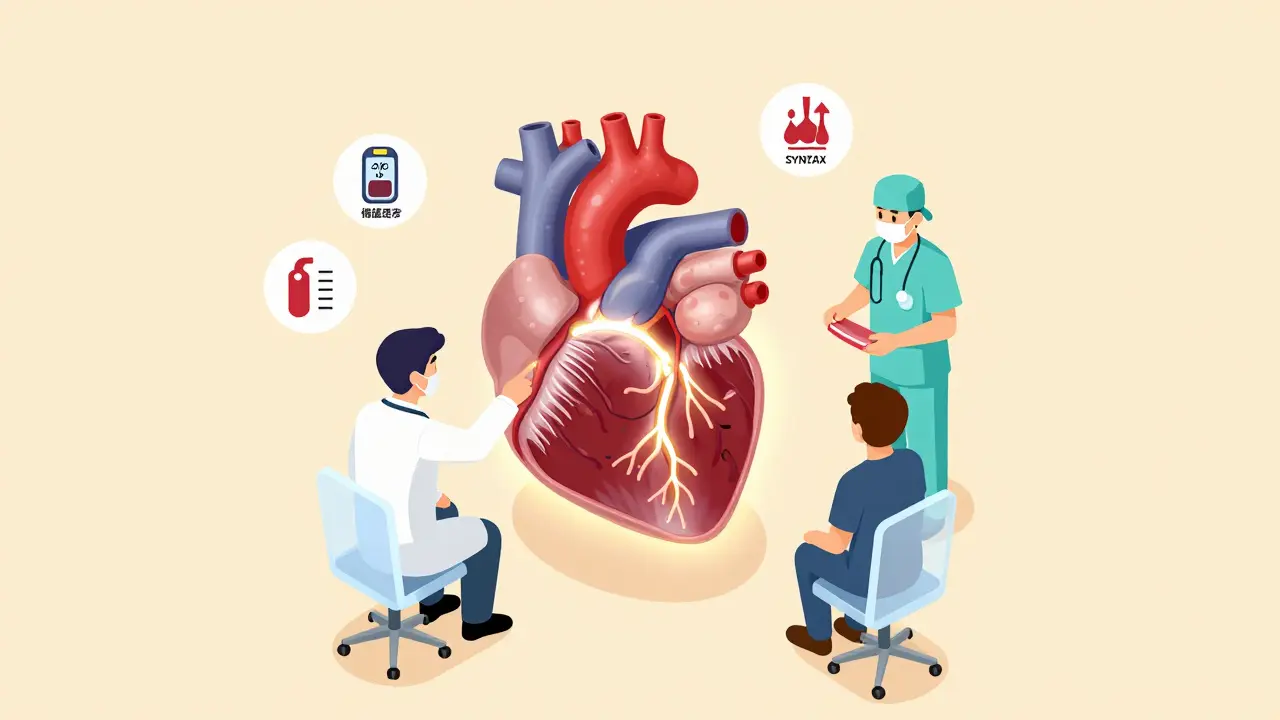
The Heart Team: Why You Need More Than One Doctor’s Opinion
Guidelines now say the decision should be made by a heart team-not just a cardiologist or a surgeon alone. That means a cardiologist who does stents, a cardiac surgeon, a nurse specialist, and sometimes a diabetes or rehab expert all sit down together with your records and talk.
This isn’t bureaucracy. It’s necessary. Studies show that when a heart team makes the call, patients are more likely to get the right procedure for their condition. In high-volume centers, CABG mortality is 1.8%. In low-volume ones, it’s 3.2%. That’s a huge difference.
And it’s not just about skill-it’s about coordination. If you have diabetes, kidney disease, or a history of stroke, your team needs to weigh all those factors. A stent might seem safer today, but if you’re a diabetic with multiple blockages, you’re more likely to need another procedure-and that increases your risk of complications over time.
What’s Changing Now-and What’s Coming
Technology keeps evolving. New stents are being tested that dissolve over time. Robotic-assisted CABG is reducing recovery time. And surgeons are using more arterial grafts (from the chest and arm) instead of vein grafts from the leg-because they last longer.
The COMPLETE trial showed that treating all significant blockages during PCI (not just the one causing symptoms) reduces heart attacks and death by 25%. That’s changing how PCI is done.
And the next big thing? Hybrid procedures. Imagine a surgeon doing a minimally invasive bypass to the main artery (LAD), and a cardiologist putting in stents for the other blockages-all in one visit. Early results are promising, and experts predict this approach could become standard for some patients within the next five years.
Final Thoughts: No One-Size-Fits-All
There’s no "best" option. Only the best option for you.
If you’re young, healthy, and have one or two simple blockages? PCI is likely your best bet. Fast, safe, and effective.
If you’re older, have diabetes, multiple blockages, or disease in your main artery? CABG gives you the best shot at living longer, with fewer repeat procedures. The recovery is harder, but the payoff is bigger.
And if you’re somewhere in between? Don’t rush. Get a heart team evaluation. Ask questions. Understand your SyNTAX score. Know your options. Your heart doesn’t just need a fix-it needs a plan.
Alexander Erb
March 10, 2026 AT 04:01Donnie DeMarco
March 10, 2026 AT 14:58Tom Bolt
March 11, 2026 AT 11:59Mike Winter
March 13, 2026 AT 08:35Randall Walker
March 14, 2026 AT 04:08Gene Forte
March 15, 2026 AT 05:13Kenneth Zieden-Weber
March 15, 2026 AT 14:29Chris Bird
March 16, 2026 AT 20:03David L. Thomas
March 18, 2026 AT 03:05