Imagine taking a pill that works perfectly for your neighbor but leaves you feeling nauseous or ineffective. This isn't just bad luck; it’s often biology. Pharmacogenomics is the study of how a person's DNA affects their response to medications. It combines pharmacology (how drugs work) with genomics (your genetic code) to predict which medicines will help you and which might hurt you.
For decades, medicine has operated on a "one-size-fits-all" model. Doctors prescribe standard doses based on average patient data. But averages don’t apply to individuals. Adverse drug reactions cause about 6.7% of all hospital admissions. Pharmacogenomic testing aims to fix this by identifying your genetic makeup before you start treatment, ensuring you get the right dose of the right drug at the right time.
How Does Pharmacogenomic Testing Work?
The process is simpler than most people expect. You provide a biological sample-usually a saliva swab, cheek swab, or blood draw. Labs then analyze specific genes that control how your body processes drugs.
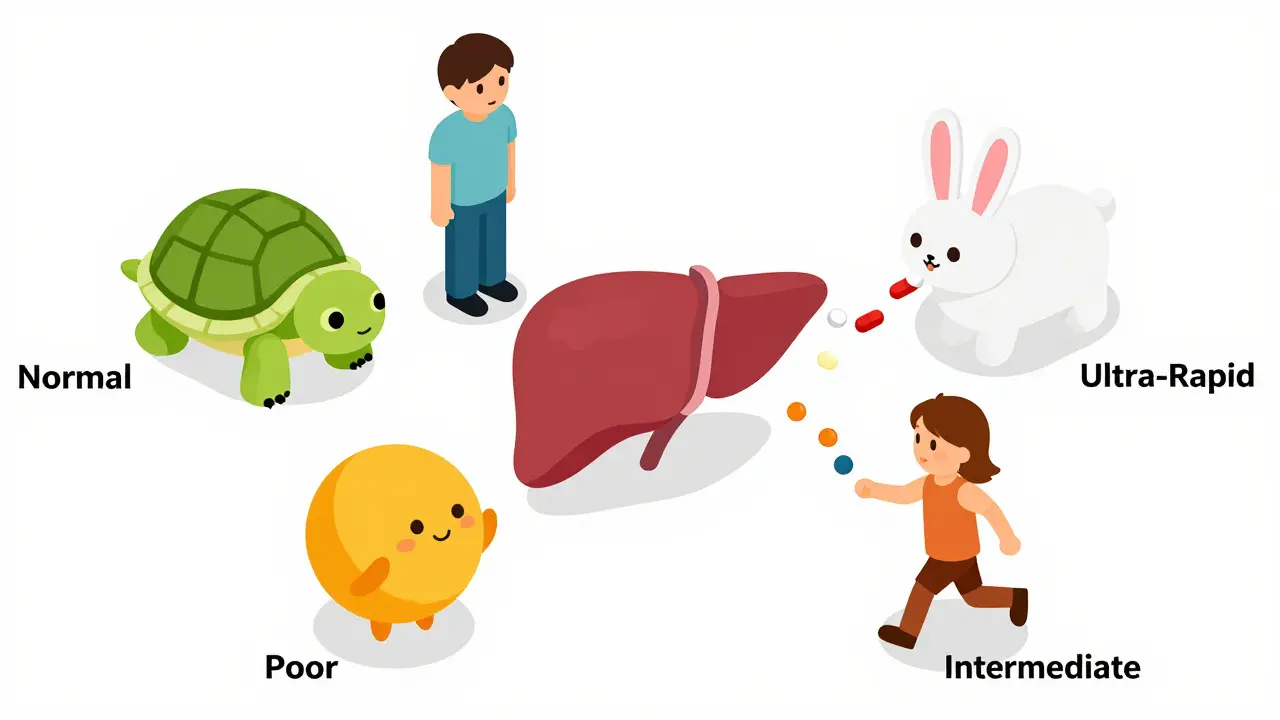
Your liver contains enzymes that break down medications. The most critical ones belong to the Cytochrome P450 family, specifically CYP2D6, CYP2C19, and CYP2C9. These three genes account for 70-80% of clinically significant drug-gene interactions. Depending on your genetics, you fall into one of four categories:
- Poor Metabolizer: Your body breaks down the drug very slowly. Standard doses can build up to toxic levels, causing severe side effects.
- Intermediate Metabolizer: Breakdown is slower than average. You may need a lower dose to avoid toxicity.
- Normal Metabolizer: You process drugs as expected. Standard dosing usually works well.
- Ultra-Rapid Metabolizer: Your body clears the drug too quickly. The medication never reaches effective levels, making it useless.
For example, if you are an ultra-rapid metabolizer of codeine, your body converts it to morphine so fast that you risk respiratory depression. If you are a poor metabolizer, codeine won’t relieve pain at all because it never converts to morphine. A simple genetic test reveals this status instantly.
Key Genes and Drug Interactions
Not every gene matters for every drug. Clinicians focus on high-impact pairs where genetic variation drastically changes outcomes. The Clinical Pharmacogenetics Implementation Consortium (CPIC) provides guidelines for these scenarios. As of late 2023, they have published evidence-based recommendations for 42 gene-drug pairs.
| Gene | Medication Class | Clinical Impact |
|---|---|---|
| CYP2C19 | Clopidogrel (Plavix) | Poor metabolizers have reduced efficacy, increasing heart attack risk after stents. |
| CYP2D6 | Tamoxifen | Poor metabolizers produce less active drug, reducing breast cancer protection. |
| HLA-B*15:02 | Carbamazepine | Carriers face a 1,000x higher risk of Stevens-Johnson Syndrome, a life-threatening rash. |
| SLCO1B1 | Statins | Variant increases risk of muscle pain and damage. |
| CYP2C9/VKORC1 | Warfarin | Genetics dictate starting dose to prevent bleeding or clots. |
These aren't theoretical risks. In psychiatry, a 2022 meta-analysis showed that patients with major depressive disorder who received PGx-guided treatment had a 30.8% remission rate, compared to only 18.5% for those on standard care. That’s a massive difference in quality of life.
Who Should Consider Genetic Testing?
You don’t need a rare disease to benefit from pharmacogenomics. It’s particularly useful if you:
- Experience frequent side effects from medications.
- Have tried multiple drugs for the same condition without success (treatment-resistant).
- Take multiple medications (polypharmacy), increasing interaction risks.
- Are starting therapy for mental health, heart disease, or cancer.
Psychiatry is one of the biggest adopters. Antidepressants and antipsychotics rely heavily on CYP2D6 and CYP2C19 for metabolism. A Canadian study found that 22% of patients required medication changes after testing, leading to better symptom control and fewer side effects. One patient reported eliminating six months of severe nausea after switching from codeine to tramadol based on their CYP2D6 status.
Oncology also uses PGx extensively. Targeted therapies require specific genetic markers to work. However, cardiology lags behind. The TAILOR-PCI trial found no significant difference in cardiovascular events between genotype-guided clopidogrel therapy and standard care. This highlights a crucial point: PGx isn’t a magic bullet for every drug.
Limitations and Realistic Expectations
Despite the hype, pharmacogenomics has limits. Only about 15-20% of commonly prescribed medications have actionable PGx information. For many drugs, lifestyle factors like diet, smoking, and other medications influence effectiveness more than genetics.
Also, not all variants are equal. Some commercial tests, like direct-to-consumer kits from 23andMe, provide raw data but lack clinical interpretation. A user on Reddit noted their psychiatrist ignored their CYP2C19 results because the evidence wasn’t strong enough to change sertraline dosage. Always use tests validated by clinicians and interpreted by professionals familiar with CPIC guidelines.
Another challenge is diversity. Currently, 78% of PGx studies involve participants of European ancestry. Variants common in Asian, African, or Hispanic populations may be missed or misinterpreted. The NIH’s All of Us Research Program aims to fix this by including diverse genomic data, but we’re still early in this journey.

Cost, Coverage, and Access
Is it worth the money? The global PGx market is growing rapidly, projected to reach $23.8 billion by 2030. Prices vary widely. Comprehensive panels cost between $200 and $500 out-of-pocket. Insurance coverage depends on the condition:
- Oncology: ~89% of commercial plans cover PGx testing.
- Psychiatry: ~47% of plans cover it.
- Primary Care: Limited coverage, often requiring prior authorization.
In Australia, some private health funds cover PGx testing under ancillary benefits, while Medicare may rebates for specific cancer-related tests. Check with your provider first. Many hospitals now offer preemptive testing, analyzing dozens of genes upfront so results are ready whenever a new prescription is written.
Getting Started with Pharmacogenomics
If you’re curious about testing, talk to your doctor or pharmacist. Ask if they use CPIC guidelines or tools like PharmCAT. Don’t order random online tests without professional guidance. Look for labs accredited by CLIA or CAP to ensure accuracy.
Remember, your genetic profile doesn’t change. Unlike cholesterol or blood pressure, your DNA is static. This means a single test can guide your medication choices for life. As research expands, more drugs will have clear genetic instructions. By 2027, experts predict 50% of common prescriptions will have actionable PGx data.
Personalized medicine isn’t science fiction anymore. It’s available today, and it could save you from unnecessary suffering. Start the conversation with your healthcare team-you might just find the right medication faster.
What is pharmacogenomics?
Pharmacogenomics is the study of how your genes affect your response to drugs. It helps doctors choose medications and doses that work best for your unique biology, reducing side effects and improving outcomes.
How accurate are genetic medication tests?
Clinical-grade tests have over 99% accuracy for detecting known variants. However, accuracy depends on whether the specific gene-drug pair has strong scientific backing. Always consult a healthcare provider to interpret results correctly.
Does insurance cover pharmacogenomic testing?
Coverage varies by condition and insurer. Oncology testing is widely covered (~89%), while psychiatric testing has moderate coverage (~47%). Primary care coverage is limited. Check with your insurance provider and doctor before ordering.
Which genes are most important for medication safety?
The CYP450 family, especially CYP2D6, CYP2C19, and CYP2C9, handles most drug metabolism. Other key genes include HLA-B (for immune reactions), SLCO1B1 (for statins), and VKORC1 (for warfarin).
Can I take a genetic test at home?
Yes, saliva kits are available. However, direct-to-consumer results lack clinical context. For medical decisions, use tests ordered by your doctor and interpreted using established guidelines like those from CPIC.
Will my genetic results change over time?
No. Your DNA remains the same throughout your life. A single pharmacogenomic test provides lifelong insights into how you metabolize drugs, unlike blood tests that fluctuate with health status.
Are there risks associated with pharmacogenomic testing?
Physical risks are minimal since it’s just a blood or saliva sample. The main risk is misinterpretation of results leading to wrong medication choices. Always review results with a qualified healthcare professional.
How long does it take to get results?
Most clinical labs return results within 1-2 weeks. Some rapid tests can provide preliminary data in days. Preemptive testing programs store results permanently for future reference.
Is pharmacogenomics only for serious illnesses?
No. While heavily used in oncology and cardiology, it’s increasingly applied to mental health, pain management, and even common conditions like depression and anxiety to improve daily quality of life.
What should I do if my current medication causes side effects?
Talk to your doctor about pharmacogenomic testing. If you’re a poor or ultra-rapid metabolizer, switching to a different drug processed by another enzyme pathway might resolve the issue.