By your mid-40s, you might start holding your phone farther away to read the text. You squint at menus in restaurants. You reach for the lamp just to see the recipe on the kitchen counter. This isn’t bad eyesight or stress-it’s presbyopia, a natural part of aging that affects everyone. Unlike nearsightedness or astigmatism, presbyopia isn’t caused by the shape of your eye. It’s caused by your lens. Over time, it hardens, loses flexibility, and can’t bend light properly to focus on close objects anymore.
Why Your Eyes Stop Focusing Up Close
Your eye’s lens works like a tiny, flexible camera lens. When you look at something nearby, muscles around the lens squeeze it into a rounder shape so light bends correctly onto the retina. At age 10, your lens can adjust by about 14 diopters-enough to focus on something just 7 centimeters from your eyes. By age 60, that ability drops to less than half a diopter. Your near point-the closest distance your eye can focus-moves from 7 cm to over 100 cm. That’s why you need to hold your book at arm’s length. This isn’t a disease. It’s not caused by too much screen time or poor lighting. It’s biological. The lens keeps growing throughout life, layer by layer like an onion. Those extra layers make it stiffer. The muscles around it weaken. No eye exercises, vitamins, or supplements can reverse it. As Dr. Emily Chew from the National Eye Institute says, “It’s as inevitable as gray hair.”How Presbyopia Progresses-And When to Expect It
Most people first notice symptoms between 40 and 45. At first, it’s subtle. You might complain about “bad lighting” or say your glasses are “just dirty.” But over time, the problem gets worse. By 45, most people need about +1.00 diopter correction. By 50, it’s usually +1.50 to +2.00. By 65, many need +2.50 to +3.00. That’s why you’ll find yourself buying stronger reading glasses every few years. The progression is predictable. Studies from Mount Sinai and the NEI show that if you’re not using correction by age 50, you’re likely already struggling with close-up tasks. If you’re 55 and still reading your phone without glasses, you’re either very lucky or you’re compensating by squinting or leaning in-which can cause headaches and eye strain.Reading Glasses: The Simple Fix
Reading glasses are the most common solution-and for good reason. They’re cheap, easy to find, and work immediately. Over-the-counter readers range from +0.75 to +3.50 diopters in 0.25-step increments. You can buy them at Walmart, CVS, or Amazon for under $20. Many people start with +1.25 or +1.50 and adjust as needed. But here’s the catch: off-the-shelf glasses assume both eyes need the same correction. That’s not always true. About 35% of people who buy readers without an eye exam end up with the wrong strength, which can cause blurry vision, headaches, or neck pain from leaning forward. If you have different prescriptions in each eye, or if you’re nearsighted and now need reading help, OTC readers won’t cut it. Also, reading glasses only help for near tasks. You’ll need to take them off to drive, watch TV, or see across the room. For people who switch between reading and distance often-like teachers, mechanics, or graphic designers-that’s a hassle.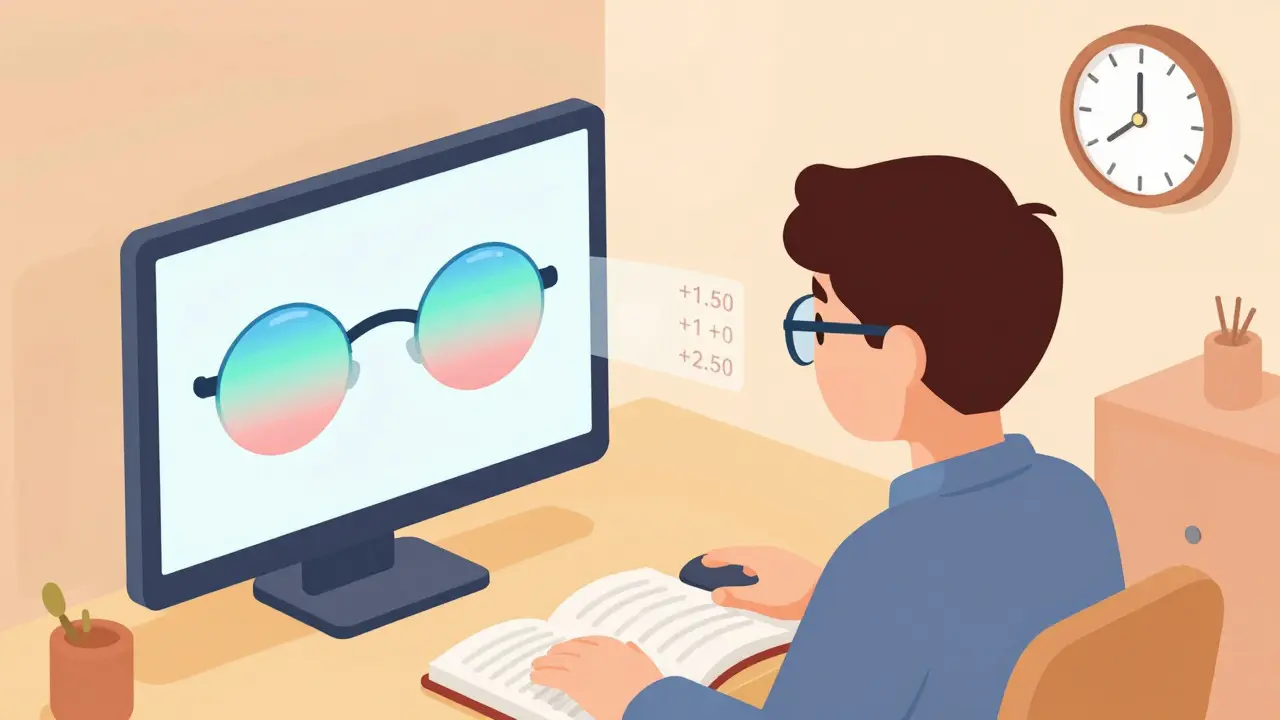
Progressive Lenses: The Seamless Alternative
If you’re tired of switching glasses, progressive lenses are the next step. These are single lenses that correct for distance, intermediate (like computer screens), and near vision-all in one. No visible lines like in bifocals. Just smooth transitions. But they’re not magic. First-time wearers often report dizziness, peripheral distortion, or a “swimmy” feeling for the first two to four weeks. That’s because your brain has to relearn how to move your head to find the right focal zone. The lens has a narrow corridor (12-16mm) for the near vision zone. If the frame is too small, too curved, or poorly fitted, the usable area shrinks even more. A 2023 study from Goodeyes.com found that 25% of new progressive wearers felt discomfort, and only 60% achieved perfect near vision without compromise. That’s why many optical shops now offer “progressive trial kits”-temporary lenses you wear for a few days before committing. Custom fitting matters: pupillary distance must be measured within 0.5mm, and frame tilt affects performance.Surgical Options: Permanent, But Not Perfect
For some, glasses or contacts are just too inconvenient. Surgery is an option-but it’s not risk-free. One common procedure is monovision LASIK. One eye is corrected for distance, the other for near. About 85% of patients report satisfaction, but 15% struggle with reduced depth perception or blurry vision in low light. Around 10-15% need a retreatment within five years. Another option is refractive lens exchange, where your natural lens is replaced with a multifocal intraocular lens (IOL). It’s the same surgery used for cataracts. You get permanent correction-and you’ll never get cataracts in that eye again. But it costs $3,500-$5,000 per eye. You might also experience halos at night (25% of patients) or reduced contrast sensitivity (15%). The risk of serious infection (endophthalmitis) is low-0.04%-but it’s still a surgery. A newer option is the Presbia Flexivue Microlens, a tiny implant placed in the cornea. Approved in Europe in 2022, it improved near vision to 20/25 in 78% of patients after a year. But it’s not yet FDA-approved in the U.S.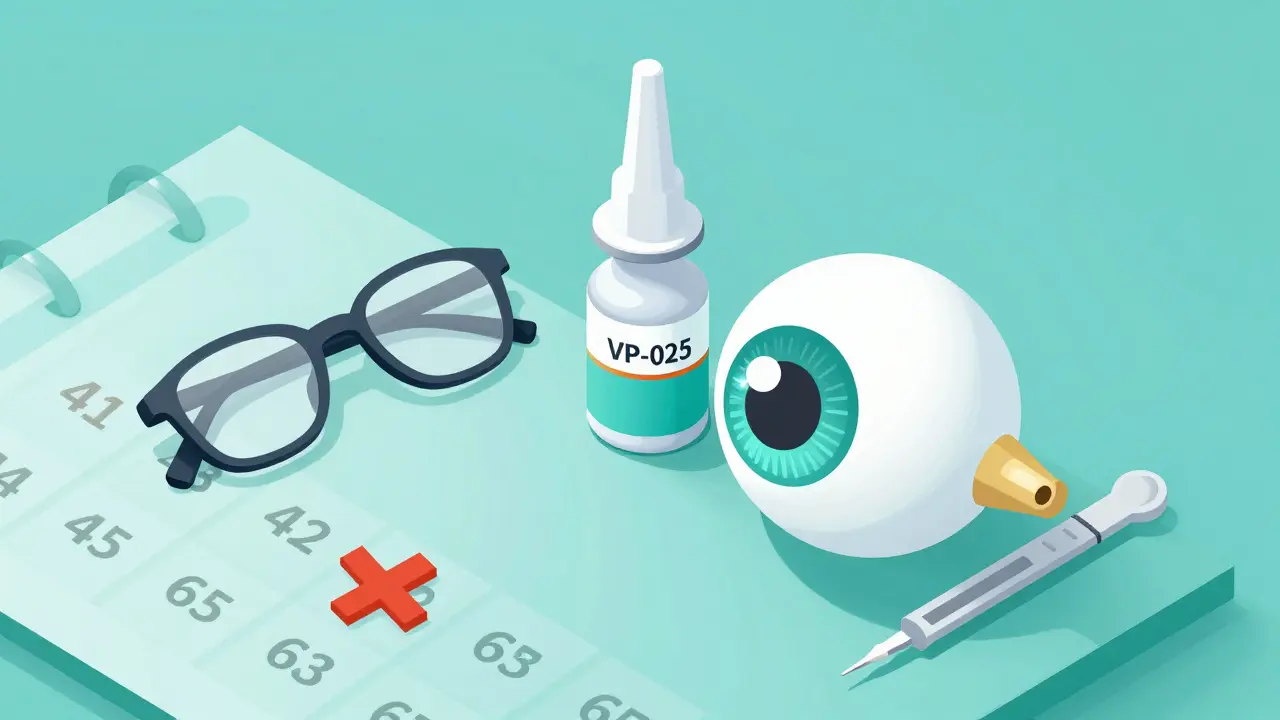
What’s New in 2026?
The field is evolving. Johnson & Johnson’s Acuvue Oasys Multifocal contact lenses, approved in early 2023, use “Enhanced Near Technology” to improve focus without blur. EssilorLuxottica’s Eyezen Progressive 2.0, released in March 2023, widened the near zone by 30% based on data from 10,000 wearers. Even more promising: topical eye drops. In 2023, the National Eye Institute began Phase 1 trials of VP-025, a miotic drop that temporarily tightens the pupil to improve near focus. Early results showed a 1.0-1.5 diopter improvement lasting six hours. If proven safe, this could mean a future where you just put in drops before reading-no glasses, no surgery.What You Should Do Now
If you’re 40 or older and struggling with close-up vision, don’t wait. Get a comprehensive eye exam. Don’t just grab readers off the shelf. An optometrist will check for other age-related issues like glaucoma, macular degeneration, or diabetic retinopathy-all of which can sneak up silently. The American Academy of Ophthalmology recommends a baseline eye exam at age 40, even if you think your vision is fine. A cycloplegic refraction (where drops temporarily paralyze the focusing muscle) gives the most accurate measurement of your true presbyopic need. Without it, your add power could be underestimated by 0.25-0.50 diopters. If you’re active, work on a computer, or drive often, consider progressives. If you only read occasionally, OTC readers are fine-just get the right strength. And if you’re thinking surgery, talk to a specialist. Understand the trade-offs: convenience versus risk, permanence versus cost.Final Thoughts
Presbyopia doesn’t mean your eyes are failing. It means they’ve lived. You’ve read books, watched sunsets, stared at newborns, scrolled through texts, and stared at spreadsheets. Your eyes have worked hard. Now they need a little help. The good news? You have options. Simple, affordable, effective ones. You don’t need to live with blurry text or strained eyes. The technology exists. The knowledge is out there. You just need to take the next step-book that eye exam, try a pair of readers, or ask about progressives. Your eyes will thank you.Is presbyopia the same as farsightedness?
No. Farsightedness (hyperopia) is caused by the shape of your eyeball being too short, so light focuses behind the retina. Presbyopia is caused by the lens losing flexibility with age. You can have both at the same time, but they’re different conditions with different causes.
Can eye exercises prevent or reverse presbyopia?
No. Despite claims online, there’s no scientific evidence that eye exercises, yoga, or supplements can restore lens flexibility. The hardening of the lens is a physical, age-related change-like wrinkles or gray hair. No amount of blinking or focusing drills will undo it.
Why do my reading glasses give me headaches?
Headaches from reading glasses usually mean the power is too strong, the lenses are poorly made, or your prescription isn’t balanced between eyes. Cheap readers often have uneven lenses or incorrect pupillary distance alignment. If you’re getting headaches, stop using them and get a proper eye exam.
Are progressive lenses worth the cost?
If you need clear vision at multiple distances-reading, computer screens, and far away-then yes. They eliminate the need to switch glasses. But they’re not for everyone. If you’re only reading occasionally, or if you hate the adaptation period, readers or bifocals may be better. Try a trial pair first.
How often should I update my reading glasses?
Every two to three years, on average. Your lens continues to stiffen as you age, so your need for stronger correction grows. If you notice yourself holding things farther away, squinting more, or getting eye fatigue, it’s time for a new pair-or a new eye exam.
Can I use contact lenses for presbyopia?
Yes. Multifocal contact lenses (like Acuvue Oasys Multifocal) are designed for presbyopia. Another option is monovision-wearing one contact for distance and one for near. About 80% of people adapt to monovision, but it can reduce depth perception. Not everyone tolerates contacts well, especially with age-related dry eyes.
Is presbyopia more common in certain countries?
It affects everyone, but onset can be earlier in some populations. A 2022 Lancet study found people in developing regions-especially those exposed to high UV light or poor nutrition-develop presbyopia 2-3 years earlier than those in Western countries. Access to correction, however, remains unequal globally.
Jake Moore
January 17, 2026 AT 17:01Been using +1.50 readers since I turned 46. Bought them at Walmart for $8. Still see fine at the grocery store, but I swear my cat judges me when I hold the food bag at arm’s length. No surgery, no drama. Just life.
Also, yes - the headaches? Probably the lenses. Don’t be cheap with your eyes. You only get one pair.
Ryan Otto
January 18, 2026 AT 02:52Let me guess - this is another corporate-sponsored piece from Big Optics. The real reason presbyopia ‘progresses’ is because pharmaceutical companies have engineered lens hardening through decades of fluoride-laced tap water and glyphosate exposure. The FDA suppresses natural remedies like eyeball yoga and cold-pressed flaxseed oil because they can’t patent them.
And don’t get me started on progressive lenses - they’re designed to make you dependent on expensive, custom-fitted frames. The ‘trial kits’? A scam to lock you into their ecosystem.
Max Sinclair
January 19, 2026 AT 06:26I appreciate how clear and well-researched this is. Presbyopia is one of those things we all pretend isn’t happening until we’re holding a menu three feet away. The fact that it’s universal - not a flaw, just biology - is oddly comforting.
I started with $12 readers, upgraded to progressives at 52, and now I’m eyeing those new eye drops. Not because I’m scared of glasses - I just hate switching between them and my sunglasses.
Also, thanks for mentioning the cycloplegic refraction. I didn’t know that was a thing until now.
Praseetha Pn
January 20, 2026 AT 08:56Oh honey, you think this is bad? Wait till you hit 55 and realize your brain forgets where your glasses are 17 times a day. I’ve lost 12 pairs in the last year - in the fridge, in my purse, under the dog, inside my left shoe. My husband thinks I’m losing my mind. I think the universe is punishing me for not buying a lifetime supply of readers when I was 40.
And don’t even get me started on progressive lenses - they’re like wearing a kaleidoscope on your face. One minute I’m reading a text, the next I’m staring at the ceiling wondering why my cat looks like a UFO.
Also, the eye drops? They’re real. I saw a TikTok about them. And if they work, I’m going to start a cult. #PresbyopiaIsACult
Emma #########
January 21, 2026 AT 23:22I’m 48 and just got my first pair of readers last month. I cried. Not because I’m old - because I realized I hadn’t read a book in 3 years. I picked up my old copy of Little Women last night. Held it close. Read three pages. Felt like I was reconnecting with a friend.
It’s not about the glasses. It’s about the moments they let you keep.
Thank you for writing this.
Andrew McLarren
January 22, 2026 AT 06:34It is of paramount importance to underscore that the physiological changes associated with presbyopia are not pathological in nature, but rather constitute a normative, biologically deterministic process of senescence. The assertion that lens hardening is analogous to gray hair is not merely metaphorical - it is ontologically accurate.
Furthermore, the proliferation of over-the-counter reading spectacles, while economically expedient, introduces significant optometric risk due to the absence of individualized pupillary distance calibration and refractive asymmetry correction. This is not a trivial concern.
One must therefore exercise due diligence in the procurement of visual correction, and consult a licensed optometrist prior to any intervention - whether pharmacological, optical, or surgical.
Andrew Short
January 23, 2026 AT 19:18Everyone’s just too lazy to learn how to read properly. You don’t need glasses - you need discipline. Back in my day, we held books at 18 inches and squinted. We didn’t whine about ‘eye strain.’ We built character.
And don’t even get me started on progressives. People think they’re entitled to perfect vision at every distance? That’s not science - that’s entitlement culture.
Also, those eye drops? Probably a government mind-control experiment. They’ve been putting lithium in the water since the 80s. You think this is coincidence?
kenneth pillet
January 24, 2026 AT 10:02My readers are in my truck, on my nightstand, in my coat pocket, and one’s probably still in the bathroom from last week. I just grab whatever’s closest. +1.75. Works fine. No need to overthink it.
Also, the doc said I need a new pair. I told him I’ll wait till the ones I have fall apart. He sighed. I didn’t care.
My eyes are fine. I just need to stop squinting at my phone like it owes me money.
Stacey Marsengill
January 25, 2026 AT 13:41They don’t want you to know the truth. Presbyopia isn’t aging - it’s a cover-up. The real reason your lens hardens is because Big Pharma wants you to buy their $300 glasses instead of letting you use the $5 ones. They’ve been poisoning the water with microplastics since the 90s. You think your eyes are the only thing that’s changing?
I’ve been doing the 20-20-20 rule since 2012. I don’t need glasses. I need a government apology.
And if you’re using progressives? You’ve already lost.
Eric Gebeke
January 26, 2026 AT 15:28I’ve been reading this entire post with my phone at 24 inches. I’m 49. I’ve never needed glasses. I don’t believe in presbyopia. I think it’s a myth invented by optometrists to sell more lenses.
My eyes are fine. You’re just not looking hard enough.
Also, the study from Mount Sinai? They got funding from Essilor. Coincidence? I think not.
Joni O
January 27, 2026 AT 23:14I’m 51 and got my first readers last year. I thought I’d hate them. Instead, I feel like I got my childhood back - reading bedtime stories to my daughter, seeing her smile without squinting. It’s not about the glasses. It’s about being present.
And hey - if you’re thinking about surgery? Talk to someone who’s had it. Not a sales rep. Someone who’s lived it.
You’re not broken. You’re just human. And that’s okay.
christian Espinola
January 27, 2026 AT 23:57Everyone’s acting like this is new. It’s not. Humans have been holding things farther away since the invention of the printing press. The only difference now is we have 17 ways to fix it - and 16 of them are overpriced scams.
Reading glasses? Fine. Progressive lenses? Overcomplicated. Eye drops? Still in trials. Surgery? Only if you want to risk blindness for convenience.
My advice? Keep your phone screen at 18 inches. Adjust the font size. Use the built-in magnifier. You don’t need to buy anything. You just need to stop treating your eyes like a tech upgrade.
Naomi Keyes
January 28, 2026 AT 08:06It is, of course, imperative to acknowledge that the prevalence of presbyopia - while universal - is not uniformly distributed across socioeconomic strata, nor is access to corrective measures equitably allocated. Furthermore, the normalization of over-the-counter readers as a first-line intervention may inadvertently perpetuate systemic disparities in ocular health, particularly among elderly populations with limited access to primary care. One must not overlook the fact that the ‘simple fix’ is, in reality, a symptom of a broken healthcare infrastructure - one that commodifies vision as a consumer product, rather than a fundamental human right.
Moreover, the promotion of surgical interventions as ‘solutions’ ignores the ethical implications of elective ocular modification in an aging population - particularly when non-invasive alternatives remain underfunded and under-researched.
Jodi Harding
January 30, 2026 AT 04:29We all go blind eventually.
Some just take longer to notice.
And that’s okay.
Danny Gray
January 31, 2026 AT 08:07What if presbyopia isn’t a problem to be solved - but a gift? A reminder that we’re not meant to stare at screens forever. That the world is meant to be read in pieces - close, then far, then close again. That we’re supposed to pause. To look up. To blink.
Maybe we’re not losing focus.
Maybe we’re being asked to see differently.