Medication Guide Request Planner
Not sure if your prescription requires a specific safety document? Use this planner to check eligibility and prepare for your pharmacy visit.
Your Action Plan
...
Key Things to Know:
Why You Should Ask for That Paper
You just picked up a new prescription. The pharmacist hands you the bag, maybe gives you a quick warning about taking it with food, and you walk out. But wait-did you get your Medication Guide? If not, you might be missing out on critical safety information that federal law says you are entitled to receive.
A Medication Guide is an FDA-mandated patient information document required for certain prescription drugs when the U.S. Food and Drug Administration determines that patient labeling is necessary for the safe and effective use of the drug product. These aren't just generic pamphlets sitting in a bin by the counter. They are specific, legally required documents tied to your exact medication because it poses a serious public health concern or has risks that could change how you decide to take it.
As of late 2023, about 150 prescription drugs require these guides. That’s roughly 5% of all prescriptions on the market. If your medication is one of them, the rules say the pharmacy must give it to you. No excuses.
The Law Behind the Paperwork
It helps to know where this requirement comes from so you can speak confidently if a pharmacy tries to brush you off. The rules were established under 21 C.F.R. Part 208, which was implemented in 1998. The goal was simple: stop adverse events by getting vital info into patients' hands before they go home.
The FDA requires these guides only when specific conditions exist:
- Patient labeling could help prevent serious adverse reactions.
- The drug has serious risks relative to its benefits that affect your decision to continue using it.
- Your adherence to directions is crucial for the drug to work effectively.
For example, blood thinners like warfarin or isotretinoin (used for acne) often come with these guides because misuse can lead to severe bleeding or birth defects. The guide isn't optional marketing material; it's a regulatory safeguard.
Your Right to Choose: Paper vs. Digital
Here is where things have shifted recently. For years, the rule was black and white: you got paper. But the landscape changed with the FDA's May 2023 Federal Register Notice (88 FR 34898). Now, you have a choice.
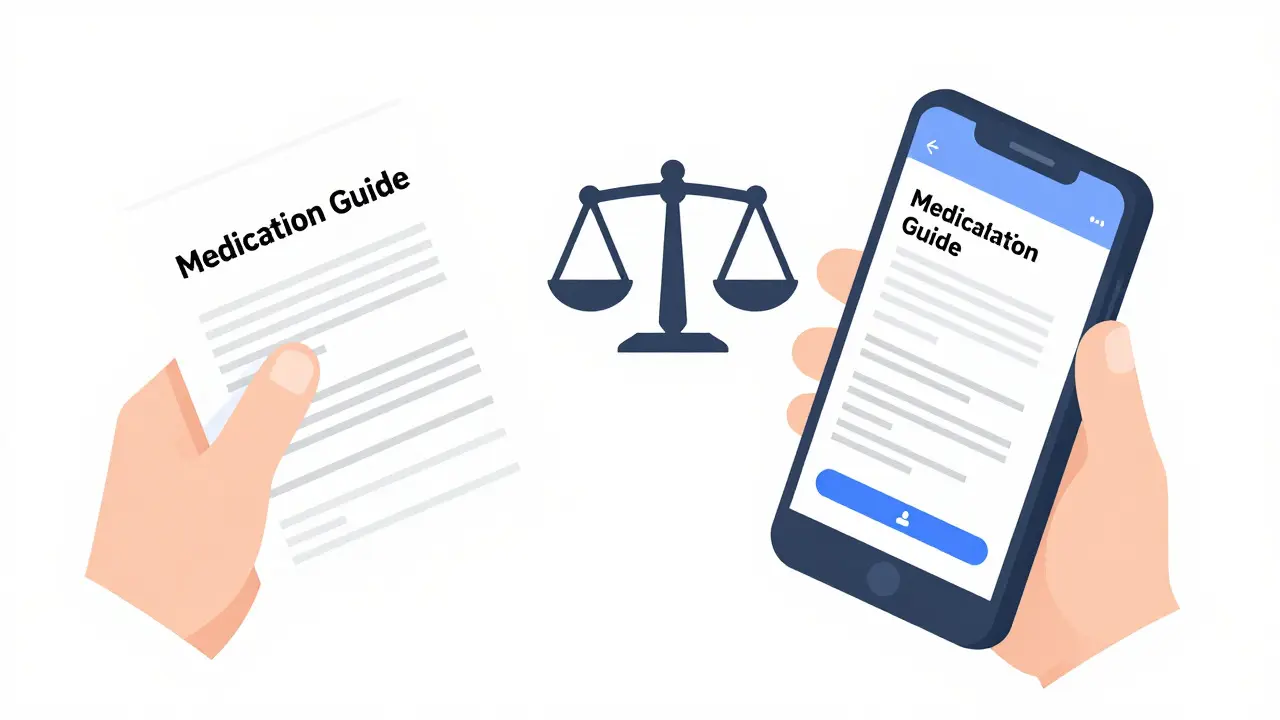
According to updated regulations, pharmacies must dispense the guide in paper form *unless* you request electronic delivery. This means:
- If you want paper: The pharmacist must hand it to you. They cannot make you dig for it or ask for it repeatedly.
- If you prefer digital: You can explicitly request an email or link to the PDF instead. Pharmacists cannot force you to accept the paper copy if you’ve opted for digital.
This flexibility is great for reducing waste, but it puts the ball in your court. If you don’t say anything, most pharmacies will default to printing it to stay compliant. Don’t assume they’ll remember to send the email unless you specify it clearly during checkout.
| Feature | Paper Copy | Electronic Delivery |
|---|---|---|
| Default Option | Yes (unless requested otherwise) | No (must be requested by patient) |
| Accessibility | Immediate physical possession | Depends on device/internet access |
| Environmental Impact | Higher (paper waste) | Lower (digital only) |
| Compliance Risk for Pharmacy | Low (easy to verify) | Moderate (requires tracking proof of receipt) |
What If They Forget? Know the Gaps
Let’s be real: pharmacies are busy. A 2022 audit by the Department of Health and Human Services Office of Inspector General found that 31% of inspected pharmacy sites had inadequate systems for tracking whether they actually gave out these guides. Community pharmacies averaged nearly three compliance deficiencies per site.
Why does this happen? It takes pharmacists about 15-20 seconds per prescription to verify and distribute the guide. During peak hours, that time gets squeezed. A survey in Pharmacy Times showed that while 52% of patients found the guides helpful, many others ignored them due to small font or repetitive info. But ignoring them doesn't mean they aren't important.
Dr. Janet Woodcock, former FDA Director, noted that these guides have "prevented countless adverse events." Yet, a National Consumers League survey revealed that 43% of patients reported *never* receiving one when they should have. That’s a huge gap between what the law says and what happens at the counter.
How to Request Your Guide Effectively
You don't need to be a lawyer to enforce your rights. Just be direct. Here is a practical script:
"Hi, I’m picking up [Drug Name]. Does this medication require a Medication Guide? If so, I’d like to receive it [in paper / via email] today."
If they say they don’t have it, ask if they can print it on demand. Under 21 CFR §208.24(b), manufacturers must provide pharmacies with the means to produce these guides in sufficient numbers. Most major chains (CVS, Walgreens, Rite Aid) have electronic systems installed since around 2015-2017. Independent pharmacies might rely on direct shipments, but they still must have a way to get it to you.
If a pharmacy consistently fails to provide required guides, consider switching providers. Consistent non-compliance suggests broader operational issues that could affect your safety.
The Future: Patient Medication Information (PMI)
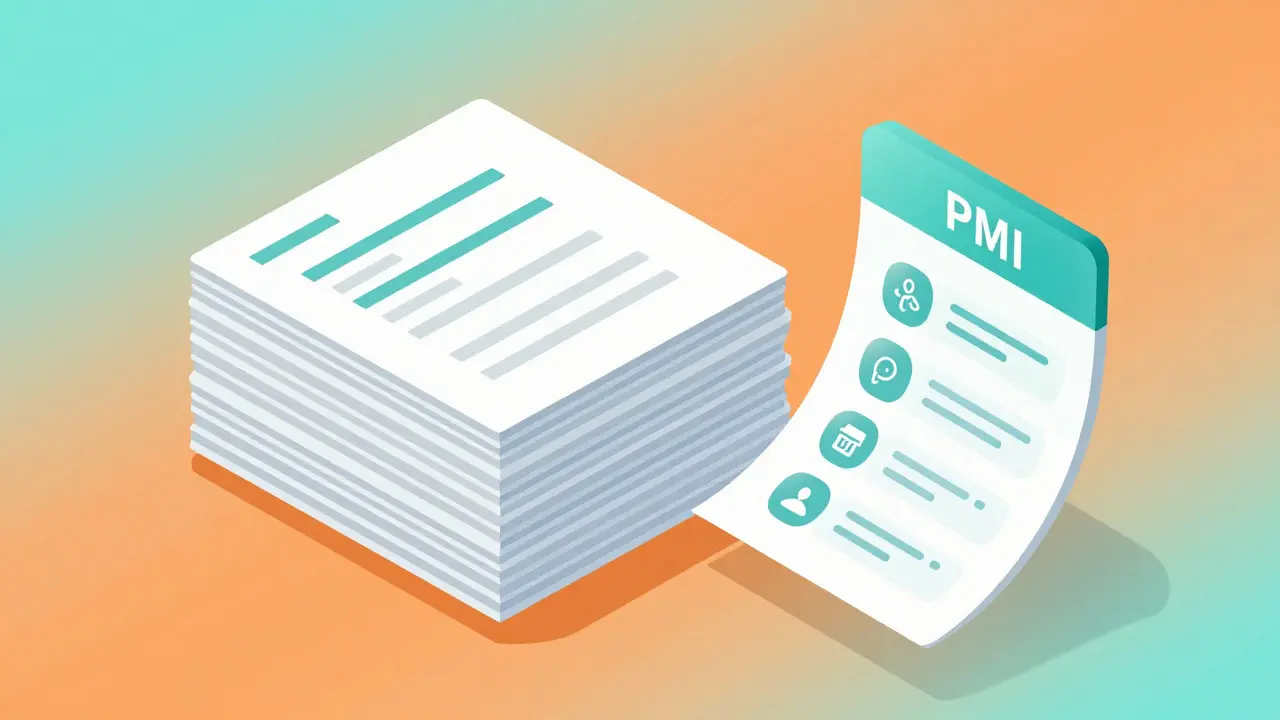
The current system is changing. The FDA is moving toward replacing traditional Medication Guides with Patient Medication Information (PMI), a standardized single-page document. This transition aims to fix complaints about inconsistent formatting and overly technical language.
Current guides often read at an 11th-grade level or higher, making them hard for many patients to understand. The new PMI format, expected to roll out fully by 2027, uses prototypes tested to improve comprehension by 37%. While the old 21 CFR Part 208 rules will eventually be withdrawn, until then, the current requirements stand. Keep asking for your guide now, even as the industry prepares for this shift.
Common Questions About Medication Guides
Is a Medication Guide the same as a package insert?
No. A package insert (or prescribing information) is written for healthcare professionals and contains dense medical data. A Medication Guide is written for patients in plain language and focuses on safety risks and usage instructions critical for your daily life.
Can I refuse to take a Medication Guide?
You can refuse the paper copy if you choose electronic delivery, but you cannot opt out of receiving the information entirely if the drug requires it. The pharmacy must ensure you acknowledge receipt, either physically or digitally, to remain compliant with FDA regulations.
Why do some drugs need these guides and others don't?
The FDA mandates them only for drugs that pose serious public health concerns, have significant risks relative to benefits, or require strict adherence to be effective. Common examples include blood thinners, certain antidepressants, and powerful acne medications like isotretinoin.
What if the pharmacy says their printer is broken?
They must still provide the information. If they cannot print it, they should offer an immediate electronic version or contact another location to bring one over. "Printer broken" is not a valid excuse to withhold legally required safety information indefinitely.
Will the new PMI replace my current Medication Guide immediately?
Not yet. The transition to Patient Medication Information (PMI) is scheduled to complete by 2027. Until then, the current Medication Guide regulations (21 CFR Part 208) remain in effect, and pharmacies must continue distributing the existing approved guides.