Stevens-Johnson Syndrome (SJS) and Toxic Epidermal Necrolysis (TEN) aren’t just rare skin conditions-they’re life-threatening emergencies triggered by your own medicine. Imagine waking up with a fever, a sore throat, and a few red spots on your chest. Within days, those spots turn into blisters. Your skin starts peeling off in sheets. Your eyes burn. Your mouth feels like it’s on fire. You’re not sick with the flu-you’re having a catastrophic reaction to a drug you took just weeks ago. This is SJS and TEN. And they’re more common than you think.
What’s the difference between SJS and TEN?
They’re not two separate diseases. They’re two ends of the same spectrum. Think of it like a scale of skin damage. SJS is when less than 10% of your skin detaches. TEN is when more than 30% does. Between them? A messy middle zone called SJS-TEN overlap, where 10-30% of skin peels off. The more skin that comes off, the higher your chance of dying. TEN kills about 25% of people who get it. SJS kills 5-15%. That’s not a small risk-it’s a medical emergency.
The names come from doctors who first described them. Stevens and Johnson reported two boys with blistering skin and mouth sores back in 1922. Lyell, in 1956, documented the worst cases-people losing almost their entire skin surface. Today, we know it’s all the same disease, just different in severity.
How do you get it?
Nearly 80% of cases are caused by medication. The rest? Sometimes infections like Mycoplasma pneumoniae. But drugs are the main culprit.
Here are the top offenders:
- Antiepileptics like carbamazepine, phenytoin, and lamotrigine-responsible for about 30% of cases
- Sulfonamide antibiotics like Bactrim (trimethoprim-sulfamethoxazole)-20%
- Allopurinol (used for gout)-15%
- NSAIDs like ibuprofen and naproxen, especially when taken long-term
- Nevirapine (an HIV drug)
But here’s the scary part: it’s not just about the drug. It’s about your genes.
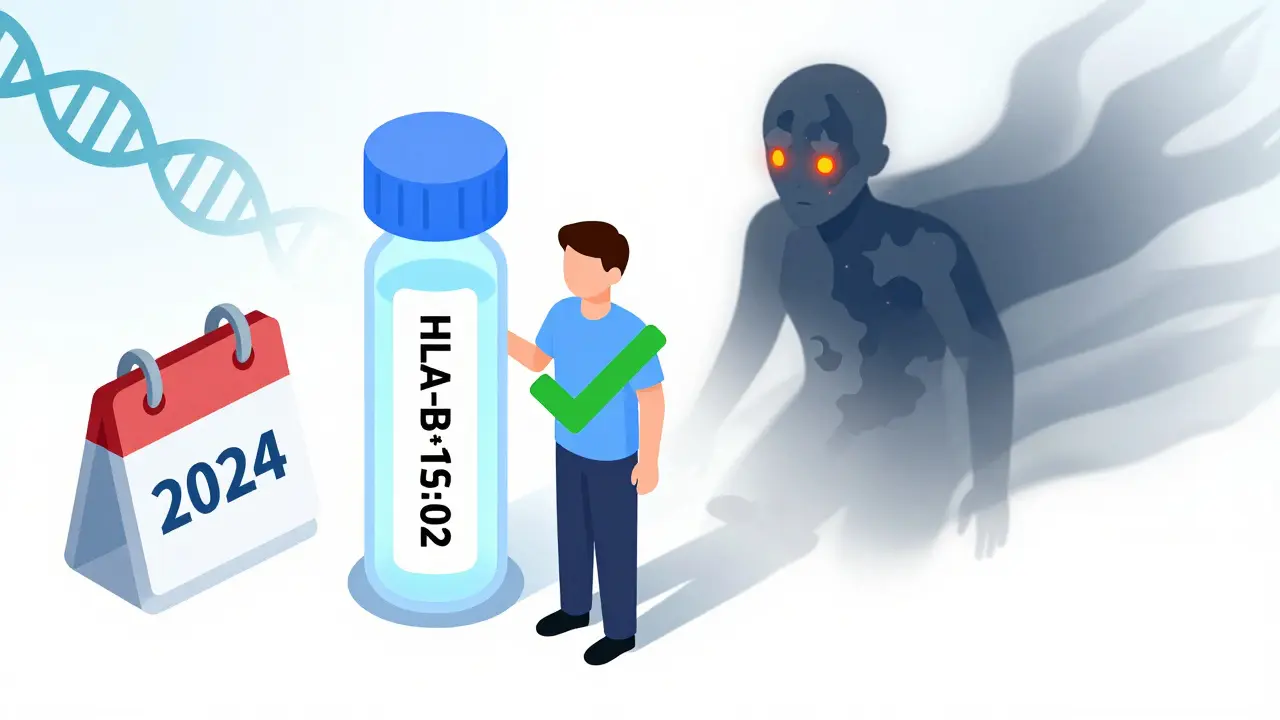
If you carry the HLA-B*15:02 gene variant, taking carbamazepine increases your risk of SJS/TEN by 1,000 times. That’s not a typo. In people of Southeast Asian descent, this gene is common. That’s why countries like Taiwan now require genetic testing before prescribing carbamazepine. Since 2007, they’ve cut SJS/TEN cases by 80%.
For allopurinol, the HLA-B*58:01 gene raises your risk 80 to 580 times. The FDA approved a point-of-care test in 2022 that gives results in four hours-not two weeks. If you’re on this drug, ask your doctor: have you tested for this gene?
What does it look and feel like?
It doesn’t start with a rash. It starts with a fever-often above 39°C (102°F)-along with a sore throat, cough, or eye pain. You might feel like you’re coming down with the flu. That lasts one to three days.
Then, the skin changes. Red or purple patches appear, usually on your chest or back. They’re flat at first, like bruises. Within 24 to 72 hours, they turn into blisters. These aren’t normal blisters. They’re flaccid-they collapse easily. And when you rub the skin? It peels off. That’s called the Nikolsky sign. It’s a red flag doctors look for.
Mucous membranes? Always affected. At least two. Often three or more. That means:
- 90% have mouth sores-so bad you can’t eat or drink
- 80% have eye damage-pain, swelling, pus, blurred vision
- 60% have genital ulcers
- Some lose their airway lining-leading to breathing failure
The skin peeling looks like a severe burn. But it’s not heat damage. It’s your immune system attacking your own skin cells. The body releases granulysin-a protein that literally kills skin cells from the inside out. The epidermis detaches from the dermis. You lose fluid. You get infected. You go into shock.
How is it diagnosed?
There’s no single blood test. Diagnosis is based on three things:
- Your history-what drugs did you take in the last 1-4 weeks?
- Your symptoms-fever, mucosal sores, skin peeling
- A skin biopsy-this is the gold standard
A biopsy shows full-thickness skin cell death with almost no inflammation. That’s different from staph infections (which affect children more) or other blistering diseases. If the biopsy doesn’t show this pattern, it’s probably not SJS/TEN.
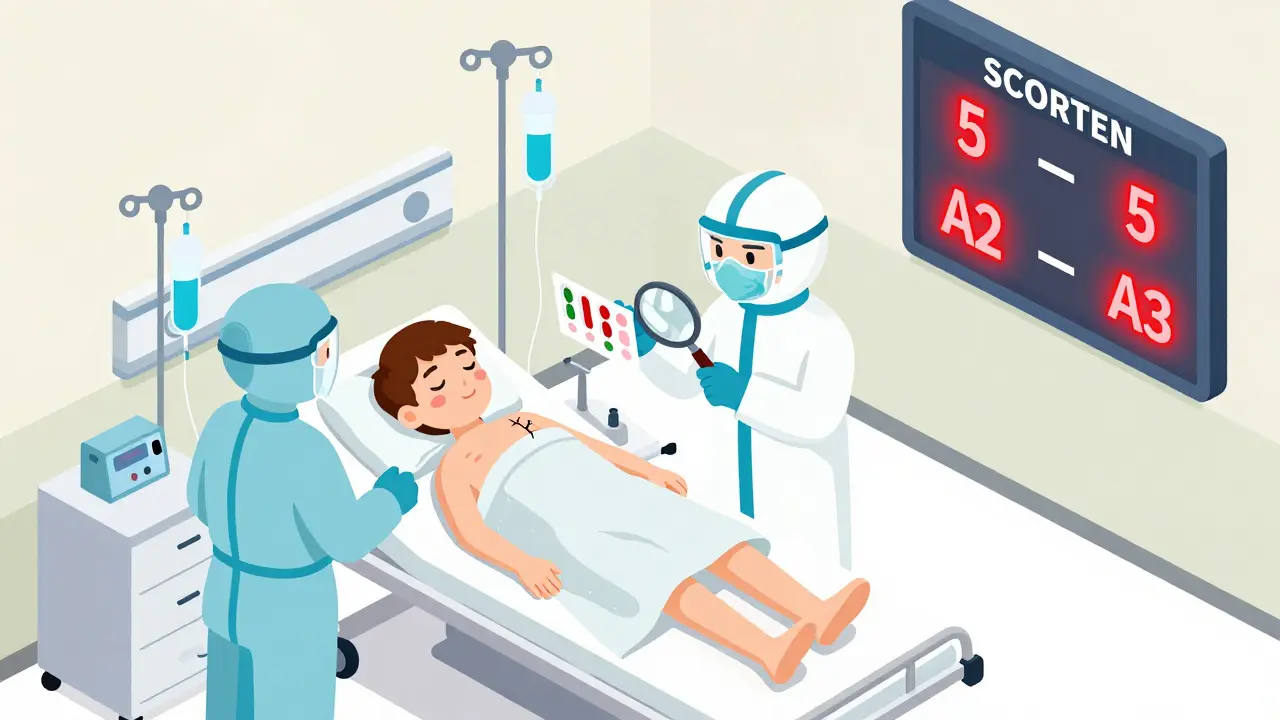
Doctors use the SCORTEN score to predict survival. It looks at seven things within the first 24 hours:
- Age over 40
- Cancer history
- Heart rate over 120
- More than 10% skin detachment
- Blood urea over 10 mmol/L
- Blood glucose over 14 mmol/L
- Bicarbonate under 20 mmol/L
Each point raises your death risk by 1.5 times. Three points? 35% chance of death. Five or more? Over 90%.
What happens in the hospital?
If you’re diagnosed, you’re going straight to a burn unit or ICU. This isn’t a dermatology ward. It’s critical care.
First step? Stop every non-essential drug. Even aspirin. Even your daily vitamin. You don’t know which one triggered it, so everything gets pulled.
Second? Fluid replacement. You’re losing as much fluid as someone with a 30% burn. You need 3-4 times your normal fluid intake. IV fluids. Electrolytes. Monitoring.
Third? Wound care. No adhesive bandages. No creams. Just sterile, non-stick dressings. Pain control is brutal. Many patients need morphine drips.
Eye care? Daily. A specialist checks for scarring, adhesions, corneal damage. Half of survivors end up with permanent vision problems.
What treatments actually work?
There’s no magic bullet. And many treatments people assume help… don’t.
IVIG (intravenous immunoglobulin) was once popular. It’s supposed to calm the immune system. But multiple large studies found it doesn’t improve survival. It’s expensive. It’s not recommended anymore.
Corticosteroids are controversial. They can suppress inflammation, but they also increase infection risk. Some doctors use high-dose methylprednisolone early on. Others avoid it completely.
Cyclosporine has better data. A 2016 trial showed it cut death rates from 33% to 12.5%. It blocks the T-cells that are killing your skin. It’s now a go-to option in many centers.
Etanercept is promising. It blocks TNF-alpha, a key inflammatory protein. A 2019 study treated 12 TEN patients with etanercept within 48 hours. Zero deaths. In the same time period, untreated patients had a 31% death rate. Larger trials are underway.
There’s no perfect treatment. But stopping the drug, supporting the body, and using cyclosporine or etanercept early gives you the best shot.
What happens after you survive?
Surviving doesn’t mean you’re back to normal. Sixty to eighty percent of survivors deal with long-term damage.
- Eyes: 50-80% have chronic dry eyes, light sensitivity, or scarring. Some go blind. Lifelong eye drops, surgeries, and specialist visits are common.
- Skin: 70% have patchy dark or light spots. 40% have scarring. 25% lose nails or grow them deformed.
- Genitals: 15% get urethral strictures. 10% get vaginal adhesions. Both need surgery.
- Mind: 40% develop PTSD. The pain, the isolation, the fear of dying-some never shake it.
Recovery takes months. Some people take years. You might need a feeding tube. A catheter. Physical therapy. Mental health support.
Can it be prevented?
Yes. And it’s getting easier.
Genetic testing is the biggest breakthrough. If you’re of Asian descent and your doctor wants to prescribe carbamazepine-ask for HLA-B*15:02 testing. If you’re on allopurinol-ask for HLA-B*58:01. These tests cost less than $200. They take hours. They can save your life.
Even if you don’t get tested, know the red flags: fever + rash + mouth sores after starting a new drug. Stop the drug. Go to the ER. Don’t wait. Don’t assume it’s just an allergy.
Pharmacies now have alerts. Some hospitals won’t dispense high-risk drugs without a genetic screen. This isn’t science fiction. It’s standard care in places like Taiwan, Singapore, and parts of the U.S.
What’s next?
Researchers are working on drugs that block granulysin-the actual killer protein in SJS/TEN. Phase II trials start in 2024. That could be the first treatment designed to stop the root cause.
Global registries like iSCAR are tracking over 1,200 cases to find new gene links. The goal? Predict risk before you even take the drug.
One thing’s clear: SJS and TEN aren’t just rare side effects. They’re preventable tragedies. And we now have the tools to stop them-before they start.