How many times have you laid in bed at night, wide awake, wondering why you can’t fall asleep-even though you’re exhausted? If you’ve had coffee after 3 p.m., that’s probably your answer. Caffeine doesn’t just give you a quick boost. It lingers in your system long after you’ve finished your cup, quietly sabotaging your sleep without you even realizing it.
Why Caffeine Keeps You Awake
Caffeine works by pretending to be adenosine, a chemical in your brain that tells you it’s time to sleep. When adenosine builds up during the day, it binds to receptors in your brain and makes you feel tired. But caffeine blocks those receptors. Your brain doesn’t get the signal to slow down. So even if you feel like you’re just “a little wired,” your body is actually fighting sleep on a chemical level.This isn’t just about feeling alert. Research from the American Academy of Sleep Medicine shows caffeine reduces total sleep time by about 45 minutes, cuts sleep efficiency by 7%, and adds 9 extra minutes to the time it takes you to fall asleep. That’s not a small tweak-it’s a major disruption to your rest cycle.
When Should You Stop Drinking Caffeine?
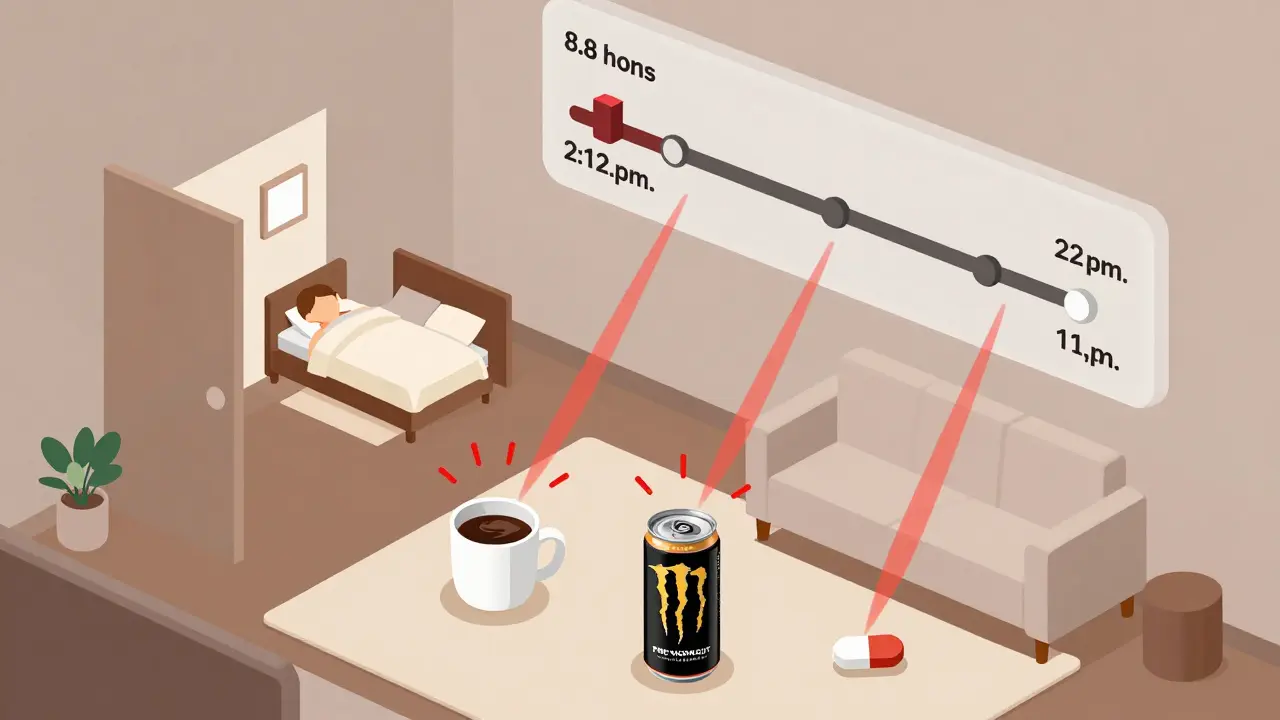
The old rule of thumb-“don’t have caffeine after 2 p.m.”-isn’t wrong, but it’s not precise enough. The real answer depends on how much caffeine you’re consuming and how your body processes it.For a standard 8-ounce cup of coffee (about 107 mg of caffeine), experts now recommend stopping at least 8.8 hours before bedtime. That means if you go to sleep at 11 p.m., your last cup should be no later than 2:12 p.m. This isn’t a guess. It’s based on a 2021 review of 24 studies published in Sleep Medicine Reviews, which analyzed real-world beverage amounts, not just lab doses.
But here’s where it gets tricky:
- A double espresso (126 mg) needs about 10.4 hours
- A 16-ounce energy drink (like Red Bull, 80 mg) still needs 8.8 hours
- A pre-workout supplement (up to 217.5 mg) requires a 13.2-hour cutoff
- Black tea? It’s lower in caffeine, and studies haven’t found a clear cutoff time-so it’s safer than coffee, but not risk-free
And don’t forget hidden sources. Excedrin has 65 mg per tablet. Some chocolate bars contain 20-30 mg. Even decaf coffee has 2-5 mg per cup-enough to matter if you’re sensitive.
Why the 6-Hour Rule Doesn’t Work
You’ve probably heard “cut off caffeine six hours before bed.” That idea came from a 2013 study where participants were given 400 mg of caffeine-about four cups of coffee-right before bedtime. The results showed clear sleep disruption. But that’s not how most people drink caffeine.Real people don’t chug four espressos at 5 p.m. They sip one cup at lunch, another at 3 p.m., and maybe a soda in the afternoon. The 2021 review corrected this by looking at typical daily intake patterns. It found that even moderate amounts-like one cup of coffee in the late afternoon-can still delay sleep onset and reduce deep sleep quality.
That’s why the Sleep Foundation updated its recommendation to 8 hours. And if you’re serious about sleep, 8.8 hours is the number backed by data.
Age and Genetics Matter More Than You Think
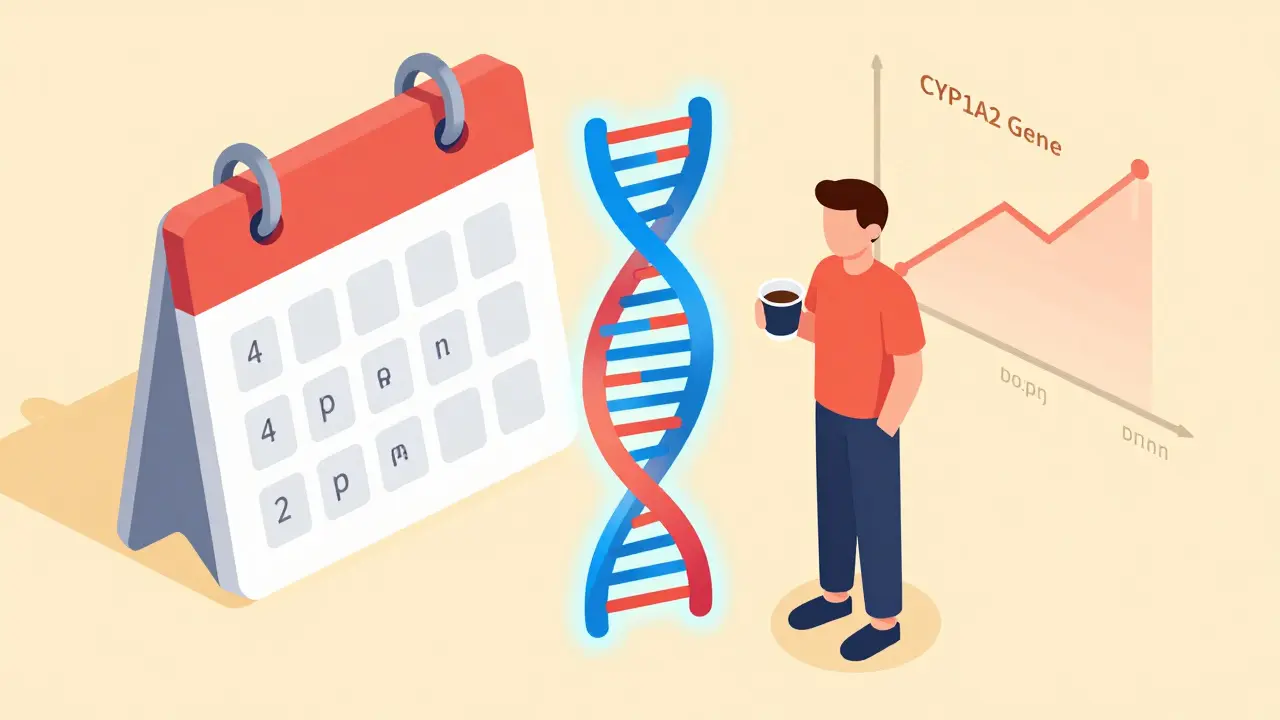
Not everyone metabolizes caffeine the same way. Your genes play a huge role. The CYP1A2 gene controls how fast your liver breaks down caffeine. Some people have a version that processes it quickly-caffeine clears out in 3-4 hours. Others are “slow metabolizers.” For them, caffeine can stay in the system for up to 12 hours.And it gets worse with age. A 2025 study in Nature Communications found that adults between 41 and 58 are significantly more sensitive to caffeine’s sleep-disrupting effects than people in their 20s. Your body changes. What worked at 25 might not work at 45.
So if you’ve been cutting off caffeine at 4 p.m. and still tossing and turning, you might be a slow metabolizer. The fix? Move your cutoff to 2 p.m. and see what happens.
What Happens If You Ignore the Cutoff?
It’s not just about taking longer to fall asleep. Caffeine doesn’t just delay sleep-it lowers its quality. A 2022 review in the American Journal of Managed Care found that 15 out of 18 studies showed caffeine reduced sleep efficiency. That means you’re spending more time awake in bed, even if you think you’re sleeping.Reddit users in r/sleep reported that 78% of people who drank coffee within 6 hours of bedtime struggled to fall asleep. And 63% said their sleep felt shallow or fragmented-even when they did manage to sleep.
One user, u/CaffeineStruggles, wrote: “I switched from my last coffee at 4 p.m. to 2 p.m. and gained almost an hour of sleep quality. It was eye-opening.”
That’s not anecdotal fluff. A 2022 analysis of 2,150 Sleepopolis users showed that those who stopped caffeine by 2 p.m. got 47 more minutes of sleep and 8% higher sleep efficiency than those who drank after 4 p.m.
How to Make It Stick
Changing your caffeine habits isn’t about willpower. It’s about systems.- Track your intake. Use an app like Caffeine Zone or MyFitnessPal to log every cup, soda, or pill. Most people underestimate their caffeine by 30-50%.
- Switch to half-caf after noon. Studies show this reduces sleep disruption by 32% compared to full-strength afternoon coffee.
- Try herbal tea or sparkling water. If you crave the ritual of an afternoon drink, swap coffee for chamomile, peppermint, or ginger tea.
- Use your smartwatch. Oura Ring and Fitbit now include personalized caffeine cutoff alerts based on your sleep patterns. Users who turned them on saw a 41% increase in engagement with their sleep goals.
- Test it for two weeks. Pick a date. Cut off caffeine at 2 p.m. every day. No exceptions. Track how you feel in the morning. You’ll know fast.
What About Decaf?
Decaf isn’t magic. A typical cup still has 2-5 mg of caffeine. For most people, that’s harmless. But if you’re a slow metabolizer, or you drink four cups a day, it adds up. If you’re still having trouble sleeping, try cutting decaf too for a week. See if it makes a difference.The Future of Personalized Cutoffs
Sleep science is moving fast. In 2024, researchers at Stanford used machine learning to predict optimal caffeine cutoff times with 89% accuracy-using your age, sleep history, and genetic data. Companies like 23andMe now offer caffeine metabolism reports as part of their health kits.The American Academy of Sleep Medicine plans to update its guidelines in 2025 to include beverage-specific cutoffs, not just vague advice like “avoid caffeine late in the day.” Starbucks even launched “Evening Brew,” a decaf blend designed for after-4 p.m. drinkers-and it captured 15% of that market in six months.
Soon, your smart home might adjust your lights and temperature automatically based on when you had your last cup of coffee.
Bottom Line: It’s Not About Cutting Out Coffee
You don’t need to quit caffeine. You just need to respect its timing. One cup of coffee at 10 a.m. won’t ruin your sleep. But that third cup at 4 p.m.? It’s stealing your rest.If you’re struggling to fall asleep, or you wake up tired even after 8 hours in bed, try this: stop caffeine at 2 p.m. for two weeks. No exceptions. Write down how you feel in the morning. You might be surprised.
Sleep isn’t about luck. It’s about chemistry. And caffeine? It’s a powerful drug. Treat it like one.
How long does caffeine stay in your system?
Caffeine has a half-life of 4-6 hours for most people, meaning half of it is cleared from your body in that time. But for slow metabolizers-due to genetics-it can take up to 12 hours. That’s why some people can drink coffee at 8 p.m. and sleep fine, while others can’t even have it at 2 p.m.
Is it okay to have caffeine after 4 p.m.?
For most people, no. Even a small amount of caffeine after 4 p.m. can delay sleep onset and reduce deep sleep. The 8.8-hour cutoff rule is based on real-world coffee consumption. If you go to bed at 11 p.m., your last cup should be no later than 2:12 p.m. If you’re sensitive or older, aim for 2 p.m.
Does decaf coffee affect sleep?
Decaf coffee still contains 2-5 mg of caffeine per cup. For most people, that’s not enough to disrupt sleep. But if you drink multiple cups in the afternoon, or you’re a slow metabolizer, it can add up. If you’re still having trouble sleeping, try cutting decaf for a week to test your sensitivity.
Can caffeine cause insomnia?
Caffeine doesn’t cause chronic insomnia on its own, but it can trigger or worsen it. If you’re regularly consuming caffeine too late in the day, your brain never gets the chance to fully shut down. Over time, this can train your body to associate bedtime with wakefulness. That’s when temporary sleep trouble becomes long-term insomnia.
What about energy drinks and pre-workout supplements?
These are the worst offenders. A single pre-workout can contain over 200 mg of caffeine-nearly double a cup of coffee. That requires a 13.2-hour cutoff. If you take one at 3 p.m. and go to bed at 11 p.m., you’re still half the caffeine in your system. Avoid them after noon if sleep is a priority.
Should I stop caffeine completely to sleep better?
No. You don’t need to quit. You just need to time it right. Most people can enjoy caffeine in the morning without any sleep issues. The problem isn’t caffeine-it’s the timing. Moving your last cup to before 2 p.m. will fix most sleep problems without requiring you to give up your favorite drink.
How can I tell if I’m a slow caffeine metabolizer?
If you’ve tried cutting caffeine at 2 p.m. and still can’t sleep, you might be a slow metabolizer. Other signs: feeling jittery after one cup, heart racing after coffee, or sleep disruption even with morning caffeine. Genetic tests from 23andMe or AncestryHealth can confirm your CYP1A2 gene type. But you can also test it yourself: try a strict 8-hour cutoff for two weeks. If sleep improves, you’re likely sensitive.
Does caffeine affect REM sleep?
Caffeine affects both NREM and REM sleep, but studies show its impact is stronger in NREM-the deeper, restorative stage. A 2025 Nature Communications study found caffeine increases brain activity during NREM, making it harder for your brain to enter restful states. REM sleep is less affected, but overall sleep quality still drops because you’re not getting enough deep sleep.
Tim Goodfellow
December 19, 2025 AT 06:48Okay but let’s be real - caffeine isn’t the villain, it’s the misunderstood roommate who won’t leave after the party. I used to drink espresso at 5 p.m. and sleep like a log. Then I turned 37. Suddenly my body’s like ‘lol nope’ and my sleep tracker screams in binary. Science didn’t change. My liver did. That’s the real plot twist.
Jedidiah Massey
December 21, 2025 AT 05:38Let’s not conflate pharmacokinetics with lifestyle theater. The 8.8-hour rule is statistically significant in population-level RCTs, but individual CYP1A2 phenotyping remains underutilized in clinical practice. Also - if you’re still drinking coffee after noon, you’re not optimizing your circadian architecture. You’re just addicted to ritual. 😅
Alex Curran
December 22, 2025 AT 15:01Been tracking my caffeine with Oura for 18 months. My cutoff used to be 3pm. Now it’s 1:30pm. Sleep efficiency jumped from 79% to 89%. No magic. Just data. And yeah decaf still messes with me if I drink 3 cups. Weird but true. Try it. You’ll thank me later.
Takeysha Turnquest
December 23, 2025 AT 12:12We think we’re drinking coffee to wake up
But really we’re drinking it to outrun the quiet
The silence that whispers you’re not enough
That you’re running on fumes and caffeine and borrowed time
And maybe sleep isn’t the enemy
Maybe it’s the only thing that remembers who you are
Kelly Mulder
December 24, 2025 AT 19:44As a board-certified sleep specialist with a PhD in neuropharmacology from Johns Hopkins, I must emphasize that the 8.8-hour cutoff is not merely recommended - it is the *only* empirically validated threshold for individuals with normal CYP1A2 expression. Anyone advocating for a 6-hour window is either misinformed or promoting pseudoscience. Furthermore, the mention of ‘decaf’ as a viable alternative is statistically negligent. Even 2mg can elevate plasma cortisol in sensitive phenotypes. This article is a start - but lacks the rigor required for clinical translation.
Lynsey Tyson
December 25, 2025 AT 08:22My mom drinks coffee at 7pm and sleeps like a baby. I can’t even have tea after 2pm. So I stopped judging. Maybe the real lesson isn’t when to stop - it’s to stop assuming everyone’s body works like yours. I just swap to sparkling water now. No drama. No guilt. Just peace.
Allison Pannabekcer
December 26, 2025 AT 15:15For anyone feeling overwhelmed by this - you’re not broken. Your body isn’t failing you. It’s just telling you it’s changed. I used to pride myself on being the ‘coffee queen’ until my 40th birthday hit and suddenly I was waking up at 3am like a startled owl. I tried the 2pm cutoff. Didn’t quit. Didn’t hate it. Just moved my cup. And now I sleep like I’m 22 again. No supplements. No apps. Just a little respect for your own biology. You deserve that.
Sarah McQuillan
December 28, 2025 AT 08:15Look I’m American and I’ve been drinking coffee since I was 12. We don’t bow to European sleep nazis who think 2pm is some sacred hour. My grandpa drank coffee at midnight and lived to 98. Sleep science is a fad. You’re not a lab rat. Drink when you want. Stop letting algorithms tell you how to live. Also - decaf is for cowards.
Emily P
December 29, 2025 AT 14:36Just curious - has anyone tracked their sleep after cutting decaf too? I’ve been doing the 2pm rule for months but still wake up tired. Maybe it’s the decaf…?
Edington Renwick
December 30, 2025 AT 10:00You people are missing the point. The real issue isn’t caffeine. It’s that we’ve normalized self-sabotage as ‘self-care.’ We think we’re being productive by drinking coffee at 4pm. We’re not. We’re just addicted to the illusion of control. And if you’re still drinking espresso after lunch? You’re not a coffee lover. You’re a slave to dopamine. Wake up.