Risk-Benefit Calculator: Understand Your Drug Label
This calculator helps you understand the difference between relative and absolute risk reduction, as explained in FDA drug labels. For example, "reduces risk by 30%" doesn't tell you the actual risk without knowing the baseline risk.
The FDA requires drugs to have a benefit-risk balance, but many patients don't understand how to interpret these statements. This tool shows you the real-world impact of medication benefits and risks.
Calculate Relative Risk Reduction
Your Results
When you pick up a new prescription, the tiny print in the drug pamphlet isn’t just filler. It’s your legal right to know what you’re signing up for - the good, the bad, and the uncertain. But most patients don’t understand it. That’s not because they’re not smart. It’s because the FDA drug labels were written for regulators, not people.
What FDA Risk-Benefit Statements Actually Mean
The U.S. Food and Drug Administration doesn’t just approve drugs because they "work." They approve them only if the benefits clearly outweigh the risks. That’s the core of every risk-benefit statement in an FDA-approved label. But what does "outweigh" really mean? It’s not a math equation. It’s a judgment call - based on data, but shaped by real-world experience. For example, a cancer drug might extend life by three months but cause severe nausea, nerve damage, and a 15% chance of hospitalization. Is that worth it? For some patients, yes. For others, no. The FDA looks at the whole group - not just you. But your doctor and you need to decide for you. The FDA’s official framework, updated in December 2021, asks reviewers to answer four big questions: What’s the condition? What treatments already exist? What benefits does this drug offer? What risks does it carry? And how can we manage those risks? That’s the full picture. But only a fraction of it ends up in the patient label.Where to Find the Real Information in the Label
You won’t find the full benefit-risk analysis on the first page. It’s buried. Here’s where to look:- Section 5 - Contraindications: What situations make this drug dangerous? (Like if you have kidney failure or are pregnant.)
- Section 6 - Adverse Reactions: What side effects happened in clinical trials? And how often? Look for numbers - "1 in 10" or "less than 1%" - not just "may cause headache."
- Section 8 - Use in Specific Populations: How does this drug affect seniors, kids, or people with other diseases?
- Section 14 - Clinical Studies: This is where the real data lives. Did the drug improve survival? Reduce hospital visits? Lower blood pressure? Look for percentages and comparisons to placebo or other drugs.
- Highlights Section: The FDA now requires a brief summary here. It’s the closest thing to a patient-friendly overview.
Take Jardiance, a diabetes drug. Its label says: "In adults with type 2 diabetes and heart disease, JARDIANCE reduced the risk of cardiovascular death by 38% (10.5% with placebo vs. 6.5% with JARDIANCE)." That’s clear. It tells you exactly how many people out of 100 had a heart attack or died - and how many fewer did with the drug. That’s the gold standard.
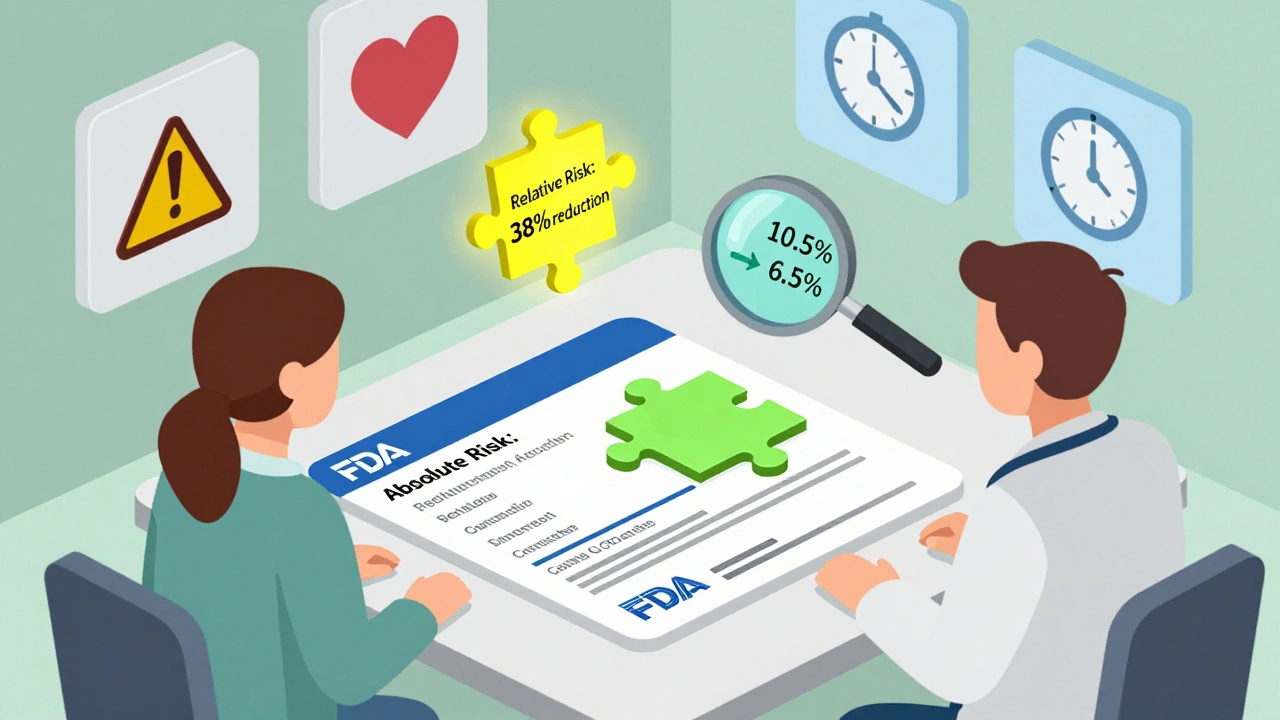
Why Most Labels Still Feel Like a Puzzle
Here’s the problem: most labels still use vague language. "May cause dizziness." "Rarely associated with liver injury." "Possible risk of depression." These phrases mean nothing to someone without a medical degree. A 2022 survey found only 22% of patients felt "very confident" in understanding their drug’s risks and benefits. For people with low health literacy? That number dropped to 9%. And it’s not just confusing wording. It’s missing context. A drug might reduce your risk of stroke by "20%." Sounds good, right? But if your baseline risk was 1%, that means the drug lowers it to 0.8%. That’s not a big win - but it sounds like one. Dr. Thomas Fleming from the University of Washington calls this "relative risk manipulation." It’s a common trick in drug marketing. The FDA knows it. But they haven’t fixed it yet.What’s Changing - And What’s Not
The FDA has started trying. In 2023, they launched a pilot program requiring six new cancer drugs to include a "Patient Benefit-Risk Summary" written at a sixth-grade reading level. That’s a huge shift. They’re also testing simple icons - like a thumbs-up for benefit, a warning sign for risk - to show the balance visually. But adoption is slow. Only 17% of new drugs approved in 2022 had any visual aid in their labels. Most still rely on dense paragraphs. Why? Because writing clear, honest, patient-friendly summaries takes time. FDA reviewers spend 40 to 60 hours per drug just on this part. And many drug companies still push for language that makes their product look better. The European Medicines Agency (EMA) does it differently. They use a more structured, numbers-heavy approach. During the pandemic, their vaccine labels clearly showed: "For every 1 million people vaccinated, 1 to 2 may develop a rare blood clot, but 10,000 lives may be saved." That kind of clarity helped people make informed choices. The FDA is watching - but they’re hesitant to copy it exactly.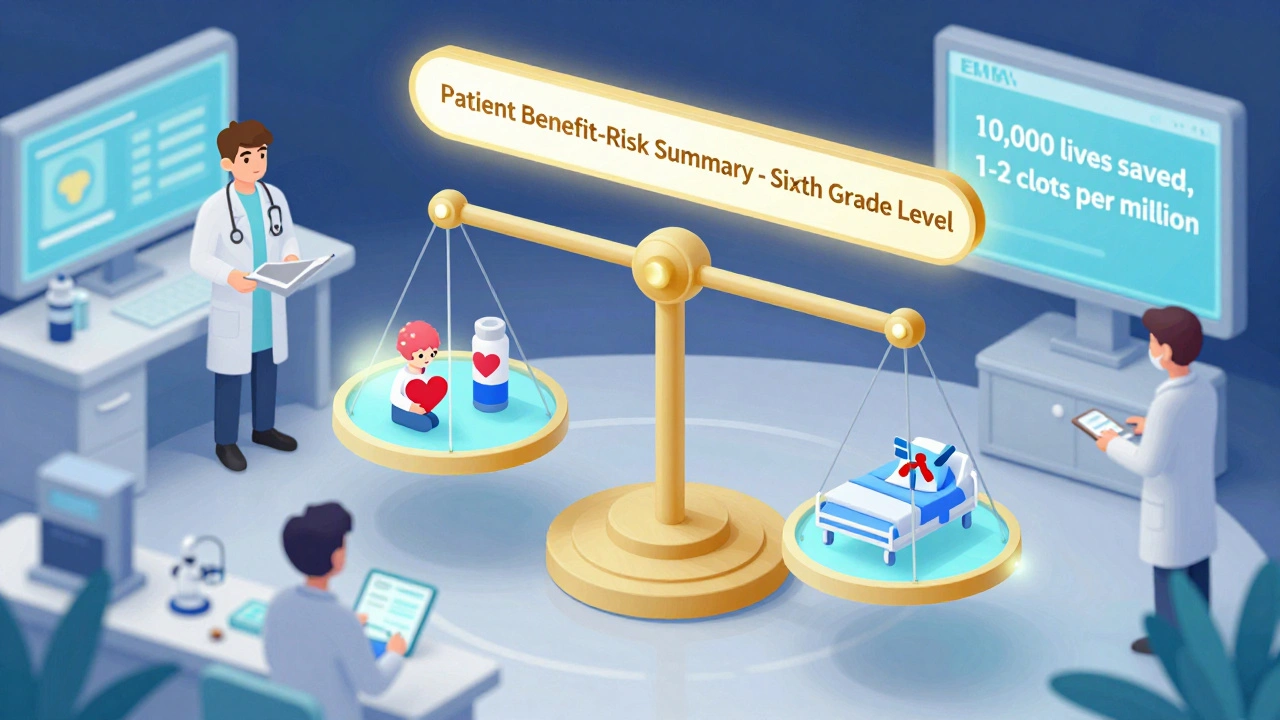
What Patients Can Do Right Now
You don’t have to wait for the FDA to fix everything. Here’s how to read your label like a pro:- Find the numbers. Look for percentages, ratios, and comparisons. "Reduced risk by 30%" means nothing without the baseline. Ask: "What was the chance before?"
- Compare to alternatives. Is this drug better than the one you’re on? Or cheaper? Or safer? The label may not say - but your pharmacist can help.
- Ask about absolute risk. Don’t settle for "reduces risk." Ask: "Out of 100 people like me, how many will avoid this problem?"
- Check the timing. Does the benefit take months to show? Are the side effects immediate? That matters for your daily life.
- Use the FDA website. Go to [email protected]. Search your drug. You’ll find the full prescribing information - including the clinical trial results the label summarizes.
One patient on Reddit said it best: "I spent three hours reading my label. I still didn’t know if I should take it. Then I asked my doctor: ‘If this were your mom, would you take it?’ She said yes. That’s all I needed."
The Future: More Transparency, Less Jargon
The FDA’s 2023-2025 plan says they want to require visual benefit-risk summaries for all breakthrough drugs by 2025. That’s promising. And with patient advocacy groups pushing harder than ever, change is coming. But until then, you’re the most important person in the room. Your doctor has the data. The FDA has the rules. But only you know what matters to your life - your pain, your fears, your goals. Don’t be afraid to say: "I don’t understand this. Can you explain it to me like I’m 12?" That’s not weakness. It’s your right.What’s the difference between relative risk and absolute risk in FDA labels?
Relative risk sounds impressive - "reduces risk by 50%" - but it doesn’t tell you how big the original risk was. Absolute risk tells you the real numbers: "Out of 100 people, 6 had a heart attack without the drug. With the drug, 3 did." That’s a 3% reduction. That’s the truth. Always ask for absolute risk.
Why do some drug labels say "serious side effects may occur" without saying how often?
It’s often because the side effect was rare in trials - maybe only 1 or 2 people out of 500. But the FDA requires it to be mentioned anyway, even if it’s unlikely. That doesn’t mean it’s common. If you see "may occur," look for a percentage nearby. If there isn’t one, ask your doctor for the trial data.
Can I trust the FDA’s benefit-risk assessment?
Yes - but understand what it means. The FDA assesses the drug for the average patient in clinical trials. Your individual risk might be higher or lower based on your age, other conditions, or genetics. The FDA’s decision says: "For most people, benefits outweigh risks." It doesn’t say: "This is safe for everyone." Always talk to your doctor about your personal situation.
Are there drugs where the risks clearly outweigh the benefits?
Yes - and the FDA pulls them off the market. In 2022, the FDA withdrew approval for a painkiller because it caused fatal liver damage in 1 in 200 users - and better alternatives existed. The benefit-risk balance had shifted. That’s why the FDA keeps reviewing drugs after approval. If new data shows risks are worse than thought, they act.
How can I find patient-friendly summaries of my drug?
Start at [email protected] for the official label. Then check the National Library of Medicine’s DailyMed website - it’s easier to read. Some patient advocacy groups, like the American Heart Association or the American Diabetes Association, also offer simplified guides for common drugs. And always ask your pharmacist - they’re trained to translate medical jargon into plain language.
Chase Brittingham
December 5, 2025 AT 09:36Been reading drug labels for years after my dad had a bad reaction to a med that said 'rare side effects.' Turns out it happened to 1 in 12 people like him. I always ask my pharmacist: 'What’s the real number?' They appreciate it. Most don’t even know Section 14 exists.
Chad Handy
December 5, 2025 AT 09:53Let’s be real - the FDA doesn’t care about patients. They’re a rubber stamp for Big Pharma. The entire system is designed to get drugs to market fast, then deal with the fallout later. I’ve seen it. My cousin got hospitalized because the label said 'possible liver injury' - no numbers, no context. That’s not transparency, that’s legal CYA. And now they want to add icons? Like we’re toddlers? The data’s already there - buried under 200 pages of legalese. Fix the structure, not the font size. They’ve had 15 years to fix this. They didn’t. They won’t.
Scott van Haastrecht
December 6, 2025 AT 11:01Oh here we go again. Another 'patient empowerment' article written by someone who thinks reading a label is the same as understanding pharmacokinetics. The FDA isn’t the enemy - the people who think they can 'read between the lines' of a 50-page prescribing info doc are. Most patients can’t even spell 'contraindication.' You want transparency? Fine. Then make the label 10 pages long and force doctors to explain it in person. But don’t pretend that handing a patient a pamphlet with '38% reduced risk' means they understand anything. They don’t. And pretending they do is dangerous.
Jenny Rogers
December 8, 2025 AT 01:10The fundamental failure lies not in the language of the label, but in the epistemological dissonance between clinical trial data and lived human experience. The FDA operates within a positivist paradigm - quantifiable outcomes, statistical significance, p-values - while the patient navigates a phenomenological reality of fear, uncertainty, and embodied suffering. To reduce risk-benefit to percentages is to commit a category error. One cannot quantify the value of a morning without nausea, or the dignity of avoiding hospitalization. The solution is not more icons, but a hermeneutic shift: from data to meaning.
Rachel Bonaparte
December 8, 2025 AT 13:06Did you know that the FDA’s own internal documents from 2019 show they were warned by their own statisticians that 'relative risk reduction' language was misleading patients? But they didn’t act because drug companies threatened lawsuits. I’ve got screenshots. This isn’t negligence - it’s collusion. And now they want to slap a thumbs-up emoji on a drug that increases your chance of stroke by 0.0003%? Please. The EMA’s approach isn’t just better - it’s ethical. The FDA is broken because it’s bought. The only reason they’re testing visuals now is because of public pressure. They don’t care until it’s trending on Twitter.
jagdish kumar
December 9, 2025 AT 23:16Numbers lie. People don’t.
Michael Feldstein
December 11, 2025 AT 00:31Good breakdown. One thing I’d add - if you’re on a drug and the label says 'rare' side effect but you’re one of the few who got it, that’s not rare to you. Always bring up your personal experience with your doctor. They need to hear it. And don’t feel bad for asking the same question three times. Your life matters more than their schedule.
Benjamin Sedler
December 12, 2025 AT 10:26So the FDA’s gonna fix this by making labels easier to read? Cute. Meanwhile, the same people who wrote those labels are now writing AI chatbots to answer your questions. You think they’re gonna let you understand the truth? Nah. They want you to trust the algorithm. Next thing you know, your doctor’s just gonna say 'the app says take it.' And you’ll believe it because the emoji was green. This isn’t transparency - it’s distraction with better UI.
Bill Wolfe
December 13, 2025 AT 22:35Let’s be honest - most patients don’t want to understand risk-benefit. They want a magic pill. That’s why they don’t read the label. They Google 'does this drug make you fat?' and take it anyway. The FDA isn’t failing patients - patients are failing themselves. If you’re too lazy to look up Section 6, you deserve what you get. And no, I won’t feel bad for you when your liver fails. You had the information. You chose ignorance.
zac grant
December 14, 2025 AT 08:17Big picture: the real issue isn’t the label - it’s the lack of shared decision-making in primary care. Most docs spend 7 minutes per visit. They don’t have time to walk through Section 14. The solution isn’t simplifying the label - it’s funding better access to pharmacists and nurse practitioners who can do the deep dive. The FDA can’t fix broken healthcare delivery. But we can push for it. Ask your rep to fund community pharmacy programs. That’s real change.
michael booth
December 14, 2025 AT 08:53Transparency requires accountability. The FDA must mandate that all benefit-risk summaries include absolute risk numbers, baseline rates, and comparator group outcomes. Anything less is incomplete. This is not optional. It is a moral imperative. Patients are not data points. They are human beings entitled to full disclosure. The current system is inadequate. The time for incrementalism is over.
Augusta Barlow
December 16, 2025 AT 04:02Did you know that the FDA’s 2021 update was written by a former Pfizer lobbyist? And the 'Patient Benefit-Risk Summary' pilot? All six drugs were from companies that donated to the FDA’s advisory committee. This isn’t reform - it’s theater. They’re using 'patient-friendly' language to distract from the fact that they still approve drugs with known fatal risks. They’re selling hope as science. And you’re falling for it.
Joe Lam
December 16, 2025 AT 17:52Look. I’ve read the full prescribing info on 47 different drugs. I know where to look. But here’s the truth: most patients don’t care. They want the pill. The label is a legal shield, not a guide. The FDA knows this. That’s why they put the good stuff in Section 14 - where no one reads it. The only people who care are the ones who’ve been burned. Everyone else? They’ll take the pill, blame the doctor, and move on. This article? It’s preaching to the choir. And the choir’s too small to matter.