Living with a chronic disease doesn’t mean your life has to shrink. Many people with diabetes, arthritis, heart disease, or COPD find that their daily function - what they can do, how they feel, and how much control they have - improves dramatically when they use the right self-management tools. It’s not about fixing the disease. It’s about learning how to live better with it.
What Self-Management Really Means
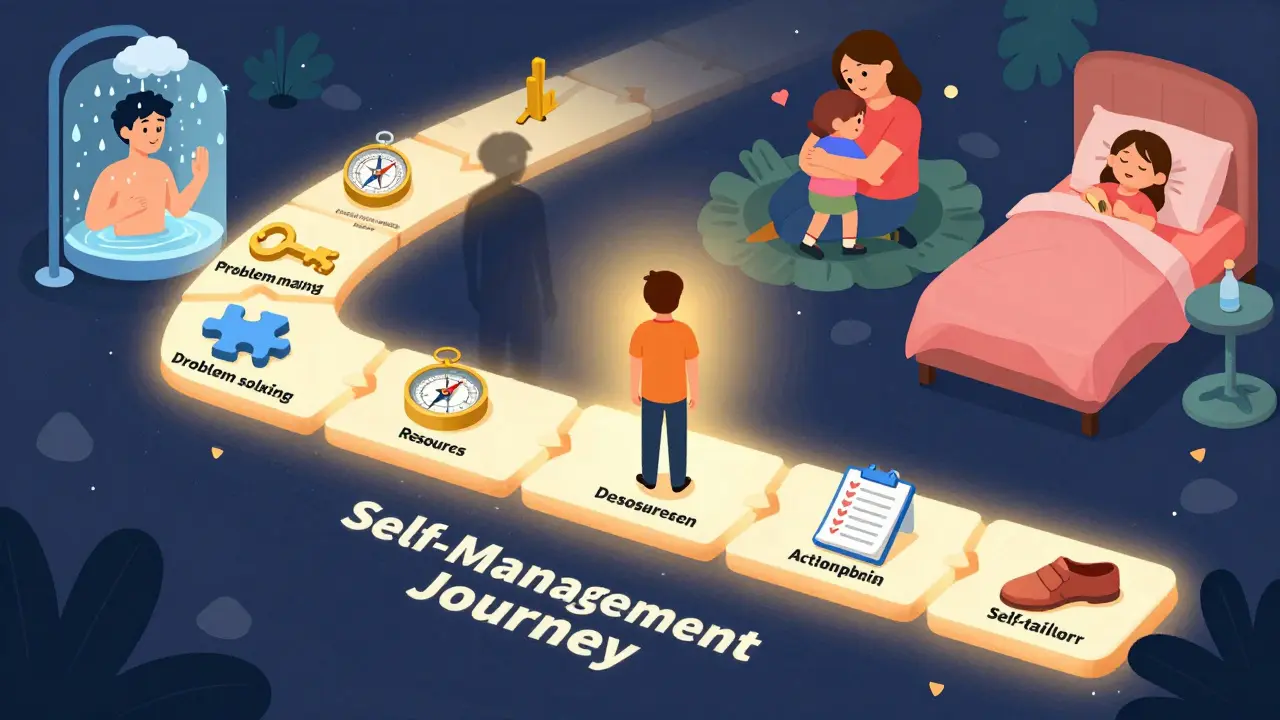
Self-management isn’t just taking your pills on time. It’s about building skills that help you handle the day-to-day challenges of living with a long-term condition. The Chronic Disease Self-Management Program (a structured, evidence-based program developed at Stanford University in the 1990s by Dr. Kate Lorig) was one of the first to prove this works. It doesn’t matter if you have asthma, depression, or arthritis - the same six core skills apply.These skills include:
- Problem solving - figuring out what’s stopping you from doing what you want to do
- Decision making - knowing when to act and when to ask for help
- Using resources - finding support, tools, or services that make life easier
- Working with your doctor - asking the right questions and speaking up about your needs
- Making action plans - setting small, doable goals instead of overwhelming yourself
- Self-tailoring - adjusting what works for someone else to fit your life
Studies show people who complete this program see real improvements: 23% better symptom management, more physical activity, and less emotional distress. These changes stick - a year later, most are still doing better than before they started.
The Two Main Ways to Learn: In-Person vs. Online
There are two main paths most people take: group workshops or digital programs.In-person workshops usually run for six weeks, with 2.5-hour sessions once a week. They’re led by trained peer leaders - people who also live with chronic conditions. This matters. You’re not just learning from a nurse or a doctor. You’re learning from someone who gets it. The program includes a 230-page workbook, videos, and group activities. Completion rates are high: 72% finish the full course. Why? Because the group keeps you accountable. You share your struggles, celebrate small wins, and realize you’re not alone.
Online programs like Better Choices, Better Health® (an asynchronous digital version of the CDSMP program requiring about two hours per week of online engagement) offer the same content but through a website. You log in 2-3 times a week, watch videos, read lessons, and join discussion boards. These are great for people who can’t leave home, live far from a clinic, or have unpredictable symptoms. But they’re harder to stick with - only 58% complete them. Without face-to-face support, motivation drops.
Here’s what the data shows:
| Feature | In-Person CDSMP | Online CDSMP (e.g., Better Choices, Better Health®) |
|---|---|---|
| Completion Rate | 72% | 58% |
| Time per Week | 2.5 hours | 2 hours |
| Peer Support | Yes - live group | Yes - online forums |
| Rural Accessibility | Low | High - 37% more reach |
| Medication Adherence | Higher - 22% better than online | Lower |
One rural health center in Illinois saw hospital visits drop by 28% in COPD patients using their adapted CDSMP program. The same patients in standard care only saw a 9% drop. That’s not luck. That’s skill-building.
What Digital Tools Are Adding Now
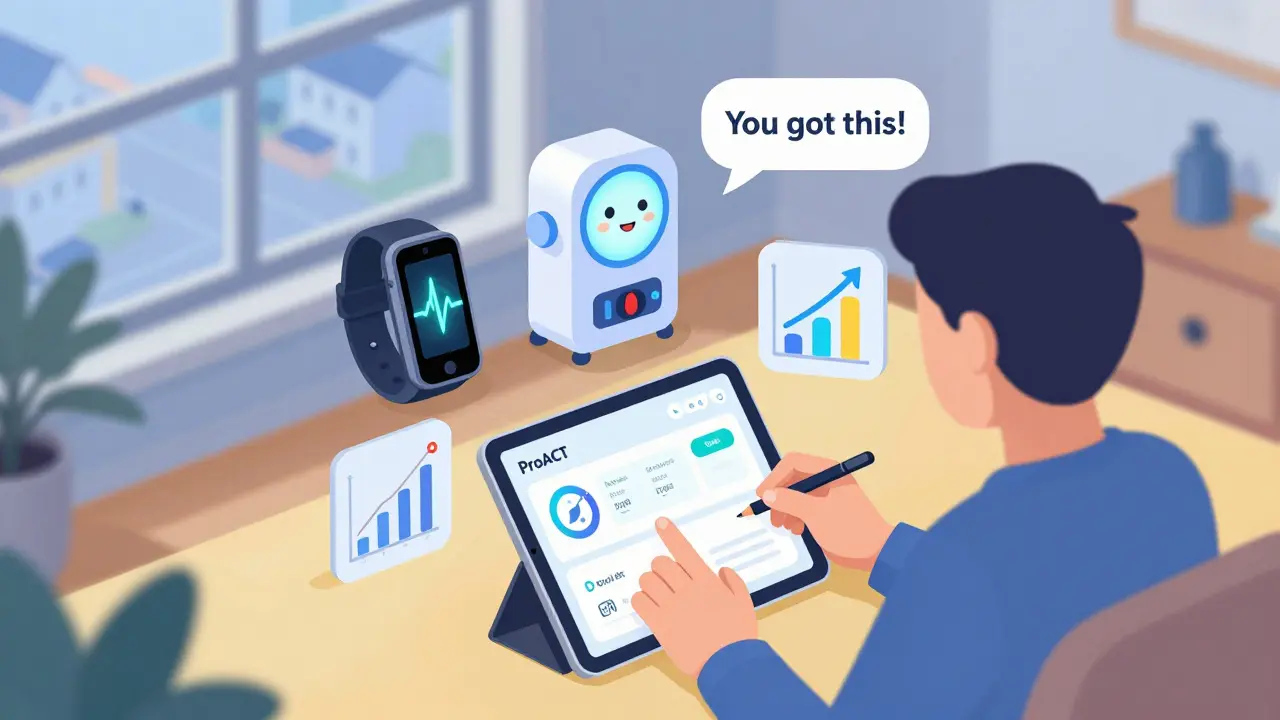
New tools are stepping in where traditional programs fall short.ProACT (a digital health platform with mobile apps, clinician dashboards, and IoT integration for older adults with multiple chronic conditions) connects your wearable devices, medication reminders, and symptom logs to your care team. In a 12-month trial, users improved their self-management behaviors by 28%. It’s not just tracking - it’s acting. If your heart rate spikes or your blood sugar drops too low, the system alerts your doctor before you even realize something’s wrong.
Another innovation is Mun Health (an AI-powered digital companion that provides emotional support and culturally tailored guidance). Traditional programs mostly focus on physical symptoms. Mun Health talks about anxiety, loneliness, and burnout. Early pilot testing showed 85% user satisfaction. It even offers content in Spanish, Mandarin, and African American English - something most programs still don’t do.
But here’s the catch: 41% of people with chronic conditions struggle to understand basic health info. If a digital tool uses jargon or complex menus, it’s useless. That’s why programs like CDSMP keep their materials at a 6th-8th grade reading level. Simplicity works.
How to Get Started
You don’t need to overhaul your life overnight. Start small.Step 1: Assess where you are. What’s the one thing that makes your day hardest? Is it pain? Fatigue? Forgetting meds? Talking to your doctor? Pick one area to focus on.
Step 2: Set one tiny goal. Instead of “I’ll exercise more,” try “I’ll walk for 10 minutes after lunch three times this week.” Write it down. Use a notebook, a notes app, or a sticky note on your fridge.
Step 3: Use an action plan. The CDSMP workbook teaches a simple formula: “I will do X by Y time, and I’ll know I succeeded when Z happens.” Example: “I will take my blood pressure at 8 a.m. every Monday, Wednesday, and Friday, and I’ll know I succeeded if I log it in my app.”
Step 4: Find your support. Join a program. Talk to your doctor about referrals. Check if your Medicare or private insurance covers Diabetes Self-Management Training (DSMT) (a Medicare-covered service that saw 1.2 million beneficiaries in 2022). Many states offer free or low-cost workshops. In Australia, similar programs are available through local health networks.
Common Pitfalls - And How to Avoid Them
Not everyone succeeds. Here’s what usually goes wrong - and how to fix it.- Overwhelm. One participant said, “Checking my blood sugar, adjusting meds, and foot care felt impossible.” Solution: Do one thing at a time. Master walking before you tackle meal planning. Celebrate small wins.
- Inconsistent tracking. 45% of new users stop logging symptoms within a month. Solution: Tie tracking to something you already do - like brushing your teeth. “After I brush my teeth, I’ll check my blood pressure.” Habit stacking works.
- Medication confusion. 28% of users make errors adjusting meds without guidance. Solution: Ask for a “medication coach.” Some clinics offer this. Or use a pill organizer with alarms.
- Isolation. People with chronic illness often feel alone. Solution: Join a group - even online. One woman in North Dakota said, “Talking to others who get it made me feel human again.”
What Works for Real People
Reddit user r/ChronicIllness shared: “I started at 1,200 steps a day. After writing action plans in the CDSMP program, I hit 5,800 in eight weeks. My Fitbit didn’t lie.”The Oregon Health Authority found 87% of participants felt more confident managing their condition. That confidence doesn’t come from magic. It comes from knowing how to solve problems, one step at a time.
And it’s not just about health. It’s about dignity. The ability to shower without help. To go to a grandchild’s birthday. To sleep through the night. That’s what self-management gives back.
What’s Next for Self-Management
The future is personalized. Programs are moving beyond one-size-fits-all. AI tools will adapt to your mood, your pain levels, your cultural background. Medicare and other insurers are expanding coverage. By 2025, the CDC wants doctors to refer 40% more patients to self-management programs.But the biggest change? We’re starting to see self-management not as a side task - but as part of real care. Your doctor doesn’t just prescribe a pill. They connect you to a program. They ask: “What’s stopping you from doing what matters to you?”
That’s the shift. You’re not just a patient. You’re the CEO of your own health. And with the right tools, you’re not just surviving - you’re living.
Can I do self-management on my own without a program?
Yes, but structured programs work better. Studies show people who use evidence-based programs like CDSMP improve their symptom management by 23% compared to those who try alone. Programs give you proven tools, peer support, and accountability - things most people miss when going solo.
Are these programs free?
Many are. In the U.S., Medicare covers Diabetes Self-Management Training (DSMT), and most states offer free CDSMP workshops. Online versions like Better Choices, Better Health® are often free too. Check with your local health department, hospital, or Area Agency on Aging.
Do I need to be tech-savvy to use digital tools?
No. The best digital tools are designed for low-tech users. They use large buttons, simple language, and voice-guided steps. Programs like Mun Health and ProACT include tutorials and phone support. If you can send a text or use a video call, you can use them.
What if I have trouble understanding medical terms?
That’s normal. Most programs use materials written at a 6th-8th grade reading level. They avoid jargon. If you’re struggling, ask for plain-language guides or request help from a health educator. Many programs offer one-on-one coaching to explain complex info.
How long before I see results?
Most people notice small changes within 2-4 weeks - like sleeping better or feeling less anxious. Big changes - like walking farther or reducing doctor visits - usually take 8-12 weeks. The key is consistency, not speed. Even small daily actions add up.
Can I join if I have more than one chronic condition?
Yes - and you should. Programs like CDSMP and ProACT were designed for people with multiple conditions. In fact, 60% of U.S. adults with chronic diseases have two or more. The tools help you prioritize, simplify routines, and avoid conflicting advice.
Cory L
February 22, 2026 AT 03:09Emily Wolff
February 23, 2026 AT 09:11Jacob Carthy
February 23, 2026 AT 11:38Lisandra Lautert
February 24, 2026 AT 00:11Matthew Brooker
February 24, 2026 AT 00:20Bhaskar Anand
February 24, 2026 AT 06:26Anil bhardwaj
February 25, 2026 AT 10:39lela izzani
February 26, 2026 AT 22:01