Imagine picking up a new prescription. The pharmacist hands you the bottle with a quick nod. You glance at the label, see "Take 1 tab PO BID," and assume it means one tablet twice a day. It does. But what if you missed the part about taking it with food? Or what if "BID" looked like "QD" (once daily) because your eyes aren't what they used to be?
This isn't just a hypothetical scenario. It is a dangerous reality for millions of people. Every year, approximately 1.3 million emergency department visits in the United States are linked to medication errors, many stemming directly from patients misinterpreting their prescription labels. These aren't always mistakes made by doctors or pharmacists; often, the blame falls on confusing instructions that fail to account for how real people read and process information.
The stakes are incredibly high. According to the Agency for Healthcare Research and Quality, medication misuse causes between 2% and 11% of all hospital admissions, costing the healthcare system roughly $200 billion annually in avoidable expenses. The good news? Most of these errors are preventable. By understanding where labels go wrong and learning specific strategies to decode them, you can take control of your medication safety.
Why Do Prescription Labels Confuse Patients?
You might think reading a prescription label is simple. After all, it’s just a few lines of text. But research tells a different story. A landmark multi-site study by Davis et al. in 2006 revealed that 46% of primary care patients misunderstood at least one instruction on their prescription container. For those with marginal health literacy, that number skyrocketed to 71%.
The root cause isn’t patient intelligence; it’s design failure. Many standard pharmacy labels rely heavily on medical jargon. Phrases like "ii tab PO qHS" (two tablets by mouth every night) mean nothing to someone without a medical background. Even translated labels often fail, with studies showing that 27% of translated instructions exceed high school reading levels. If a label requires an 8th-grade reading level, it is nearly 13 times more likely to be misinterpreted than one written at a 3rd-grade level.
Furthermore, inconsistency plays a major role. While major chains like CVS and Walgreens have moved toward standardized templates, independent pharmacies often use different software systems-such as Epic, Cerner, or Rx30-that generate labels with varying font sizes, color contrasts, and information hierarchies. One day your label has clear icons; the next, it’s a wall of tiny text. This lack of uniformity forces patients to constantly relearn how to read their medications.
The Most Dangerous Abbreviations and Terms
Certain terms on prescription labels are notorious for causing errors. Understanding these common pitfalls is the first step toward avoiding them.
- BID vs. QID: "BID" stands for *bis in die* (twice a day). "QID" stands for *quater in die* (four times a day). Confusing these can lead to severe overdosing or ineffective treatment. Some patients mistakenly interpret "twice daily" as "every two hours," which is a critical error.
- PO: This Latin abbreviation means *per os*, or "by mouth." While most people understand this, others might confuse it with other routes of administration if not clearly explained.
- qHS: Meaning "at bedtime." However, without context, some patients take this as "every 4-6 hours" due to visual similarity to other dosing intervals, leading to sedation risks.
- PRN: Stands for *pro re nata* (as needed). Patients often struggle with defining "needed." Does mild pain count? What about nausea? Ambiguity here leads to either under-dosing or over-reliance on medication.
A striking example comes from online patient communities. In a 2023 discussion thread, a user shared that they took an antibiotic four times a day for three days because they interpreted "q6h" (every six hours) as four doses total, rather than spaced throughout the day. The result? They ended up in the ER with stomach bleeding. These stories highlight why relying solely on abbreviations is risky.
How to Decode Your Label: A Step-by-Step Guide
You don’t need a pharmacy degree to understand your medication. Here is a practical approach to ensuring you know exactly what to do.
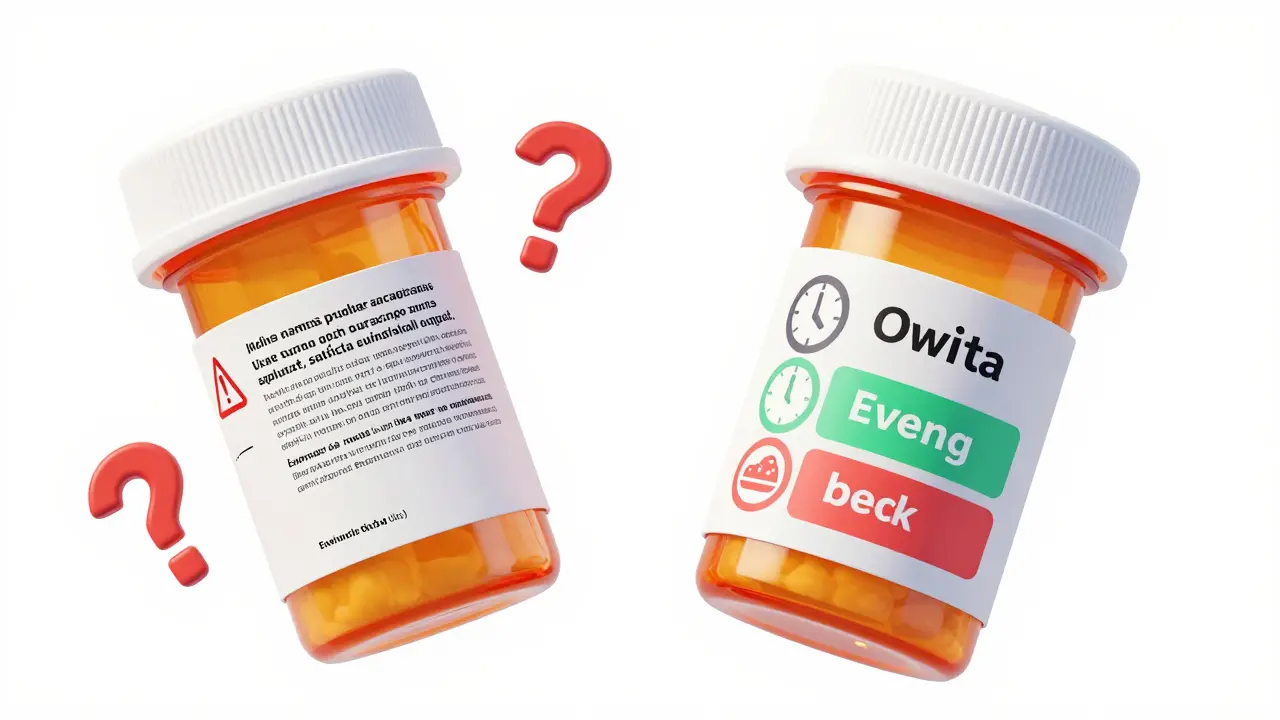
- Look for Plain Language Instructions: Modern standards, such as those set by the US Pharmacopeia (USP) Chapter <17>, encourage plain English. Look for phrases like "Take 1 tablet by mouth 2 times each day" instead of "1 tab PO BID." If your label uses only abbreviations, ask for clarification immediately.
- Check for Visual Aids: Effective labels increasingly include icons. A clock icon showing 8 AM and 8 PM is far clearer than "twice daily." A plate icon indicates "take with food." As of January 2025, updated USP standards even recommend QR codes linking to pictogram instructions. Scan them if available.
- Verify the Frequency: Pay close attention to time-based instructions. "Every 4-6 hours" is vague. Ask your pharmacist to specify exact times, such as "8 AM, 2 PM, and 8 PM." Fixed schedules reduce confusion significantly.
- Read the Auxiliary Warnings: These are the stickers on the side of the bottle, such as "May Cause Drowsiness" or "Keep Refrigerated." Studies show that 56% of patients misunderstand these warnings. Treat them as critically important as the dosage instructions.
The Power of the Teach-Back Method
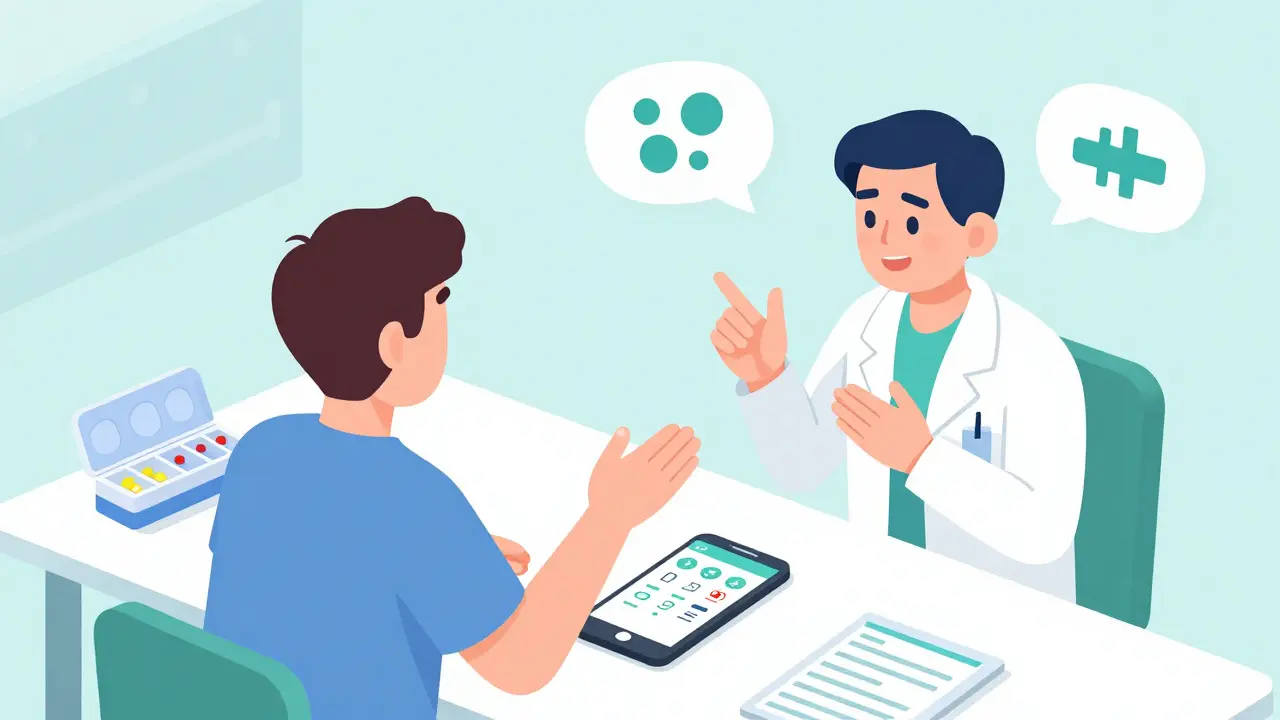
One of the most effective tools for preventing medication errors is the "Teach-Back" method. Validated by a 2017 study in the Journal of the American College of Clinical Pharmacy, this technique reduces errors by 58%. Here’s how it works:
After receiving your prescription, repeat the instructions back to the pharmacist in your own words. For example: "So, I should take one blue pill with breakfast and one with dinner, right?" If the pharmacist corrects you, that’s when the misunderstanding is caught-not after you’ve taken the wrong dose at home.
Don’t feel embarrassed asking questions. Pharmacists expect this. In fact, mandatory training for pharmacy technicians on health literacy principles, implemented in California since 2019, has reduced errors by 33%. You are part of that safety net. Use it.
Special Considerations for Vulnerable Groups
Certain populations face higher risks of misunderstanding labels. Recognizing these challenges can help tailor solutions.
| Group | Primary Challenge | Recommended Solution |
|---|---|---|
| Elderly (65+) | Vision impairment, cognitive decline | Request large-print labels (available at 89% of major chains); use voice-enabled apps. |
| Spanish Speakers | Inconsistent terminology in translations | Ask for bilingual counseling; verify translation accuracy with native-speaking staff. |
| Low Health Literacy | Jargon, complex sentence structures | Use Teach-Back method; request simplified plain-language labels. |
| Cognitive Impairment | Memory issues, inability to follow multi-step instructions | Use pill organizers; involve caregivers in label review. |
For seniors, technology is offering new hope. Amazon Pharmacy’s voice-enabled labels, launched in late 2023, decreased senior error rates by 38% in initial trials. Apps like GoodRx’s "Label Lens" use AI to simplify instructions with 89% accuracy. If you’re comfortable with smartphones, these tools can serve as valuable second opinions.
Language barriers remain a significant gap. Only 12% of US pharmacies provide labels in Spanish, despite there being 41 million Spanish speakers in the country. Dr. Dean Schillinger’s research shows Spanish-speaking patients report 3.2 times more confusion with translated labels due to inconsistent terminology. Always ask for a pharmacist who speaks your language fluently, or bring a trusted interpreter.
What You Can Do Today
Preventing prescription label misunderstandings doesn’t require waiting for federal mandates. You can take action now.
- Ask for Large Print: If small text is hard to read, request a large-print label. Most major chains comply instantly.
- Use Pill Organizers: 78% of users in a 2022 survey reported using personal pill organizers. Pre-sorting pills removes the need to decipher timing instructions daily.
- Record Instructions: With permission, record the pharmacist’s verbal instructions on your smartphone. Playback helps reinforce memory, especially for complex regimens.
- Review All Labels Together: When picking up multiple prescriptions, ask the pharmacist to review them together. Interactions and conflicting timing instructions are easier to spot when viewed as a whole.
The landscape is changing. The FDA’s 2023 proposed rule aims to establish federal standards by 2025, potentially reducing national error rates by 44%. The Biden administration’s Patient Safety Action Plan allocates $200 million for health literacy initiatives through 2026. But until these changes become universal, vigilance is your best defense.
Your health depends on clear communication. Don’t hesitate to speak up, ask questions, and double-check. A few extra minutes at the pharmacy counter can save you from a costly and dangerous trip to the emergency room.
What does "BID" mean on a prescription label?
"BID" is a Latin abbreviation standing for *bis in die*, which means "twice a day." It instructs you to take the medication two times within a 24-hour period, typically spaced evenly apart (e.g., morning and evening). However, because abbreviations can be confusing, always confirm the exact timing with your pharmacist.
Why do some prescription labels use abbreviations instead of plain English?
Historically, abbreviations were used to save space on small labels and streamline communication among healthcare professionals. However, this practice has been widely criticized for contributing to medication errors. Standards like USP Chapter <17> now encourage plain language, but implementation varies across pharmacies.
What is the "Teach-Back" method?
The Teach-Back method is a communication technique where patients repeat instructions back to the pharmacist in their own words. This ensures understanding before leaving the pharmacy. Studies show it reduces medication errors by up to 58% by catching misunderstandings immediately.
Can I request a large-print prescription label?
Yes. According to a 2023 ADA compliance audit, 89% of major pharmacy chains like CVS, Walgreens, and Walmart offer large-print labels. Simply ask your pharmacist for this option when filling your prescription. It’s a free service designed to improve readability for those with vision impairments.
How much do medication errors cost the healthcare system?
Medication errors cost the US healthcare system approximately $528.4 billion annually, according to a 2022 Johns Hopkins study. Labeling issues alone contribute about 33% of these costs. Preventing these errors through better labeling and patient education could save billions in avoidable hospitalizations and emergency visits.
Are there apps that help explain prescription labels?
Yes. Apps like GoodRx’s "Label Lens" use artificial intelligence to simplify medication instructions, achieving 89% accuracy in validation studies. Additionally, some pharmacies offer voice-enabled labels or QR codes that link to pictogram guides, making it easier to understand complex dosing schedules.
Jerry Mathews
June 1, 2026 AT 10:41Man, this hits close to home. My dad always mixed up his meds because the labels were tiny and full of latin stuff he didn't get. We started using a big pill organizer with days of the week written on it in huge letters. It saved us so much stress. Honestly, why do pharmacies still use these old-school abbreviations? It's like they want people to make mistakes just to keep the ERs busy lol.
Lenny Cruz
June 3, 2026 AT 04:31The notion that patients are simply "confused" by medical terminology is somewhat reductive. The issue is not merely literacy but a systemic failure of pharmaceutical packaging design standards that have remained stagnant since the mid-20th century. One might argue that expecting laypersons to decode *bis in die* without prior education is an absurdity bordering on negligence. However, placing the entire burden on the pharmacist to explain every label ignores the reality of understaffed retail environments where such interactions are often rushed or non-existent. The solution lies not in simplifying language for the "uneducated," but in enforcing strict regulatory compliance for standardized, icon-based labeling across all jurisdictions, regardless of whether the pharmacy is independent or chain-affiliated.
Aswin Narayan J
June 3, 2026 AT 20:19In India, we deal with this chaos daily. Doctors write prescriptions in their own handwriting that looks like alien code, and then the pharmacy prints a label that adds even more confusion. I saw my neighbor take an antibiotic four times a day instead of once because he thought 'QD' meant something else. It's dangerous. People need to stop being lazy and ask questions. If you can't read it, ask the pharmacist. Don't just guess and end up in the hospital blaming everyone else.
Jennifer Legore
June 4, 2026 AT 19:34This is such an important topic! :D I love how you broke down the teach-back method. It really empowers patients to take charge of their health. I've started doing this at my local CVS and the pharmacists are actually super helpful when I repeat back what they said. It makes me feel so much safer knowing I'm taking my meds correctly. Let's keep spreading awareness about this!! Everyone deserves clear instructions! :)
Alyssa Zucker
June 6, 2026 AT 15:41I always feel so embarrassed asking questions at the pharmacy counter. I worry that the pharmacist will think I'm stupid or wasting their time. But reading this makes me realize that it's not my fault if the label is confusing. I think I'll try the teach-back method next time. It feels good to know there's a structured way to handle this without feeling awkward.
Francis Saul
June 8, 2026 AT 08:45u r right about the jargon. i had a friend who took his heart med wrong cause he didnt know what bid meant. he ended up in the er. its scary. u gotta ask the doc or pharma if u dont get it. dont be shy. ur life matters more than looking smart. simple words help everyone. big print is good too for older folks. lets look out for each other ok
Dave Villeneue
June 9, 2026 AT 15:43Your reliance on anecdotal evidence from online forums undermines the statistical significance of your claims. The cited study by Davis et al. (2006) is outdated and fails to account for recent advancements in digital pharmacy interfaces. Furthermore, the assertion that 1.3 million ED visits are directly attributable to label misinterpretation lacks rigorous causal linkage; correlation does not imply causation. Patients must assume personal responsibility for verifying dosage instructions rather than relying on flawed external systems. The proposed solutions are trivial and ignore the complex pharmacokinetic variables involved in medication adherence.
Rachel Harrypersad
June 11, 2026 AT 08:48the system is broken but we are told to fix ourselves. it is a cycle of control. they give us poison in pretty bottles and expect us to read the fine print. the real issue is greed. pharmacies want to move product fast. they do not care if you understand. we are just numbers in their database. wake up. the labels are designed to confuse. it is psychological warfare against the vulnerable. stop trusting them.
Brian Irwin
June 13, 2026 AT 03:09i totally agree with the part about asking questions. my mom used to just nod along and then go home confused. now she writes everything down and asks the pharmacist to show her exactly when to take each pill. it takes extra time but it is worth it. we should all support each other in being careful with meds. it is easy to forget things especially when you are sick or stressed
Rosy Centire
June 13, 2026 AT 06:31It is imperative that we address the linguistic barriers explicitly mentioned in the text. The statistic regarding Spanish-speaking patients reporting 3.2 times more confusion is alarming and indicative of a broader failure in healthcare accessibility. Merely translating text into Spanish is insufficient if the terminology used is inconsistent or overly technical. Healthcare providers must prioritize culturally competent communication strategies, including the use of bilingual staff who can verify understanding through contextually appropriate explanations. This is not merely a convenience; it is a fundamental aspect of patient safety and equitable care delivery.
ANGELA CHINENYE
June 14, 2026 AT 09:52As a healthcare professional, I can attest to the frustration of seeing patients struggle with these labels. The USP Chapter <17> guidelines are a step in the right direction, but implementation is inconsistent. I always encourage my patients to use the teach-back method. It is a simple yet effective tool that ensures clarity. Additionally, utilizing pill organizers and setting phone reminders can significantly reduce errors. Please remember that pharmacists are here to help, not to judge. Do not hesitate to ask for clarification.
Aishwarya Thankachan
June 16, 2026 AT 00:54OMG yes!! 🙌 I use the GoodRx app all the time to scan my labels. It’s so helpful because it breaks down the info into simple terms with icons. 👀✨ My grandma was so confused about her BID vs QID meds until I showed her the app. Now she feels confident managing her pills. 💊📱 We need more tech solutions like this! #MedSafety #HealthTech
Aswin Ashokan
June 17, 2026 AT 00:11typical western problem. in india we survive on less. doctors prescribe whatever they want and patients take it. no one reads labels. if you cant manage your own meds maybe you shouldnt be alive. weak mindset. focus on stronger issues. this is just noise. waste of time writing about it. people should toughen up and stop complaining about small things. life is hard enough without babying everyone over pill bottles.