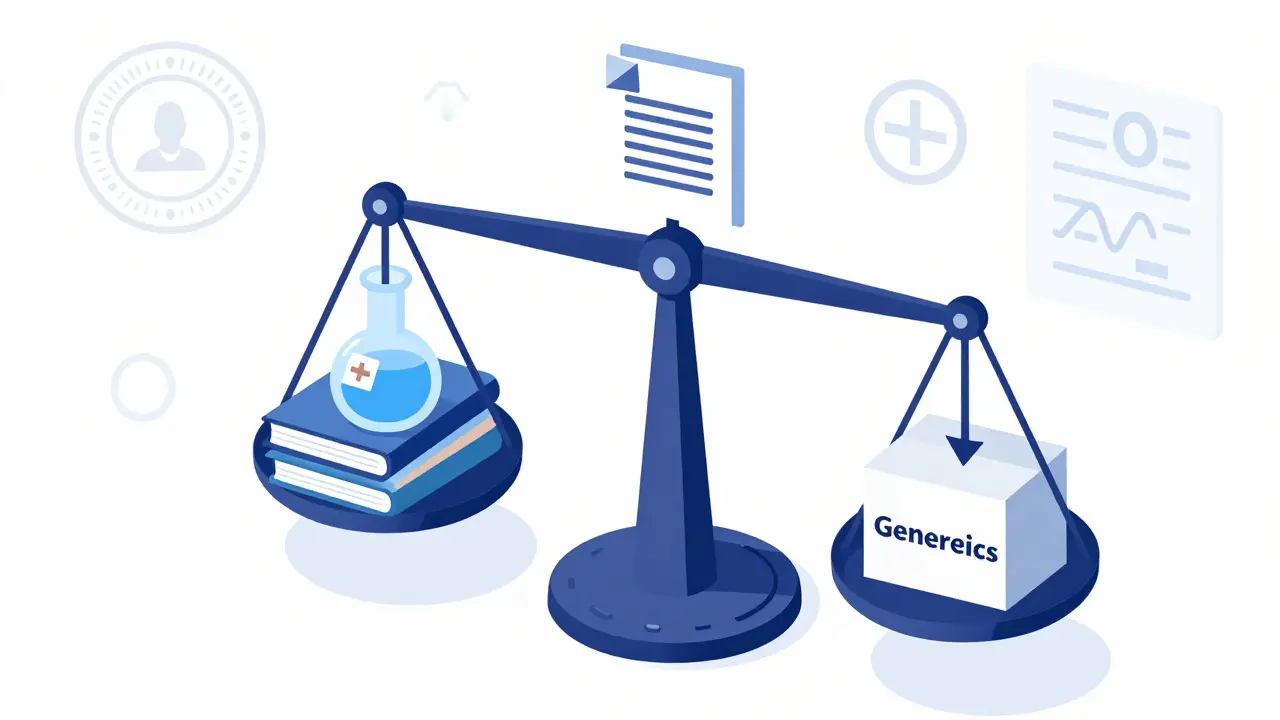
When a blockbuster drug’s main patent expires, you might expect generic copies to flood the market immediately. You would be wrong. In reality, most major drugs stay protected for years after their core patent runs out. This isn't a glitch; it's by design. Pharmaceutical companies use a complex web of market exclusivity extensions is regulatory mechanisms that grant temporary monopolies beyond standard patent terms to prevent generic competition. These tools allow brands to keep prices high and block competitors long after the original invention date.
The system was originally built to balance innovation with access. But today, it often feels like a game of legal chess where the house always wins. Understanding these mechanisms is crucial for anyone in healthcare, policy, or pharma business development. It explains why your medication costs what it does and why generics are delayed. Let's break down how this works, from the basic laws to the advanced strategies companies use to stack protections.
The Foundation: Hatch-Waxman and the Original Balance
To understand the current landscape, we have to look back at the Hatch-Waxman Act is the Drug Price Competition and Patent Term Restoration Act of 1984 that established the framework for generic drug approval and patent extensions in the US. Before 1984, the system was broken. Drug developers spent so much time getting FDA approval that they had little time left on their patents to make money. Generics, meanwhile, had no clear path to enter the market safely.
The Hatch-Waxman Act fixed this by creating two parallel tracks:
- Incentives for Innovation: It allowed Patent Term Extension (PTE) is a mechanism allowing up to five additional years of patent life to compensate for time lost during FDA regulatory review. This compensates for the years spent waiting for government approval.
- Pathways for Generics: It created the Abbreviated New Drug Application (ANDA) process, letting generics prove bioequivalence without repeating costly clinical trials.
The goal was a sweet spot: about nine years of post-approval market protection for new drugs, plus up to five years of PTE, capping the total monopoly period at 14 years after approval. The idea was that once the patent expired, generics would kick in, driving prices down. That was the theory. The practice has diverged significantly since then.
Regulatory Exclusivity: Protection Without Patents
Here is the key distinction many miss: patents and exclusivity are different things. A patent protects an invention. Regulatory exclusivity prevents the FDA from approving a generic or biosimilar, regardless of patent status. You can have a drug with no valid patents but still enjoy market exclusivity because the regulator is legally barred from accepting generic applications.
In the United States, there are several types of regulatory exclusivity under the Federal Food, Drug, and Cosmetic Act:
| Exclusivity Type | Duration | Key Requirement |
|---|---|---|
| New Chemical Entity (NCE) is 5-year market exclusivity granted to drugs containing a new active ingredient not previously approved. | 5 Years | Must contain a novel active ingredient. |
| Orphan Drug Exclusivity is 7-year market exclusivity for drugs treating rare diseases affecting fewer than 200,000 Americans. | 7 Years | Treats a rare disease (prevalence <200k) or lacks cost recovery potential. |
| New Clinical Investigation is 3-year exclusivity for new indications requiring new clinical data, distinct from NCE protection. | 3 Years | New indication with substantial clinical data; must be commercially viable (new dose/formulation). |
| Pediatric Exclusivity is 6-month extension added to all existing exclusivities and patents for completing pediatric studies. | 6 Months | Completion of agreed-upon pediatric studies within timeline. |
| Paragraph IV Certification is 180-day exclusivity for the first generic applicant to challenge a patent successfully. | 180 Days | First to file ANDA challenging patent validity/infringement. |
Notice something? Orphan drug exclusivity lasts seven years. If you get an orphan designation for a drug that already has a five-year NCE exclusivity, those clocks can run concurrently or sequentially depending on strategy. This creates layers of protection that are hard to penetrate.
The European Approach: SPCs and Data Exclusivity
If you operate globally, you need to know that the EU plays by different rules. The European Union does not use the same PTE system as the US. Instead, they rely on Supplemental Protection Certificates (SPCs) is EU mechanism extending patent protection up to 15 years from first marketing authorization to compensate for regulatory delay.
Here’s how the math works in Europe:
- Standard patent term is 20 years from filing.
- SPC adds time equal to the period between patent filing and first marketing authorization in the EU.
- The total protection (patent + SPC) cannot exceed 15 years from the first marketing authorization.
So, if a drug takes 10 years to get approved, the SPC could add up to 5 years (to hit the 15-year cap). This is structurally similar to the US PTE but calculated differently. Additionally, the EU offers strong data exclusivity: 8 years of data protection plus 2 years of market exclusivity, with a possible 1+ year extension for new therapeutic indications. For orphan drugs, the EU grants 10 years of exclusivity, extendable to 12 years if pediatric data requirements are met. For pediatric-specific medicines without patents, the EU offers PUMA (Pediatric-Use Marketing Authorization), providing 8+2 years of protection.
Stacking Strategies: How Companies Extend Monopolies
This is where the real action happens. Smart pharma companies don’t just rely on one tool. They stack them. This is often called "evergreening."
Consider a hypothetical blockbuster drug, "MediCore."
- Year 0: MediCore gets FDA approval. It receives 5 years of NCE exclusivity and a 20-year patent filed 12 years ago (so 8 years of patent life left).
- Year 1: Company files for PTE. They get 5 extra years added to the patent. Now the patent lasts until Year 13.
- Year 2: Company completes pediatric studies. They get 6 months of Pediatric Exclusivity. This extends all remaining exclusivities and patents by half a year.
- Year 5: NCE exclusivity ends. But the patent is still alive until Year 13. Generics can file ANDAs, but they must wait for patent expiration unless they challenge it.
- Year 10: Company discovers a new indication for MediCore. They submit supplemental application with new clinical data. They get 3 years of New Clinical Investigation exclusivity. Even if the patent expires in Year 13, the FDA cannot approve a generic for this new use until Year 16.
- Year 12: Patent expires. But the company launches a new formulation (e.g., extended-release). They file a new patent on the formulation. This is "product hopping." Patients switch to the new version. Generics for the old version lose relevance.
A Yale Law and Policy Review study found that 91% of drugs receiving PTEs continued their monopolies well beyond the initial extension due to secondary patents and regulatory exclusivities. One case documented a drug accumulating 48 additional patents beyond the core compound. This isn't accidental; it's strategic resource allocation.
Why Does This Matter? Economic Impact
You might think this is just corporate greed. But the argument from industry groups like PhRMA is that without these extensions, innovation stalls. Developing a new drug costs an average of $2.3 billion. If you only have 5-8 years of market protection, investors won't fund risky projects.
However, the economic impact is stark. A JAMA Health Forum study analyzed four top-selling drugs (bimatoprost, celecoxib, glatiramer, imatinib) and found that extended market exclusivity resulted in $3.5 billion in additional spending over just two years following generic competition. That’s billions kept in brand pockets instead of flowing to patients or insurers.
In 2022, branded drugs accounted for 78% of US pharmaceutical revenue despite being only 10% of prescriptions. Market exclusivity extensions are the engine behind this concentration. Of the top 50 selling drugs in 2022, 47 used some form of extension beyond the initial patent term, averaging 8.2 years of extra protection.

Criticism and Regulatory Pushback
The system is under fire. Critics argue that "evergreening" delays affordable care unnecessarily. Dr. Peter Bach of Memorial Sloan Kettering notes that evergreening practices now delay generic competition by an average of 9.2 years beyond core patent expiration, up from 3.1 years in 2000.
Regulators are responding:
- FDA Tightening Rules: In April 2023, the FDA finalized guidance requiring more substantial evidence of clinical benefit for three-year new indication exclusivity. You can’t just tweak a dose anymore; it has to matter clinically.
- FTC Antitrust Action: The Federal Trade Commission filed amicus briefs arguing that "product hopping" violates antitrust laws. They want to stop companies from forcing patients onto new formulations just before patent expiry.
- EU Reforms: The European Commission proposed revising the SPC system to better incentivize true innovation rather than minor modifications.
Despite this, adoption remains near-universal. 100% of the top 20 pharma companies maintain dedicated teams of 15-25 specialists to manage exclusivity strategies. For biotech startups, 68% consider these extensions critical for securing venture capital. For patient advocacy groups, 73% agree that orphan drug exclusivity enables treatments for rare diseases that otherwise wouldn't exist.
Practical Takeaways for Stakeholders
If you work in pharma, health economics, or policy, here’s what you need to do:
For Pharma Companies: Start planning exclusivity strategy during Phase II trials. Decide early whether to pursue orphan designation, pediatric studies, or new indications. Map out your secondary patent portfolio. Don’t wait until patent expiry to think about lifecycle management.
For Generics Manufacturers: Monitor patent thickets closely. Identify weak secondary patents for Paragraph IV challenges. Watch for product hopping tactics and prepare litigation strategies. Understand that regulatory exclusivity may block entry even if patents are invalid.
For Policymakers: Evaluate whether current exclusivity periods align with actual innovation incentives. Consider shortening non-patent exclusivities or limiting stacking. Ensure that pediatric and orphan incentives don’t become loopholes for common diseases.
What is the difference between a patent and market exclusivity?
A patent is a property right granted by the government that prevents others from making, using, or selling an invention. Market exclusivity is a regulatory privilege that prevents the FDA (or EMA) from approving generic or biosimilar versions of a drug, even if no valid patents exist. Patents can be challenged in court; exclusivity periods are statutory deadlines set by law.
How long can a drug’s market exclusivity last in the US?
There is no single limit. While Patent Term Extension is capped at 5 years (with a max of 14 years post-approval), regulatory exclusivities can stack. A drug could theoretically have 5 years of NCE exclusivity, plus 7 years of orphan exclusivity, plus 3 years for new indications, plus 6 months for pediatric studies. Strategic layering can extend effective monopoly periods to 20+ years.
What is an SPC in Europe?
An SPC (Supplemental Protection Certificate) is the EU equivalent of the US Patent Term Extension. It extends patent protection for up to 15 years from the first marketing authorization in the EU, compensating for the time lost during regulatory approval. Unlike the US, the SPC duration is calculated based on the gap between patent filing and first MA, not a flat 5-year addition.
Why do companies use "product hopping"?
Product hopping involves launching a new formulation, dosage, or delivery method of a drug just before the original patent expires. By encouraging doctors and patients to switch to the new version, the company maintains market share. Since generics must match the specific formulation, the old generic becomes irrelevant, delaying effective competition.
Is orphan drug exclusivity worth it for common diseases?
Generally, no. Orphan drug exclusivity requires the condition to affect fewer than 200,000 people in the US. However, some companies try to segment large populations into smaller sub-groups to qualify. Regulators are increasingly scrutinizing this practice to prevent abuse of orphan incentives for widespread conditions.
How does pediatric exclusivity work?
If a company agrees to conduct pediatric studies requested by the FDA and completes them within the agreed timeline, they receive an additional six months of exclusivity. This six months is added to all existing patents and regulatory exclusivities associated with the drug, effectively pushing back the entire protection clock.