For decades, proving that a generic drug works just like its brand-name counterpart meant running expensive, time-consuming clinical trials with human volunteers. Blood samples. Long waits. High costs. But since 2023, that’s changed-dramatically. New technologies are rewriting the rules of bioequivalence testing, making it faster, cheaper, and more precise. The goal hasn’t changed: ensure that a generic pill delivers the same amount of active ingredient to the bloodstream at the same rate as the original. But now, machines, AI, and advanced imaging are doing much of the heavy lifting.
AI Is Cutting Study Timelines in Half
The biggest shift? Artificial intelligence. The FDA’s BEAM (Bioequivalence Assessment Mate), launched in mid-2024, is a game-changer. It’s not just software-it’s a data-crunching engine that reads through thousands of pages of study reports, pulls out key pharmacokinetic values, flags inconsistencies, and even suggests potential issues reviewers might miss. Before BEAM, a single bioequivalence application could take a reviewer 80-100 hours to assess. Now, it’s down to 28-35 hours. That’s a 52-hour reduction per application, according to internal FDA metrics. In 2024, about 20% of all new generic drug approvals were directly impacted by tools like BEAM, part of the GDUFA science push to speed up reviews without sacrificing safety.Machine learning doesn’t stop at document review. It’s now embedded in pharmacokinetic (PK) and pharmacodynamic (PD) modeling. Instead of manually plotting blood concentration curves over time, algorithms automatically fit models to data from hundreds of volunteers, adjusting for age, weight, metabolism, and even genetic variations. This means fewer volunteers are needed, studies can be smaller, and results are more reliable. Studies using AI-driven PK/PD models have shown a 28% improvement in data accuracy and a 40-50% reduction in study duration. For companies developing generics, that’s millions saved per product.
Replacing Human Trials with Virtual Models
For complex drug forms-like long-acting injectables, inhalers, or patches-traditional bioequivalence testing has always been messy. You can’t just measure blood levels and call it done. The drug behaves differently in the body. That’s where virtual bioequivalence (virtual BE) platforms come in. These are computer simulations that predict how a drug will behave in the human body based on its physical and chemical properties, formulation, and dissolution profile.The FDA funded two major projects in 2024 to build these platforms. One focuses on PLGA implants-slow-release devices used for hormone therapy and antipsychotics. The other is a broader virtual BE system designed to replace clinical endpoint studies for certain complex products. Early results show these models can reduce the need for human trials by up to 65% for drugs like transdermal patches and inhaled corticosteroids. That’s huge. It means faster access to affordable medicines, especially for chronic conditions where patients need steady, long-term treatment.
Advanced Imaging and Dissolution Testing
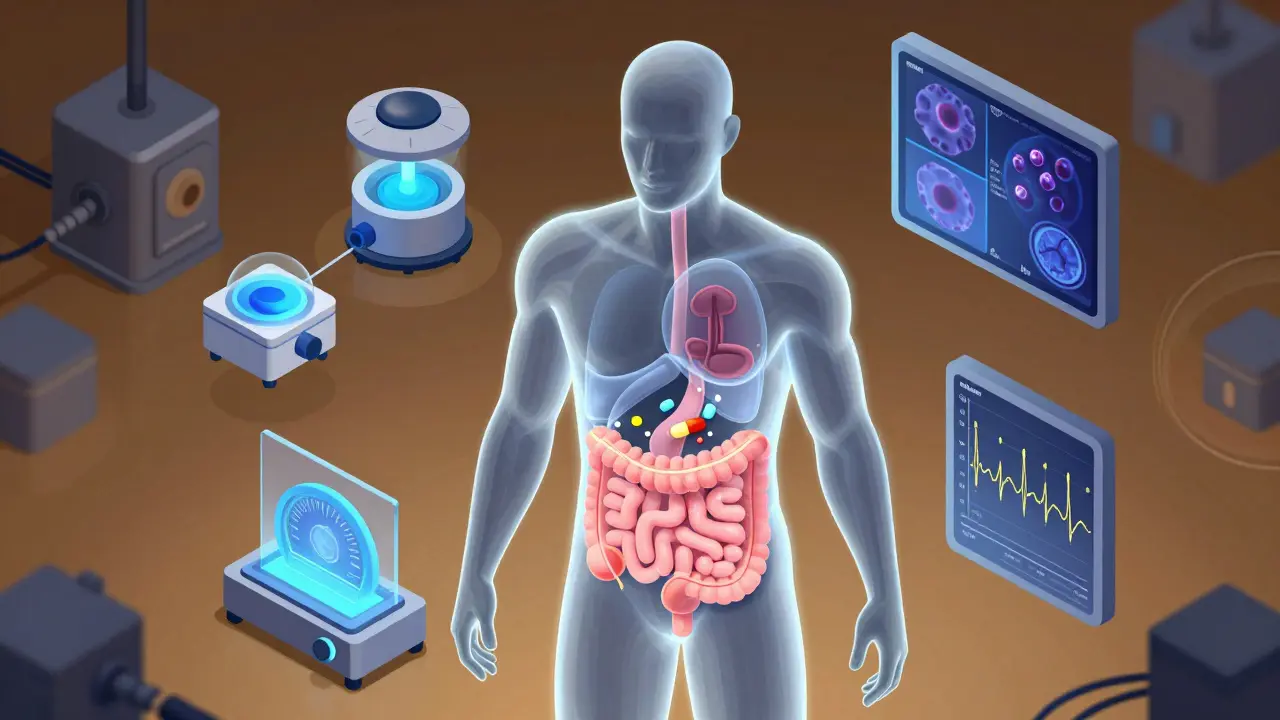
But AI isn’t the only player. Physical testing has gotten smarter too. The Dissolvit system (a next-generation in vitro dissolution apparatus) mimics the human digestive tract far better than old-school beakers and paddles. It’s especially critical for orally inhaled products, where traditional methods couldn’t tell if two formulations would perform the same in the lungs. Dissolvit uses biorelevant fluids, controlled pH changes, and dynamic flow rates to simulate real-life conditions. The FDA’s March 2025 research paper confirmed it has strong discriminative power-meaning it can spot small but meaningful differences between formulations that older tests missed.Meanwhile, imaging tech is now part of routine bioequivalence analysis. Scanning electron microscopy (SEM) shows the surface structure of drug particles. Atomic force microscopy reveals how a tablet breaks down at the nanoscale. Optical coherence tomography maps how a topical cream spreads on skin. These aren’t lab curiosities-they’re standard tools now in FDA-approved labs. They help manufacturers tweak formulations before ever going to human trials, reducing failure rates and speeding up development.
Global Harmonization and Regulatory Shifts
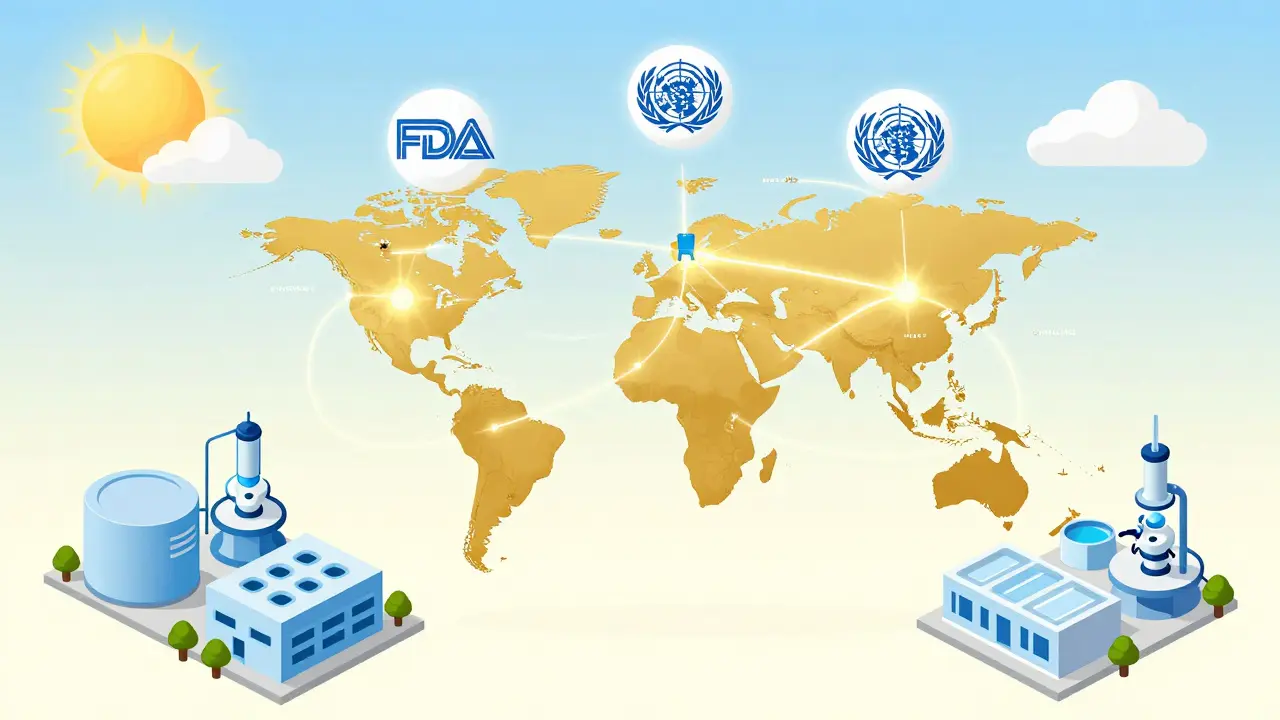
Before 2024, bioanalytical testing rules varied wildly between the U.S., Europe, and other regions. One lab’s validation protocol was another’s rejection letter. That changed with the adoption of the ICH M10 guideline (a unified global standard for bioanalytical method validation) by the FDA in June 2024 and WHO in August 2024. Now, labs from Boston to Bangalore follow the same rules for validating blood tests. This has cut method validation discrepancies by 62% across regions, making it easier for generic manufacturers to file applications globally.But there’s a catch. In October 2025, the FDA launched a pilot program requiring all bioequivalence testing for accelerated ANDA applications to be conducted in the U.S. using only domestically sourced active pharmaceutical ingredients (APIs). This isn’t just about quality control-it’s a policy push to rebuild U.S. manufacturing capacity. Companies now face a choice: pay more to run tests locally, or wait longer for standard review. For smaller generics firms, this adds pressure.
Where the Tech Still Falls Short
These advances don’t mean old methods are obsolete. For simple, small-molecule generics-like metformin or atorvastatin-traditional PK studies are still cheaper and more reliable. A standard bioequivalence study costs $1-2 million. A tech-enhanced one, with AI modeling, advanced imaging, and virtual BE, can run $2.5-4 million. Unless you’re dealing with a complex formulation, the ROI doesn’t justify the cost.And some areas remain stubbornly difficult. Transdermal patches? We still struggle to predict skin irritation and adhesion reliably. Orally inhaled products? Standardized charcoal block PK studies haven’t been fully validated across platforms. Topical semisolids? We need better ways to link compositional differences to clinical outcomes. The FDA’s Generics Workshop in January 2025 laid out these gaps clearly: we can model dissolution, but we can’t yet model how a cream feels on the skin or how it’s absorbed over 12 hours.
There’s also a safety concern. Dr. Michael Cohen of ISMP warned in September 2025 that over-relying on in vitro models for narrow therapeutic index drugs-like warfarin or lithium-could be dangerous. These drugs have tiny windows between effectiveness and toxicity. If a virtual model misses a subtle formulation difference, patients could be at risk. The FDA agrees: virtual BE is approved only for certain product types, and clinical confirmation is still required for high-risk drugs.
The Future Is Already Here
By 2030, experts predict AI-driven bioequivalence testing will handle 75% of standard generic applications. Complex products will rely on virtual platforms, advanced imaging, and mechanistic models. The global market for bioequivalence studies is projected to grow from $4.54 billion in 2025 to $18.66 billion by 2035. That’s a 15.54% annual growth rate, fueled by biosimilars-76 of which have been approved by the FDA as of October 2025.And it’s not just the U.S. The Middle East and Africa are investing heavily. Saudi Arabia’s Vision 2030 and UAE partnerships with global CROs are building state-of-the-art bioanalytical labs. WHO-backed vaccine programs are driving demand for reliable bioequivalence data in low- and middle-income countries.
The message is clear: bioequivalence testing is no longer about counting blood samples. It’s about data, modeling, and precision. The technology is here. The regulators are adapting. The cost savings are real. And for patients waiting for affordable medicines, that’s the most important outcome of all.
What is bioequivalence testing and why does it matter?
Bioequivalence testing proves that a generic drug delivers the same amount of active ingredient into the bloodstream at the same rate as the brand-name version. It ensures that switching from a brand to a generic won’t change how well the drug works or increase side effects. Without this testing, generic drugs couldn’t be approved for sale.
How is AI changing bioequivalence studies?
AI automates data analysis, predicts drug behavior using pharmacokinetic models, and reduces the need for large human trials. Tools like BEAM cut reviewer workload by over 50 hours per application and improve data accuracy by nearly 30%. Machine learning can now identify subtle differences in drug absorption that humans might overlook.
Can virtual bioequivalence replace human trials completely?
For certain complex products-like long-acting injectables, inhalers, and patches-yes, virtual BE can replace clinical trials in many cases. The FDA allows it for specific drug types where models have been validated. But for high-risk drugs with narrow therapeutic windows, like blood thinners or epilepsy meds, human trials are still required to ensure safety.
Why is the FDA requiring U.S.-based bioequivalence testing now?
Since October 2025, the FDA’s pilot program requires accelerated review for ANDAs only if bioequivalence testing is done in the U.S. using domestically sourced active ingredients. This is part of a broader effort to strengthen U.S. pharmaceutical manufacturing and reduce reliance on overseas suppliers, especially after supply chain disruptions during the pandemic.
Are these new technologies more expensive than traditional methods?
Yes, initially. A standard bioequivalence study costs $1-2 million. Technology-enhanced studies using AI, virtual models, and advanced imaging can cost $2.5-4 million. But for complex drugs, they’re often cheaper overall because they reduce trial failures, shorten development time, and avoid costly late-stage setbacks. For simple generics, traditional methods still make more financial sense.
What’s the biggest limitation of current bioequivalence technologies?
The biggest gap is in transdermal and topical products. We still can’t reliably predict skin irritation, adhesion, or long-term absorption from lab tests alone. For orally inhaled drugs, standardized methods for charcoal block PK studies are still being refined. And for narrow therapeutic index drugs, regulators remain cautious about fully replacing human data with models.
Anu radha
December 17, 2025 AT 15:50This is amazing for people who can't afford brand meds. My dad takes blood pressure pills and he's been saving so much. Thank you for explaining it so clearly.
CAROL MUTISO
December 17, 2025 AT 17:26So let me get this straight - we’re using AI to replace human trials, but the FDA still wants us to test everything in the U.S. with American-made ingredients? 🤔 Like, are we building a pharmaceutical wall now? The irony is thick enough to spread on toast.
Joe Bartlett
December 18, 2025 AT 15:36Britain did this better in the 90s. We had proper generics long before you all started playing with robots.
Victoria Rogers
December 19, 2025 AT 00:08AI is watching your blood now. They're not just testing drugs-they're building a database on every American's metabolism. Next thing you know, insurance companies will use this to deny your meds if your 'model score' is too low
Brooks Beveridge
December 19, 2025 AT 03:21This is actually beautiful. We’re not just making medicine cheaper-we’re making it smarter. Less pain for patients, less waste, faster access. The science is finally catching up to the need. Keep going. 🙌
Nishant Desae
December 19, 2025 AT 15:14I come from a small town in India where people wait months for basic meds, and seeing this tech spread globally gives me hope. My cousin’s mom uses insulin, and if virtual BE can help get cheaper versions to places like ours, that’s not just progress-that’s life saved. Thank you for sharing this, really. 🙏
Michael Whitaker
December 21, 2025 AT 01:52While I appreciate the technical advancements, one must question the underlying assumption that automation inherently improves safety. The FDA's reliance on proprietary AI models-none of which are open to independent audit-is a regulatory abdication masquerading as innovation. The reduction in reviewer hours does not equate to increased rigor; it merely shifts the burden of error from human oversight to algorithmic opacity. Until the BEAM system's training data and validation protocols are publicly disclosed, any claim of enhanced safety is merely marketing.
Furthermore, the assertion that AI-driven models improve data accuracy by 28% is statistically dubious without disclosing the baseline variance or the sample size of the validation cohort. Are these figures derived from controlled trials or internal benchmarks optimized for approval speed? The lack of transparency here is not merely inconvenient-it is ethically concerning.
The global harmonization via ICH M10 is commendable, yet the sudden imposition of U.S.-only API sourcing for accelerated ANDAs undermines that very principle. This is not science-it is economic nationalism dressed in lab coats. If the goal is public health, why restrict testing geography? If the goal is domestic manufacturing, say so. Do not confuse protectionism with pharmacology.
And let us not forget: virtual bioequivalence for transdermal patches remains unvalidated for long-term dermal absorption. To approve such models without clinical confirmation for chronic-use drugs is to gamble with patient outcomes. The FDA’s own workshop acknowledged this gap. Yet here we are, accelerating approvals anyway. The precautionary principle is not dead-it is being quietly buried under PowerPoint slides.
Let us not mistake efficiency for excellence. Speed without scrutiny is not progress. It is negligence with a machine learning logo.
Jody Patrick
December 21, 2025 AT 23:58Make America test again. No more foreign API. Period.
Virginia Seitz
December 22, 2025 AT 10:37So… AI is doing the boring work now? 😎 That’s actually kinda cool. More medicine for less money? Yes please! 🙌
Steven Lavoie
December 23, 2025 AT 22:58Michael Whitaker raises a valid point about transparency, but I think he’s missing the forest for the trees. The FDA didn’t just slap an AI on an old system-they rebuilt the entire workflow. BEAM isn’t a black box; it’s a decision-support tool that flags anomalies for human review. The 52-hour reduction isn’t about cutting corners-it’s about freeing up experts to focus on the hard cases, like narrow-therapeutic-index drugs. And yes, the API sourcing rule is protectionist, but after 2020, we can’t afford to ignore supply chain fragility. This isn’t perfect, but it’s the best we’ve got right now.
Erik J
December 25, 2025 AT 21:04How many of these AI models were trained on data from diverse populations? I’m curious if the algorithms account for genetic differences in drug metabolism across ethnic groups-or if they’re biased toward the data we’ve historically collected, which is mostly white, middle-aged Americans.
Jigar shah
December 27, 2025 AT 09:26Interesting. In India, we still use old methods for most generics because labs can’t afford SEM or Dissolvit. But if virtual BE becomes cheaper, maybe we can leapfrog the expensive phase. Hope the tech reaches us soon.
Meghan O'Shaughnessy
December 28, 2025 AT 10:53Just read this whole thing. I’m not a scientist, but I’m a mom who buys generic insulin. This matters. Thank you for writing it like someone who actually cares.
Kaylee Esdale
December 30, 2025 AT 07:40AI in pharma? Wild. I mean, we used to have to wait forever for generics. Now it’s like… Netflix but for medicine. Instant access. 🤯
Marie Mee
January 1, 2026 AT 06:49They’re using AI to replace human trials but still need humans to test the AI? What if the AI is wrong and no one catches it? What if this is all just a cover to let Big Pharma charge more later? I saw a documentary once where they said the FDA takes money from drug companies…