Every year, thousands of children end up in emergency rooms because of a simple mistake: the wrong dose of medicine. Not because parents are careless, but because the system is stacked against them. In pediatric emergencies, medication errors happen more than twice as often as in adults. A 2023 study found that 31% of pediatric medication orders contain some kind of error-compared to just 13% for adults. And in real life, these aren’t just numbers. They’re children who got too much acetaminophen, too little antibiotics, or the wrong liquid formula because the label was confusing.
Why Kids Are at Higher Risk
Adults get pills. Kids get liquids. And liquids are where things go wrong.
Most pediatric doses are calculated by weight-milligrams per kilogram. That means if a child weighs 10 kg, and the dose is 15 mg/kg, you need to multiply 10 by 15 to get 150 mg. Then you have to figure out how many milliliters that equals based on the concentration of the liquid. One bottle might be 160 mg per 5 mL. Another might be 250 mg per 5 mL. Mix them up, and you’ve given a child five times the dose they should have.
Studies show that 60% to 80% of dosing errors at home involve liquid medications. One parent in a 2024 Reddit thread said they gave their 2-year-old 5 mL of children’s Tylenol, thinking it was the same as infant Tylenol. It wasn’t. The infant version is twice as strong. The child ended up in the ER with liver damage.
Even in hospitals, mistakes happen. A 2019 study found 0.78 errors per medication order in pediatric emergency departments. That’s nearly one mistake for every dose given. Why? Time pressure. Verbal orders. Overworked staff. And the fact that many hospitals still don’t have pediatric-specific tools built into their electronic systems.
Common Mistakes and Real Cases
Let’s look at what actually goes wrong.
- Wrong dose (13% of errors): A child with a fever gets 5 mL of liquid acetaminophen instead of 5 mg/kg. If the child weighs 10 kg, the correct dose is 150 mg. But 5 mL of standard children’s acetaminophen (160 mg/5 mL) is 160 mg-close enough, right? Not if the bottle says “infant” and the concentration is 80 mg/0.8 mL. That’s 500 mg in 5 mL. Ten times too much.
- Duplicate dosing (15-25% of cases): Mom gives Tylenol at 8 a.m. Dad gives it again at 11 a.m. because he didn’t know it was already given. Or worse-both give it because they’re using different measuring tools. One uses a cup, the other a syringe. Neither knows the difference between mL and mg.
- Wrong concentration: A parent receives discharge instructions saying “give 5 mL.” They assume all children’s Tylenol is the same. But infant drops and children’s suspension are not interchangeable. One is 80 mg/0.8 mL. The other is 160 mg/5 mL. Give the wrong one, and you overdose.
- Weight misestimation: In 10-31% of errors, the child’s weight is wrong. Parents guess. Nurses estimate. A child who weighs 15 kg gets dosed as if they’re 20 kg. That’s a 33% overdose before the calculation even starts.
One case from a 2019 incident report: a mother gave her 10 kg child 5 mL of liquid acetaminophen, thinking it was the right amount. The bottle was labeled 160 mg/5 mL. She didn’t realize the correct dose was 150 mg total. She gave 160 mg-close, but the real problem was she gave it every 4 hours for 12 hours straight. The child developed acute liver failure. They survived, but barely.
Who’s Most at Risk?
This isn’t just about mistakes. It’s about inequality.
Parents with low health literacy are 2.3 times more likely to make a dosing error. Families who speak limited English have a 45% error rate compared to 28% for English speakers. Children on Medicaid have 27% higher error rates than those with private insurance. Why? Because they’re more likely to get discharge instructions in a language they don’t understand. More likely to use kitchen spoons because they don’t have a dosing syringe. More likely to be rushed out of the ER without time to ask questions.
One study found that Spanish-speaking families had 32% higher dosing error rates-even when given translated instructions. Translation alone isn’t enough. The instructions need to be visual. Simple. Repeated.
What Works: Real Solutions
It’s not hopeless. Some hospitals have turned things around.
Nationwide Children’s Hospital in Ohio cut harmful medication events by 85% in five years. How? They did three things:
- They made every pediatric dose calculation go through pharmacy verification before it’s given.
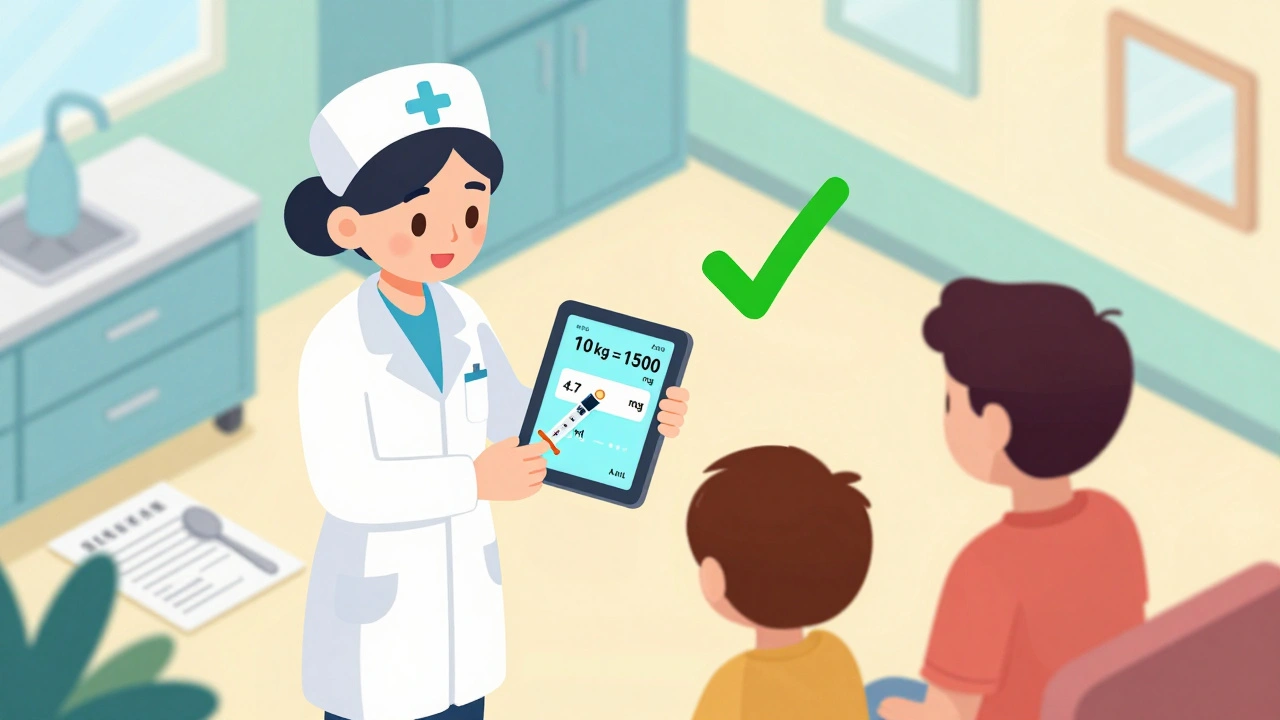
- They built weight-based dosing calculators directly into their electronic records. If a doctor types in “acetaminophen,” the system auto-calculates the dose based on the child’s weight and shows the correct volume in mL.
- They started using the “teach-back” method: after giving instructions, they ask the parent, “Can you show me how you’ll give this medicine?”
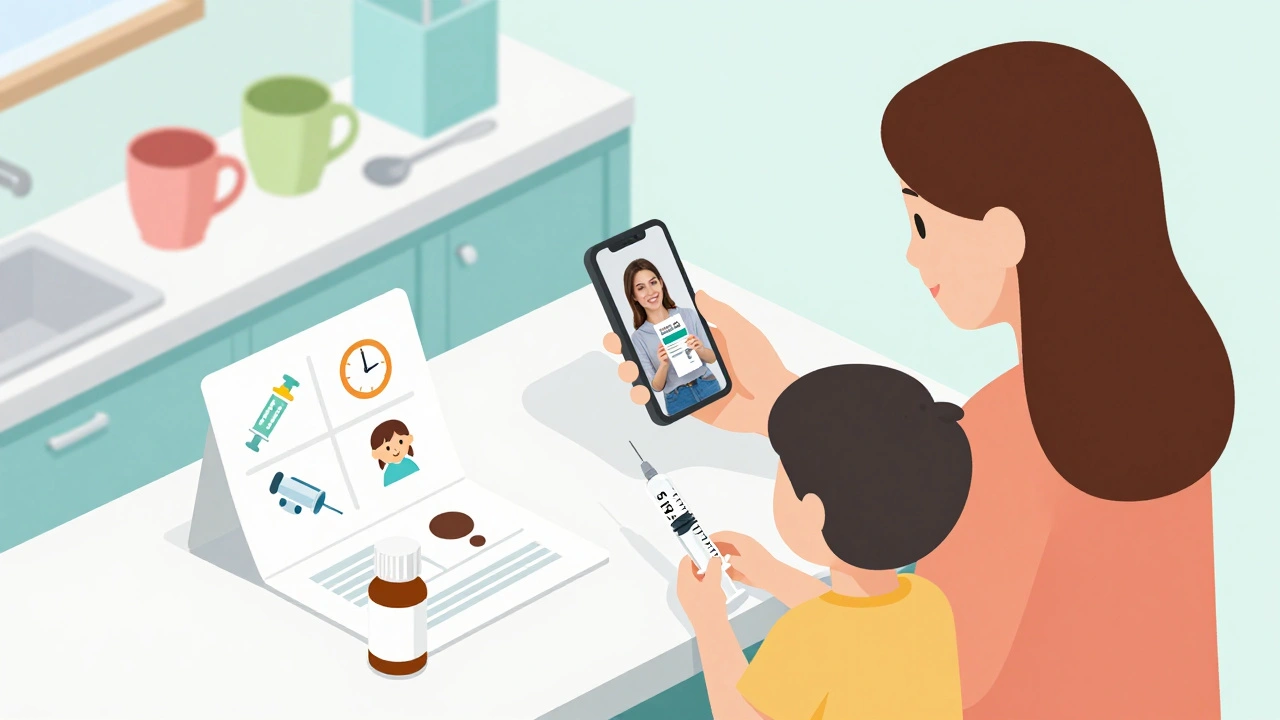
Another program, called MEDS, tested a simple change: instead of handing out a paper sheet with tiny text, they gave parents a card with pictures and one clear instruction: “Give 5 mL every 6 hours.” No numbers. No mg/kg. Just a picture of a syringe and a clock. They also gave every family a dosing syringe. Result? Dosing errors dropped from 64.7% to 49.2%-and stayed down even after the program ended.
Even small changes help. Using a dosing syringe instead of a teaspoon cuts errors by 35-45%. A 2024 JAMA study found that families who used syringes were far less likely to make mistakes than those who used cups or spoons.
What Hospitals Still Get Wrong
Not every hospital has a pediatric specialist on staff. Not every ER has a dosing calculator built into their system. Many community hospitals still rely on paper charts, handwritten orders, and nurses who estimate weights because the scale is broken.
Only 68% of children’s hospitals have pediatric-specific EMR tools. That number drops to under 30% in general emergency departments. That means a child who lives in a rural town and goes to the nearest ER might get a dose calculated the same way as an adult-because the system doesn’t know how to do it differently.
And even when tools exist, they’re not always used. One nurse told a researcher: “I know the system says to double-check, but we’re swamped. I’ve done this a thousand times.” That’s the dangerous mindset. One time is all it takes.
What Parents Can Do Right Now
You don’t need a medical degree to keep your child safe.
- Always ask: “What’s the exact dose in milliliters?” Not “How much?” Not “A teaspoon?” Ask for the number of mL.
- Use the syringe that comes with the medicine. Never use a kitchen spoon. Even a tablespoon isn’t accurate.
- Write it down. Write the dose, the time, and the date on your phone or a piece of paper. Show it to the next caregiver.
- Check the label twice. Is it “infant” or “children’s”? Is it 80 mg/0.8 mL or 160 mg/5 mL? They’re not the same.
- Ask the teach-back question: “Can you show me how you’ll give this?” If you’re unsure, ask the nurse or pharmacist to watch you do it.
One parent in Sydney told me: “I used to think I was being careful. Then I gave my daughter the wrong dose because I didn’t realize the bottle had changed. I cried for days.” She now keeps a photo of the correct syringe fill line on her phone. She shows it to every nurse.
The Bigger Picture
Medication errors in children aren’t about bad parents or lazy doctors. They’re about systems that haven’t caught up to the reality of pediatric care.
Every child deserves a system that works for them-not one that assumes they’re just small adults. That means standardized dosing tools. Clear labeling. Pharmacy checks. And training that doesn’t stop after orientation.
By 2025, the American Academy of Pediatrics plans to roll out standardized metrics to track outpatient medication errors. That’s a start. But until every ER, every pharmacy, every home has the right tools and the right training, children will keep getting hurt by mistakes that should never happen.
The good news? We know what works. We’ve seen it. We’ve measured it. Now we just need to do it everywhere.
Ethan McIvor
December 2, 2025 AT 23:26Just read this and my hands are shaking. I gave my kid liquid ibuprofen once using a teaspoon because the syringe was lost. I didn’t even know the difference between mg and mL until now. I’m so grateful this post exists. Thank you for putting this out there. 😔
Michael Bene
December 4, 2025 AT 19:53Oh please. Another ‘parents are clueless’ sob story. The real issue? Hospitals still use paper charts in 2024. If your EMR can’t auto-calculate a 12kg child’s dose, you’re not a hospital-you’re a medieval apothecary. And no, ‘teach-back’ isn’t a magic wand. It’s a Band-Aid on a gunshot wound. Fix the system, not the parents. 🤦♂️
Brian Perry
December 5, 2025 AT 03:53so like… i just found out my kid’s tylenol bottle said ‘infant’ but i thought it was ‘children’s’ and i gave him 5ml like a total idiot and he was fine?? but now i’m paranoid af. like… did i almost kill him?? 😭 i think i need to go cry in the pharmacy aisle
Mindy Bilotta
December 6, 2025 AT 08:04I’m a pediatric nurse and this is 100% accurate. We had a mom come in last week because her 8-month-old had a fever after she gave him the infant drops thinking it was the same as the children’s liquid. She used a kitchen spoon. We had to do liver enzymes. She didn’t know the difference between mL and mg. No blame-just fear. We now give every family a syringe + a laminated card with a picture of the fill line. It’s tiny, but it helps. 🙏
bobby chandra
December 7, 2025 AT 21:27THIS. This is the kind of content that needs to go viral. Not just for parents, but for every damn ER doc who thinks ‘weight-based dosing’ is just a suggestion. We’re talking about children here. Not lab rats. Not small adults. REAL KIDS. If your hospital doesn’t have a pediatric dosing calculator built into your EMR, you’re not just behind-you’re dangerous. Share this. Tag your local hospital. Demand change.
Archie singh
December 8, 2025 AT 20:16Pathetic. Parents can’t read labels so we punish the entire medical system? The real problem is that people are too lazy to learn basic math or use a measuring device. Why does every parent think a kitchen spoon is a medical instrument? You wouldn’t use a coffee mug to measure insulin-why do it with Tylenol? Fix the parent, not the system.
Ignacio Pacheco
December 8, 2025 AT 23:52So let me get this straight. You’re blaming hospitals for not having perfect pediatric EMRs… but also blaming parents for not knowing the difference between 80mg/0.8mL and 160mg/5mL? That’s like blaming a driver for not knowing how to read the gas gauge… while the car’s dashboard is just a blank screen. Both are broken. But who’s supposed to fix it when the manual is written in hieroglyphs?
Jim Schultz
December 9, 2025 AT 10:02Oh wow. Another ‘parents are innocent victims’ narrative. Let’s not forget that 78% of these errors happen because parents refuse to read the label, don’t call the pharmacy, and trust ‘common sense.’ And then they come to the ER demanding ‘better care.’ You want better care? Then take responsibility. Stop outsourcing your brain to a bottle. The system is fine. The users are the problem.
Kidar Saleh
December 9, 2025 AT 22:15I’m from London and we’ve had the same issue here. We introduced pictorial dosing cards in all NHS pediatric units three years ago. Results? 40% drop in home dosing errors. Simple. Visual. No jargon. The key isn’t complexity-it’s clarity. And yes, we give every family a syringe. No exceptions. Because if you’re going to give medicine to a child, you owe them precision. Not guesswork.
Francine Phillips
December 10, 2025 AT 12:30my kid got the wrong dose once. i didn’t know until a year later when i read this article. i still feel awful. i don’t even know if i should tell my doctor.
Katherine Gianelli
December 10, 2025 AT 16:05My daughter had a fever last winter and I was terrified I’d mess up the dose. So I took a photo of the syringe at the fill line, saved it to my phone, and showed it to every nurse. They were impressed. One said, ‘I wish more parents did that.’ You don’t need to be a doctor. You just need to be careful. And a little brave. You’ve got this.
Gavin Boyne
December 11, 2025 AT 07:37Let’s be real-this isn’t about ‘systems’ or ‘labels.’ It’s about the fact that 80% of parents in the U.S. can’t read a prescription label. We’ve turned medicine into a game of Russian roulette because we don’t teach basic pharmacology in school. You wouldn’t let someone drive without a license. Why let them give a child medicine without training? The system’s broken, but the real failure is cultural.
shalini vaishnav
December 11, 2025 AT 19:03USA has so many problems. In India, we don’t even have liquid medicine for kids in most villages. We give crushed tablets with water. No measuring tools. No syringes. No EMR. No one dies? We just hope. You think your system is bad? Try being poor and trying to save your child with a spoon and a prayer.
vinoth kumar
December 12, 2025 AT 15:51I’m a pharmacist in Delhi and I can confirm this. We’ve started giving pictorial instructions with every pediatric prescription. Even if the parent can’t read, they can follow the picture. One drawing of a syringe. One clock. One child. That’s all they need. Simple. Human. Works every time. Maybe the West needs to learn from the Global South sometimes.
Rashi Taliyan
December 13, 2025 AT 14:09I’m from Mumbai and I cried reading this. My cousin’s baby died from an overdose because the nurse gave her the adult concentration by mistake. The hospital didn’t have pediatric labeling. No one apologized. No one changed anything. This isn’t just a mistake. It’s a crime. And it keeps happening. We need to scream louder.