Opioid Use Disorder Assessment Quiz
Understanding the Difference
This quiz helps you understand the difference between physical dependence (a normal physiological response to opioids) and Opioid Use Disorder (addiction), which is a brain disease. Based on DSM-5 criteria, this assessment can help identify if you may need medical attention for addiction.
Answer these questions honestly
You'll need at least 2 'yes' responses to indicate possible Opioid Use Disorder (OUD).
Based on your responses, you have
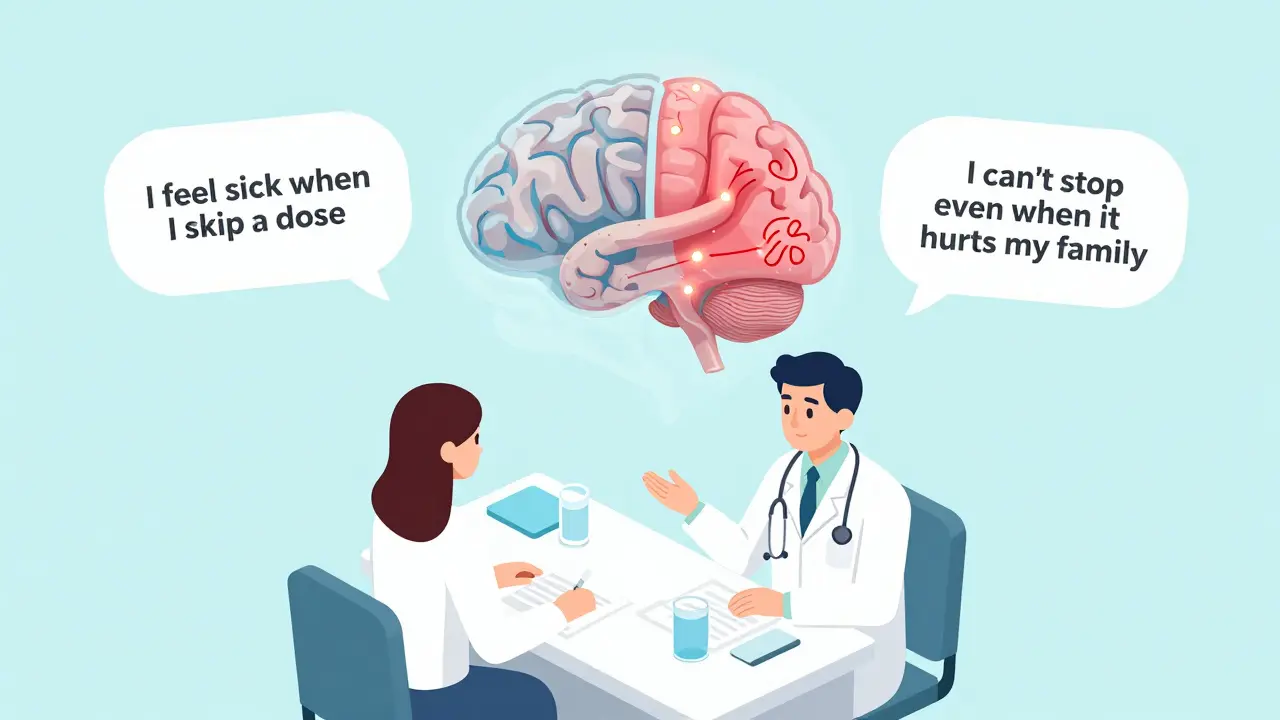
When someone takes opioids for pain, they might start feeling sick if they miss a dose. They could feel nauseous, sweaty, or anxious. Many assume this means they’re addicted. But that’s not true. What they’re experiencing is physical dependence-a normal, expected response to long-term opioid use. It’s not addiction. And confusing the two can cost people their pain relief, their dignity, and even their lives.
What Is Physical Dependence?
Physical dependence happens when your body adapts to a drug over time. It’s not about cravings or loss of control. It’s biology. When you take opioids daily-especially at doses over 30 morphine milligram equivalents (MME) per day-your brain adjusts. The locus ceruleus, a region that controls stress and alertness, starts producing more norepinephrine to counteract the drug’s effects. When you stop taking the opioid, that overactive system goes into overdrive. That’s withdrawal.Symptoms are unmistakable: nausea (92% of cases), vomiting (85%), sweating (78%), anxiety (89%), and diarrhea (68%). These aren’t signs of moral failure. They’re signs of physiology. Studies show nearly 100% of patients on chronic opioid therapy develop this dependence within 7 to 10 days. It’s predictable. It’s common. And it’s not addiction.
Doctors often mistake it for addiction. A 2020 study in the Journal of Pain Research found that 68% of chronic pain patients believed withdrawal meant they were addicted. That’s why so many stop their medication-even when it’s working. Fear drives them away from relief, not science.
What Is Addiction?
Addiction, now called Opioid Use Disorder (OUD) in clinical terms, is a brain disease. It’s not about how long you’ve taken the drug. It’s about what the drug does to your behavior. OUD changes how your brain’s reward system works. The nucleus accumbens, the part that drives motivation, gets rewired. The prefrontal cortex, responsible for decision-making, weakens. You don’t take opioids because they help your pain. You take them because you can’t stop.The DSM-5, the official diagnostic manual, defines OUD by 11 criteria. You need at least two within 12 months. These include: craving, losing control over how much you use, continuing to use despite job loss or relationship damage, and spending hours getting or using the drug. In severe cases, 83% report intense cravings. 89% keep using even when it hurts them.
Neuroimaging proves it. Brain scans of people with OUD show lasting changes-even after years of sobriety. Their reward circuits stay stuck in overdrive. That’s why relapse rates are high. That’s why addiction needs treatment, not judgment.
Key Differences Between Dependence and Addiction
Here’s the clearest way to tell them apart:
- Physical dependence = your body reacts when you stop. Addiction = your brain compels you to keep using, no matter the cost.
- Dependence = happens to almost everyone on long-term opioids. Addiction = affects only about 8% of people, even after months of use.
- Dependence = managed with gradual tapering. Addiction = requires Medication-Assisted Treatment (MAT) like buprenorphine or methadone.
- Dependence = no behavioral harm. Addiction = stealing, lying, job loss, overdose risk.
A 2017 study in Pain Medicine found that while 9.9 million Americans misused prescription opioids, only 1.7 million had OUD. That means most people who use opioids long-term don’t become addicted. But they still get physically dependent.
Why the Confusion Matters
When doctors and patients mix up dependence and addiction, real harm happens.
Patients get abruptly cut off from pain medication. Their pain flares. They’re told they’re “addicts” for needing their medicine. Some even die from uncontrolled pain or suicide.
The CDC’s 2022 guidelines say clearly: “Physical dependence is not a reason to discontinue opioid therapy when benefits outweigh risks.” Yet, a 2021 report found that 42% of chronic pain patients quit opioids because they feared addiction-even though only 0.7-1.0% of opioid-naïve patients develop OUD after surgery.
Meanwhile, people with true OUD are left without treatment. They’re shamed into silence. They don’t know MAT works. Buprenorphine cuts overdose deaths by 70-80%. Methadone reduces them by 50%. But only 67% of insurance plans have clear rules for managing physical dependence during pain treatment-while 98% cover MAT.
How to Tell If You or Someone Else Has OUD
If you’re on opioids and worried about addiction, ask yourself:
- Do I take more than prescribed, even if I don’t need it?
- Have I lied to doctors or family to get more pills?
- Do I spend hours getting prescriptions, filling them, or hiding use?
- Have I lost a job, relationship, or custody of my kids because of drug use?
- Do I keep using even though it’s making me feel worse physically or emotionally?
If you answer yes to two or more, you may have OUD. Talk to a doctor who understands addiction medicine. Don’t wait. MAT saves lives.
If you’re just feeling sick when you miss a dose, and you’re still able to work, care for your family, and follow your treatment plan-you’re probably dependent, not addicted. Talk to your provider about a slow taper. Most people taper successfully with a 5-10% reduction every 2-4 weeks.
What Treatment Looks Like
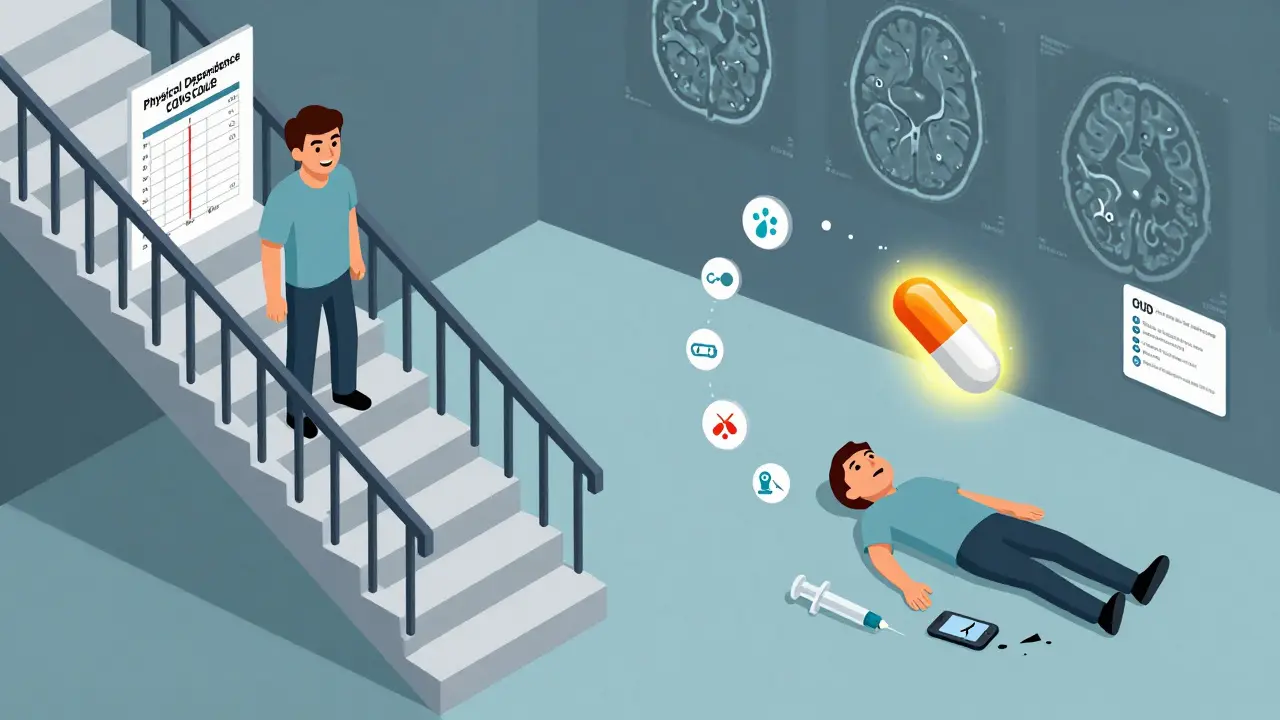
For physical dependence: A supervised taper is all you need. The CDC recommends reducing your dose by 5-10% every 2-4 weeks. Slower if you’re on over 100 MME/day. Use the Clinical Opiate Withdrawal Scale (COWS) to track symptoms. A score above 12 means you need more support.
For OUD: MAT is the gold standard. Buprenorphine, methadone, or naltrexone-combined with counseling-work better than abstinence alone. They reduce cravings, prevent overdose, and help people rebuild their lives. The FDA approved lofexidine extended-release in 2023 specifically to ease withdrawal without addiction risk.
Behavioral therapy matters too. Cognitive behavioral therapy (CBT) helps rewire the brain’s response to triggers. Peer support groups like Narcotics Anonymous help with accountability. But MAT is non-negotiable for severe OUD.
What’s Changing Now
Science is catching up. In 2023, researchers used fMRI to distinguish physical dependence from OUD with 89% accuracy by measuring prefrontal cortex activity during cravings. That’s huge. Within 3-5 years, clinics may use brain scans to guide treatment-not guesswork.
The CDC, AMA, and NIDA are all pushing for better education. The American Pain Society’s 2023 statement says: “Routine education for both providers and patients about the distinction between physical dependence and addiction is essential.”
Insurance companies are slowly improving. But you still have to advocate for yourself. If your doctor wants to cut you off suddenly, ask: “Am I dependent or addicted? What’s the evidence?”
Final Thoughts
You can be physically dependent without being addicted. And you can be addicted without being physically dependent-think cocaine or methamphetamine users. The brain changes are different. The treatments are different. The stigma is wrong.
If you’re on opioids for pain, you’re not weak. You’re not broken. You’re managing a chronic condition. If you’re struggling with cravings, compulsive use, or self-destructive behavior, you’re not a criminal. You have a medical illness-and it’s treatable.
Knowing the difference isn’t just academic. It’s lifesaving.
Can you be physically dependent on opioids without being addicted?
Yes. Nearly everyone who takes opioids daily for more than a week develops physical dependence. It’s a normal body adaptation. Addiction requires compulsive use despite harm, cravings, and loss of control. Dependence is biological. Addiction is behavioral.
Does physical dependence mean I need to stop taking opioids?
No. The CDC and American Medical Association say physical dependence alone is not a reason to stop opioid therapy. If your pain is managed and you’re not misusing the drug, continuing treatment is safe and appropriate. A gradual taper, not abrupt cessation, is recommended if discontinuation is needed.
How do I know if I have Opioid Use Disorder (OUD)?
OUD is diagnosed when you have at least two of 11 symptoms in a 12-month period. These include: craving, inability to cut down, spending too much time getting or using opioids, neglecting responsibilities, continuing use despite health or relationship problems, and developing tolerance or withdrawal. If you’re unsure, talk to a specialist who uses the DSM-5 criteria.
Is withdrawal from opioids dangerous?
Withdrawal from opioids is extremely uncomfortable but rarely life-threatening. Symptoms like nausea, vomiting, diarrhea, and anxiety can lead to dehydration or electrolyte imbalance if not managed. Medical supervision during tapering reduces risks. Unlike alcohol or benzodiazepine withdrawal, opioid withdrawal doesn’t typically cause seizures or death.
What’s the best treatment for Opioid Use Disorder?
Medication-Assisted Treatment (MAT) with buprenorphine or methadone, combined with counseling, is the most effective treatment. MAT reduces overdose deaths by 50-80%, lowers criminal activity, and improves retention in care. Abstinence-only approaches have high relapse rates. MAT is not replacing one drug with another-it’s treating a brain disease.
Can physical dependence turn into addiction?
Not directly. Dependence is a physiological state. Addiction is a behavioral disorder. But dependence can create conditions that make addiction more likely-like increased tolerance leading to higher doses, or withdrawal driving someone to use again to feel normal. Risk factors like mental illness, trauma, or family history of addiction increase the chance of progression. Monitoring and early intervention are key.
Are there tests to diagnose OUD?
There’s no single blood test. Diagnosis is clinical, based on DSM-5 criteria. However, tools like the Opioid Risk Tool (ORT) help assess risk before prescribing. New research using fMRI brain scans can differentiate OUD from dependence with 89% accuracy by measuring prefrontal cortex activity during cravings-though this isn’t yet standard in clinics.
Why do some doctors cut off opioids suddenly?
Many doctors confuse physical dependence with addiction due to outdated training or fear of regulatory penalties. Some follow blanket policies from insurers or health systems. But guidelines from the CDC, AMA, and NIDA all warn against this. Abrupt discontinuation can cause severe pain, suicide, or drive patients to illicit opioids. Patient-centered care requires distinguishing the two.
Zacharia Reda
March 3, 2026 AT 14:01Let me get this straight-you’re telling me someone on opioids for back pain who gets sweaty and nauseous when they miss a dose isn’t ‘addicted’? Holy shit, finally someone says it out loud. I’ve seen doctors treat people like criminals just because they didn’t want to quit cold turkey. This isn’t a moral failing. It’s biology. My cousin tapered off for 6 months with zero drama. No cravings. No lying. Just a body readjusting. Why do we still act like withdrawal = demon possession?
Mike Dubes
March 3, 2026 AT 14:26man i was so confused for years til i read this. i thought if i felt sick without my meds i was a junkie. turns out i was just… normal? like my body got used to it. doc said i was ‘dependent’ not ‘addicted’ and it felt like a weight lifted. no one ever explained the difference. now i tell my friends: dependence = your body’s way of saying ‘hey, we’ve been here before.’ addiction = your brain screaming ‘I NEED IT’ even when your life is falling apart. big difference.
Tobias Mösl
March 4, 2026 AT 05:09Oh, so now we’re pretending opioids are harmless? Let’s not forget the 40,000+ overdose deaths a year. You’re romanticizing dependence like it’s a spa day. The CDC didn’t issue guidelines because people were ‘misunderstanding biology’-they did it because doctors were prescribing like candy. And now you want to keep handing out 100 MME? That’s not science. That’s negligence wrapped in a lab coat. Wake up. This isn’t about stigma-it’s about bodies piling up.
Ethan Zeeb
March 5, 2026 AT 12:51Dependence isn’t the issue. The issue is that every time you say ‘it’s just dependence,’ you’re giving pharmaceutical companies a free pass to keep pushing pills. The system doesn’t care if you’re dependent or addicted-it just wants you to keep buying. Your ‘gradual taper’? That’s a PR stunt. The real solution is eliminating opioids entirely. They’re not medicine. They’re a trap. And you’re helping them sell it.
Darren Torpey
March 6, 2026 AT 12:11Bro, this post is like a breath of fresh air in a room full of smoke. I used to think if you needed opioids long-term, you were somehow weak. But now I see it like this: if you’re on insulin for diabetes, no one calls you ‘addicted.’ Same logic. Your body adapts. That’s not failure-it’s evolution. I’ve got a friend on buprenorphine for chronic pain. She works full-time, raises two kids, and still hikes on weekends. She’s not ‘using.’ She’s living. Let’s stop calling survival a sin.
Lebogang kekana
March 6, 2026 AT 23:32I’m from South Africa-we’ve got a crisis with morphine misuse here too. But here’s the thing: when people don’t understand the difference between dependence and addiction, they panic. They cut off the painkillers, and suddenly you’ve got people in wheelchairs, screaming in agony because no one believed them. This isn’t just American. It’s global. We need education, not fear. Doctors need to be trained, not punished. Patients need compassion, not judgment. This post? It’s a lifeline.
Raman Kapri
March 7, 2026 AT 22:06The data presented is statistically flawed. You cite 9.9 million misusers and 1.7 million with OUD, implying the rest are ‘just dependent.’ But misuse includes recreational use, not just chronic pain patients. You’re conflating populations. Furthermore, the 8% addiction rate you cite is from a 2017 study with narrow inclusion criteria. Recent longitudinal data from the National Institute on Drug Abuse shows rates closer to 15-20% among long-term users. This oversimplification is dangerous.
Megan Nayak
March 9, 2026 AT 13:06Let’s be honest-this whole ‘dependence isn’t addiction’ narrative is just a way to make people feel better about staying on opioids. It’s therapeutic gaslighting. If your brain adapts to a drug so severely that you can’t function without it, isn’t that a form of addiction? You’re redefining addiction to fit a narrative. The real problem? We don’t have enough non-opioid pain solutions. So instead of fixing the system, we’re just telling people it’s ‘fine’ to be chemically tethered to a drug. That’s not science. That’s surrender.
Tildi Fletes
March 9, 2026 AT 20:56It is imperative to emphasize that physical dependence, as a neurobiological phenomenon, is neither pathognomonic nor diagnostic of opioid use disorder. The clinical distinction between physiological adaptation and compulsive behavioral patterns remains empirically valid and is supported by the Diagnostic and Statistical Manual of Mental Disorders, Fifth Edition. Furthermore, abrupt discontinuation of opioid therapy in the absence of evidence-based behavioral criteria constitutes a violation of the standard of care as delineated by the American Medical Association. A structured, patient-centered taper protocol remains the gold standard for managing dependence.
Pankaj Gupta
March 11, 2026 AT 08:57This is one of the clearest explanations I’ve ever read. I’m from India, where opioids are either banned or overprescribed-no middle ground. People here think if you take painkillers for more than a week, you’re a drug addict. This post should be translated and shared in every clinic. The difference between dependence and addiction is not academic-it’s the difference between suffering in silence and getting real help. Thank you.
Betsy Silverman
March 12, 2026 AT 04:31I’m a nurse in rural Oregon. I’ve seen both sides. A guy on 60 MME for 3 years? Withdrawal? Nausea, shaking, insomnia. But he still showed up for work. Took his kid to soccer. Didn’t lie. Didn’t steal. Just… needed the meds. Then there’s the guy who sold his wheelchair for more pills. That’s addiction. One’s a patient. The other’s a person with a disease. We treat them differently. This post? It’s the truth we need to stop whispering.
Ivan Viktor
March 12, 2026 AT 15:05So basically, if you’re on opioids and don’t turn into a monster, you’re fine? Cool. I guess that’s one way to look at it. Meanwhile, my uncle OD’d on a script he got from his ‘nice’ doctor. Guess he was just ‘dependent.’ Right. Whatever. I’m not arguing science. I’m arguing reality. And reality is, people die because this stuff gets handed out like candy. And now you’re giving it a fancy label so it feels less scary. That’s not helping.
Stephen Vassilev
March 14, 2026 AT 07:22While the distinction between physical dependence and opioid use disorder is clinically valid, it is being weaponized by corporate interests to maintain profit margins in the pharmaceutical industry. The CDC’s 2022 guidelines, while ostensibly evidence-based, were drafted under significant influence from opioid manufacturers who funded research through third-party lobbying entities. Furthermore, the claim that ‘98% of insurance plans cover MAT’ is misleading-coverage often requires prior authorization, co-pays exceeding $300/month, and mandatory counseling sessions that are unavailable in 73% of rural counties. This is not healthcare reform. It is performative policy.