Imagine waking up exhausted, drinking gallons of water but still feeling parched, and losing weight without trying. For many people, these aren't just bad habits or a passing virus-they are the warning signs of Type 1 Diabetes, a chronic autoimmune condition where the immune system attacks insulin-producing beta cells in the pancreas. Unlike Type 2 diabetes, which often develops gradually over years due to lifestyle factors, Type 1 diabetes can strike suddenly. It accounts for about 5-10% of all diabetes cases, affecting roughly 1.6 million Americans according to Breakthrough T1D (2023). If left untreated, it leads to a life-threatening state called diabetic ketoacidosis (DKA) within days or weeks. Understanding what happens inside your body, how doctors confirm the diagnosis, and the modern tools available for management is crucial for anyone facing this condition.
Recognizing the Early Warning Signs
The onset of Type 1 diabetes is often rapid. Because your body stops producing insulin-the hormone that unlocks cells to let glucose in for energy-sugar builds up in your bloodstream while your cells starve. This metabolic chaos triggers specific symptoms that you shouldn't ignore.
- Polyuria (Frequent Urination): Your kidneys try to flush out excess sugar through urine, pulling fluids from your tissues. You might find yourself visiting the bathroom every hour.
- Polydipsia (Excessive Thirst): As you lose fluid through urination, dehydration sets in quickly, making you feel constantly thirsty no matter how much you drink.
- Unintentional Weight Loss: Without insulin, your body burns fat and muscle for fuel instead of glucose. You may drop pounds rapidly despite eating normally or even more than usual.
- Extreme Fatigue: Your cells are literally starving for energy because glucose can’t get in. This makes simple tasks feel exhausting.
- Blurred Vision: High blood sugar causes fluid to shift into the lens of your eye, changing its shape and focusing ability.
- Increased Hunger: Despite eating, your body signals hunger because it isn't getting the energy it needs from food.
These symptoms typically develop over days to weeks. In children, bedwetting after being toilet-trained is a common red flag. Adults might mistake these signs for stress or other illnesses, delaying care. The CDC (2023) warns that DKA can develop within 24 hours if untreated, so recognizing these early indicators saves lives.
How Doctors Confirm the Diagnosis
If you experience these symptoms, a doctor won't guess-they will test. Diagnosing Type 1 diabetes involves ruling out Type 2 and confirming the autoimmune nature of the disease. Here’s what that process looks like.
First, they check your blood sugar levels using standard criteria established by organizations like the American Diabetes Association (ADA) and Mayo Clinic (2023):
- Glycated Hemoglobin (A1C) Test: An A1C level of 6.5% or higher on two separate tests confirms diabetes. This measures your average blood sugar over the past three months.
- Fasting Plasma Glucose (FPG): A level of 126 mg/dL (7.0 mmol/L) or higher after fasting for at least eight hours indicates diabetes.
- Random Plasma Glucose (RPG): A level of 200 mg/dL (11.1 mmol/L) or higher with classic symptoms is diagnostic.
- Oral Glucose Tolerance Test (OGTT): A 2-hour level of 200 mg/dL (11.1 mmol/L) or higher confirms the condition.
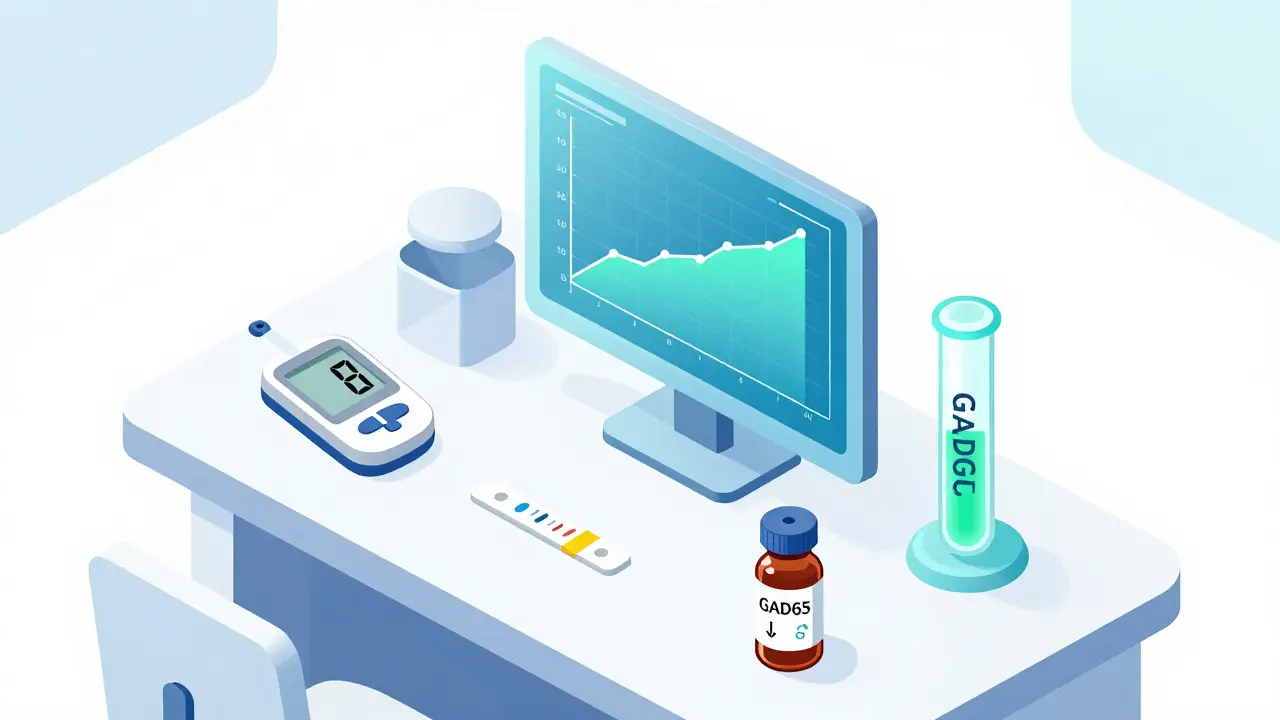
But confirming high blood sugar isn't enough to distinguish Type 1 from Type 2. Doctors must look for evidence of autoimmunity. They order autoantibody testing, blood tests that detect proteins attacking pancreatic cells. GAD65 antibodies are usually the first test ordered. If negative, they may check for IA2 or ZNT8 antibodies. Additionally, a C-peptide test, a measure of residual insulin production, helps differentiate the types. In Type 1 diabetes, C-peptide levels are low because the beta cells are destroyed. In Type 2, they are often normal or high as the body struggles to keep up with demand.
If you present with severe symptoms, doctors also test for ketones in your blood or urine to check for DKA. This involves measuring pH and bicarbonate levels to assess acidosis severity.
Insulin Therapy: The Cornerstone of Management
Once diagnosed, there is no cure for Type 1 diabetes yet, but it is highly manageable. The goal is to mimic your pancreas's natural function. Since your body produces little to no insulin, you must replace it externally. There are two primary ways to do this: Multiple Daily Injections (MDI) or Continuous Subcutaneous Insulin Infusion (CSII), commonly known as an insulin pump.
Multiple Daily Injections (MDI)
Also called basal-bolus therapy, MDI involves injecting insulin several times a day. You use long-acting insulin once or twice daily to provide a baseline level (basal) that keeps your blood sugar stable between meals and overnight. Then, you take rapid-acting or short-acting insulin before meals (bolus) to cover the carbohydrates you eat. This method requires careful planning and discipline but offers flexibility.
Insulin Pumps (CSII)
An insulin pump is a small device worn on your body that delivers rapid-acting insulin continuously through a thin tube inserted under your skin. It provides basal rates automatically and allows you to deliver boluses at mealtime with the push of a button. Modern pumps integrate with Continuous Glucose Monitors (CGMs), small sensors that track blood sugar levels in real-time. This combination creates hybrid closed-loop systems, sometimes called "artificial pancreases," which adjust insulin delivery based on your glucose readings. Devices like the Medtronic MiniMed 780G and Tandem t:slim X2 with Control-IQ technology have shown significant improvements in time-in-range (TIR), increasing the percentage of time spent in the target 70-180 mg/dL range from about 50% to 70-75% in clinical trials.
Monitoring and Target Ranges
Managing Type 1 diabetes isn't just about taking insulin; it's about constant feedback. The ADA Standards of Care (2023) recommend specific targets to prevent complications:
- Pre-meal Blood Glucose: 80-130 mg/dL (4.44-7.22 mmol/L)
- Postprandial Blood Glucose: Below 180 mg/dL (10.0 mmol/L) at 2 hours after eating
- Hemoglobin A1C: Less than 7% (53 mmol/mol) for most adults, though individualized targets may range from 6.5% to 8.0% depending on age and health risks.
Traditional fingerstick monitoring requires testing 4-10 times daily. However, CGMs have revolutionized care. Studies show CGM use is associated with a 0.5-0.8% A1C reduction in adults compared to fingersticks alone. Sensors last 7-14 days and send data to your phone or pump, alerting you when levels are rising or falling too fast. This real-time data empowers you to make immediate adjustments rather than reacting after the fact.
| Feature | Multiple Daily Injections (MDI) | Insulin Pump (CSII) |
|---|---|---|
| Basal Coverage | Long-acting injection 1-2x/day | Continuous micro-doses via pump |
| Bolus Flexibility | Manual calculation and injection | Button press, adjustable duration |
| Automation Potential | None | High (with CGM integration) |
| Invasiveness | Needle sticks multiple times daily | Cannula changed every 2-3 days |
| Cost | Lower upfront cost | Higher device and supply costs |
Daily Life and Practical Management
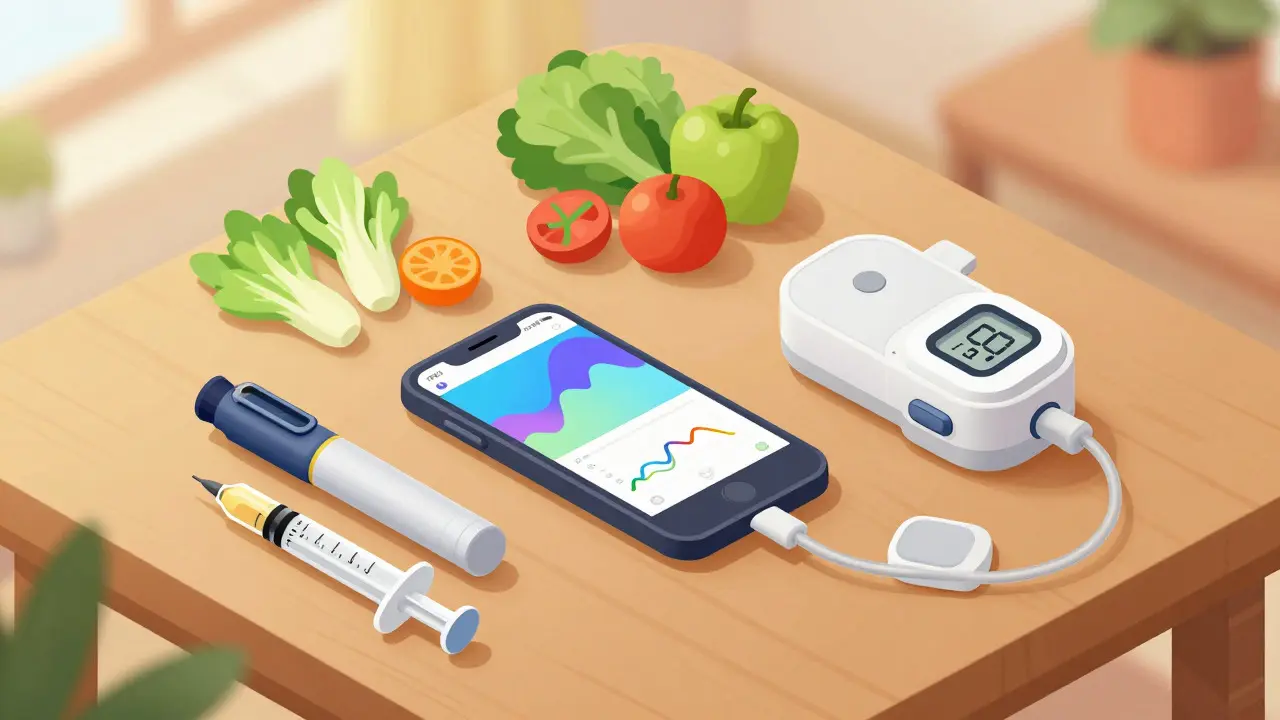
Living with Type 1 diabetes requires significant time investment. Patients spend approximately 2-4 hours daily managing their condition through monitoring, insulin administration, and dietary planning. One critical skill is carbohydrate counting. You need to know how many grams of carbs are in your food to calculate your insulin dose. Insulin-to-carbohydrate ratios vary widely, typically ranging from 1 unit per 5 to 30 grams of carbohydrates, depending on your individual sensitivity.
Hypoglycemia, or low blood sugar, is a constant risk. Symptoms occur when blood glucose drops below 70 mg/dL (3.9 mmol/L) and include shakiness, sweating, confusion, and irritability. The ADA recommends treating lows immediately with 15 grams of fast-acting carbohydrate, such as glucose tablets or fruit juice, and rechecking in 15 minutes.
Regular medical check-ups are essential beyond just glucose control. Providers assess cholesterol, thyroid function, kidney health, and liver function quarterly or biannually. Dr. William T. Cefalu, Chief Scientific and Medical Officer of the ADA, emphasizes that individualized glycemic targets are essential, particularly for older adults or those with extensive comorbidities.
Emerging Treatments and Hope for the Future
While insulin remains the standard, science is advancing rapidly. In November 2022, the FDA approved teplizumab (Tzield), the first disease-modifying therapy for Type 1 diabetes. This monoclonal antibody treatment, given as a 14-day IV infusion, can delay the onset of stage 3 T1D in at-risk individuals by a median of 24.5 months. It doesn't cure the disease but buys precious time.
Research into beta cell replacement is also promising. Vertex Pharmaceuticals' VX-880 therapy uses stem cell-derived islet cells. Early 2023 studies reported that 89% of participants achieved insulin independence at 90 days post-infusion. While still in trials, this represents a potential future where patients could be free from daily injections.
The economic burden is also a reality. The ADA's 2023 report highlights that the average annual medical expenditure for a person with T1D is $20,773, with insulin accounting for about 27% of these costs. Navigating insurance and medication access is part of the journey for many families.
What is the difference between Type 1 and Type 2 diabetes?
Type 1 diabetes is an autoimmune condition where the body destroys insulin-producing cells, requiring lifelong insulin therapy. It often develops suddenly in childhood or young adulthood. Type 2 diabetes is characterized by insulin resistance and relative insulin deficiency, often linked to lifestyle factors and genetics, and typically develops gradually in adults, though increasingly seen in younger populations.
Can Type 1 diabetes be reversed?
Currently, there is no cure for Type 1 diabetes. However, new treatments like teplizumab can delay onset in pre-diabetic stages, and experimental therapies like stem cell transplants show promise for restoring insulin production. Until a cure is found, management relies on insulin and monitoring.
How often should I check my blood sugar?
If using fingersticks, you typically need to test 4-10 times daily before meals, bedtime, and occasionally after exercise or illness. If using a Continuous Glucose Monitor (CGM), you receive real-time data continuously, allowing for proactive adjustments rather than reactive checks.
What is Diabetic Ketoacidosis (DKA)?
DKA is a serious complication of Type 1 diabetes that occurs when the body has insufficient insulin. It starts burning fat instead of glucose for energy, producing toxic acids called ketones. Symptoms include nausea, vomiting, abdominal pain, fruity-smelling breath, and confusion. It requires immediate medical attention.
Do I need to follow a special diet?
There is no single "diabetes diet," but carbohydrate counting is essential. You need to match your insulin doses to the amount of carbs you eat. A balanced diet rich in whole grains, vegetables, lean proteins, and healthy fats helps maintain stable blood sugar levels and overall health.