You’ve probably seen it on your pharmacy receipt a hundred times. One pill costs $450. The other looks identical, works the same way, but costs $12. Why? It isn’t magic, and it’s not a conspiracy. It’s basic economics mixed with smart legislation.
Generic medications save patients and insurers billions of dollars every year. In fact, in 2022 alone, generic and biosimilar medicines generated a record $408 billion in savings for America's patients and healthcare system. That is more money than many countries spend on their entire healthcare budgets. Yet, despite these massive savings, generics account for only 1.5% of total U.S. healthcare spending while making up 90% of all prescriptions filled. So, what exactly are you paying less for when you choose the generic option?
The Legal Foundation: How Generics Got Their Start
To understand why generics are cheap, you have to look back at 1984. Before that year, if a company invented a new drug, they had a monopoly on it until their patent expired. Once the patent ran out, anyone could copy it, but the process was slow and expensive. This didn't help patients get affordable medicine quickly.
Congress passed the Hatch-Waxman Act, formally known as the Drug Price Competition and Patent Term Restoration Act. This law created a shortcut called the Abbreviated New Drug Application (ANDA). Instead of running costly clinical trials from scratch, generic manufacturers just had to prove their drug was "bioequivalent" to the brand-name version. This meant the active ingredient worked the same way in the body. This change balanced innovation incentives for big pharma with immediate access to affordable meds for everyone else.
What You Actually Save On: R&D and Marketing
The biggest reason brand-name drugs cost so much is research and development (R&D). Developing a single new drug can cost over $2.6 billion and take ten years or more. Many candidates fail along the way. Pharmaceutical companies charge high prices to recoup those losses and fund future discoveries.
Generic manufacturers don't pay for that initial discovery. They also skip the massive marketing campaigns you see on TV. When you buy a generic, you are paying for the manufacturing, packaging, and distribution-not the decade of scientific trial and error. The Federal Trade Commission confirms that generics typically cost 80-85% less than brand-name equivalents because of this absence of R&D costs.
| Cost Factor | Brand-Name Drug | Generic Medication |
|---|---|---|
| Research & Development | High ($$$) | None ($) |
| Clinical Trials | Required (Years) | Bioequivalence Study Only |
| Marketing & Advertising | High ($$$) | Minimal ($) |
| Manufacturing Quality | FDA Compliant | FDA Compliant (Identical Standards) |
The Power of Competition: Why More Means Cheaper
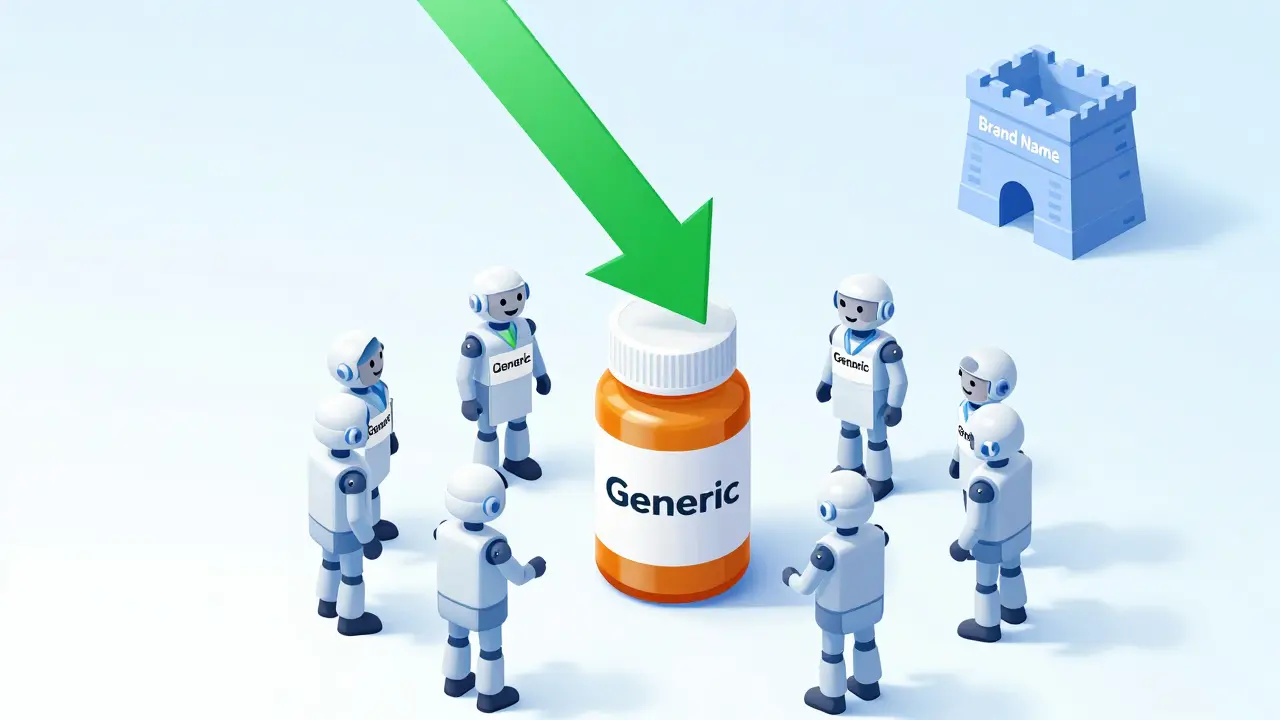
Price drops aren't linear; they are explosive once competition starts. According to the FDA, the entry of generic competition typically reduces prices to 15-20% of the brand-name drug's price within the first year. As more manufacturers enter the market, prices keep falling.
Take lurasidone hydrochloride tablets (brand name Latuda) as an example. When generics entered the market, the price per unit fell from approximately $47 to less than $2. That dropped the average 30-day prescription from about $1,400 to less than $60. Another example is pemetrexed (Alimta), where prices fell from about $88/mL to less than $10/mL. These aren't small discounts; they are life-changing reductions for chronic conditions.
Dr. Scott Gottlieb, former FDA Commissioner, noted that market entry of just a few generic competitors yields prices below the brand price. Competition is the primary driver. The more companies fighting for your business, the lower the price goes.
Quality Control: Is the Cheap Pill Safe?
This is the most common question I hear. Does cheaper mean worse? No. The FDA requires generic drugs to meet the exact same quality, strength, purity, and stability standards as brand-name drugs. They must contain the same active ingredients in the same dosage form and strength.
The only differences allowed are in inactive ingredients-things like colors, flavors, or fillers. These do not affect how the drug works in your body. The FDA inspects generic manufacturing facilities regularly. If a generic manufacturer fails to meet standards, they lose their license. So, when you switch to a generic, you are getting the same therapeutic benefit without the premium price tag.
The Hidden Trap: Not All Generics Are Equal
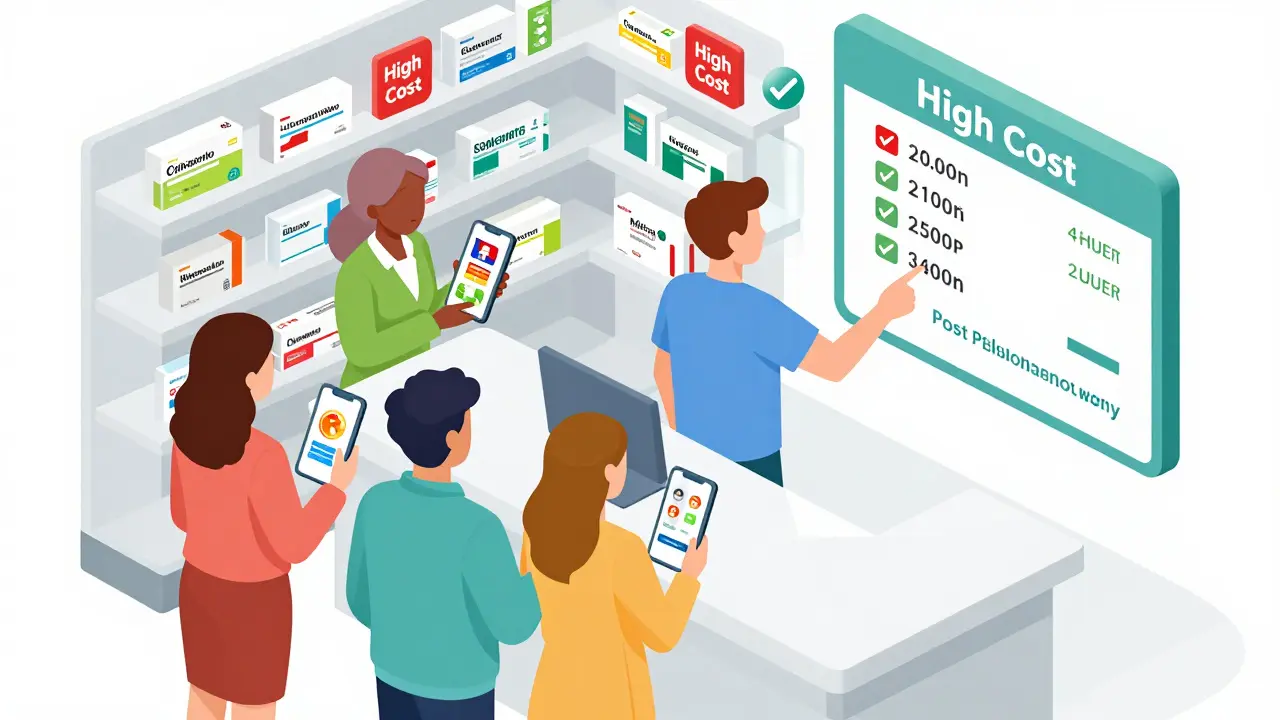
Here is where it gets tricky. Just because a drug is generic doesn't mean it’s the cheapest option available. A 2022 study in JAMA Network Open identified 45 high-cost generic products that had lower-cost therapeutic alternatives. Some of these "high-cost generics" were 15.6 times more expensive than equivalent alternatives.
Why does this happen? Pharmacy Benefit Managers (PBMs) sometimes use a practice called "spread pricing." They negotiate one price with pharmacies and charge insurers another, keeping the difference. Sometimes, PBMs incentivize pharmacies to dispense higher-priced generics because they make more profit on the spread. This means you might be paying more for a generic than necessary simply because of backend contracts you can't see.
In Colorado health plans, replacing these high-cost generics with cheaper alternatives would have achieved 88.3% savings. This highlights that being informed is crucial. Always ask if there is a cheaper therapeutic alternative, not just a cheaper generic brand.
How Patients Can Maximize Savings
You have more power than you think. The average copay for generic drugs is $6.16 compared to $56.12 for brand-name drugs. But you can often go lower. Here is how:
- Ask for Substitution: Tell your doctor to write prescriptions allowing generic substitution. In many states, pharmacists can swap brands for generics automatically unless the doctor writes "dispense as written."
- Compare Cash Prices: Sometimes paying cash with a discount coupon is cheaper than using insurance. Tools like GoodRx show that condition-specific average discounts can reach 67% for depression medications. For some erectile dysfunction medications, cash prices can be as low as $18 per month.
- Check Alternative Retailers: Services like the Mark Cuban Cost Plus Drug Company offer transparent pricing. A 2023 study found patients could have saved an average of $4.96 per prescription by using such services instead of insurance for certain generics.
- Review Your Formulary: Ask your pharmacist if your specific generic is on the preferred tier of your insurance plan. Non-preferred generics can cost significantly more in copays.
The Future of Generic Pricing
The landscape is shifting. The Inflation Reduction Act of 2022 includes provisions expected to save Medicare beneficiaries $105 billion on prescription drugs through 2031. This will accelerate generic adoption. However, challenges remain. The FDA has identified 202 "at-risk" generic medications vulnerable to shortages, which can temporarily inflate prices when supply chains break.
Additionally, the Department of Justice is investigating "pay-for-delay" agreements where brand manufacturers pay generic makers to stay out of the market. Breaking these antitrust violations will allow more competition and further drive down prices. As more blockbuster biologics lose patent protection, biosimilars (the generic version of complex biologic drugs) are projected to generate an additional $150 billion in savings between 2023 and 2027.
Are generic medications exactly the same as brand-name drugs?
Yes, regarding the active ingredient, dosage, strength, and intended use. The FDA requires generics to be bioequivalent, meaning they work the same way in the body. Differences may exist in inactive ingredients like color or flavor, but these do not impact therapeutic effectiveness.
Why do some generic drugs still cost a lot?
If there is only one generic manufacturer, they can charge higher prices due to lack of competition. Additionally, Pharmacy Benefit Managers (PBMs) may use spread pricing, where they profit from the difference between what they pay pharmacies and what they charge insurers, sometimes favoring higher-priced generics.
Can I ask my doctor for a generic instead of a brand?
Absolutely. Most doctors prefer prescribing generics because they are more accessible. You can explicitly request a generic, or ensure your prescription allows for automatic substitution by the pharmacist unless medically necessary otherwise.
Is it cheaper to pay cash for generics with a coupon?
Often, yes. Studies show that for many generic drugs, especially for patients with high-deductible plans, using discount tools like GoodRx or SingleCare can result in lower out-of-pocket costs than insurance copays. Always compare the cash price with your insurance estimate.
What is the Hatch-Waxman Act?
Passed in 1984, the Hatch-Waxman Act created the legal framework for generic drugs in the US. It established the Abbreviated New Drug Application (ANDA) process, allowing generics to bypass full clinical trials if they prove bioequivalence to brand-name drugs, thereby speeding up market entry and lowering costs.