Returning to work when you are living with chronic pain is a persistent condition lasting longer than three months that significantly limits major life activities can feel like walking a tightrope. You want to keep your job, but the physical reality of pain makes standard office hours or tasks feel impossible. The good news is that you do not have to choose between your health and your career. Federal laws and workplace programs exist specifically to bridge this gap. Understanding your rights and knowing exactly what to ask for can turn a stressful transition into a manageable routine.
The goal of a return-to-work (RTW) plan is not just to get you back in the chair; it is to maintain your employment through specific modifications. These changes address your functional limitations while keeping you productive. Whether you are recovering from an injury, managing a long-term condition, or dealing with post-viral symptoms, the process relies on clear communication and legal protections. Let’s break down how to navigate this system effectively.
Understanding Your Legal Protections
Before you draft any plan, you need to know what the law says about your situation. In the United States, chronic pain is often recognized as a disability under two key pieces of legislation: the Americans with Disabilities Act (ADA) of 1990 and the Rehabilitation Act of 1973. According to the Equal Employment Opportunity Commission (EEOC), if your pain substantially limits one or more major life activities, you are protected. This means employers cannot discriminate against you and must provide "reasonable accommodations" unless doing so causes them "undue hardship."
It is important to note who is covered. The ADA applies to private sector employers with 15 or more employees. If you work for the federal government, the Rehabilitation Act offers similar, sometimes stronger, protections through the Office of Personnel Management (OPM). For smaller businesses, state laws might apply. For example, California’s Fair Employment and Housing Act requires accommodations for employers with just five or more employees. Knowing which law protects you gives you leverage in negotiations.
| Law / Program | Who It Covers | Key Benefit | Limitation |
|---|---|---|---|
| Americans with Disabilities Act (ADA) | Private employers with 15+ employees | Mandates reasonable accommodations | Does not guarantee leave beyond FMLA |
| Rehabilitation Act | Federal employees and applicants | Streamlined accommodation process via OPM | Only applies to federal sector |
| Family and Medical Leave Act (FMLA) | Employees at companies with 50+ staff (worked 1,250 hrs) | Up to 12 weeks unpaid, job-protected leave | No pay; does not mandate accommodations |
| State Laws (e.g., CA FEHA) | Varies by state (often smaller employers) | Stricter thresholds than federal law | Only applies within specific jurisdictions |
Types of Workplace Accommodations
Accommodations are not one-size-fits-all. They are tailored to your specific job duties and pain triggers. The Job Accommodation Network (JAN) reports that 56% of accommodations cost employers nothing to implement. The remaining ones typically have a one-time median cost of only $300. This data helps counter the myth that accommodations are too expensive.
Here are common categories of adjustments that help people with chronic pain succeed at work:
- Ergonomic Adjustments: These include adjustable standing desks (costing roughly $300-$1,200), specialized keyboards and mice ($50-$300), and ergonomic chairs ($200-$1,000). For those with back pain, a sit-stand desk allows you to shift positions frequently, reducing strain.
- Time-Based Modifications: Flexible start and end times can help you avoid rush hour traffic stress or align work with your peak energy levels. Additional breaks-such as 5 to 15 minutes every 1 to 2 hours-are crucial for stretching or taking medication. Telecommuting, either full-time or intermittent, removes the commute and allows for a controlled home environment.
- Environmental Changes: Temperature control is vital for conditions like multiple sclerosis, where heat sensitivity affects up to 15% of patients. Relocating your workstation to minimize walking distances (e.g., moving closer to the restroom or printer) can prevent fatigue. Reducing repetitive motions by reorganizing your workspace also helps.
- Assistive Technology: Voice recognition software ($100-$300) reduces typing strain. Specialized seating cushions ($50-$200) and footrests ($25-$150) improve posture and circulation.
- Job Duty Reassignment: Employers may reassign marginal functions-tasks that are not essential to the core role-to other employees. This allows you to focus on high-value work without triggering severe pain.

Building an Effective Return-to-Work Plan
A successful RTW plan is built on specificity. Vague requests lead to vague results. Dr. Wong’s research found that case-by-case accommodations resulted in a 78% job retention rate, compared to just 42% for generic solutions. To build your plan, follow these steps:
- Consult Your Healthcare Provider: Get medical documentation that specifies your diagnosis, functional limitations, and recommended accommodations. Instead of saying "I have back pain," the note should say, "Patient experiences severe lumbar pain after sitting for more than 45 minutes and requires a sit-stand desk and frequent breaks."
- Identify Specific Needs: Be precise. Do not ask for "pain relief." Ask for a "heated massage cushion costing $85 that plugs into standard outlets." Specificity reduces denial rates by 55%, according to Ut Health Austin.
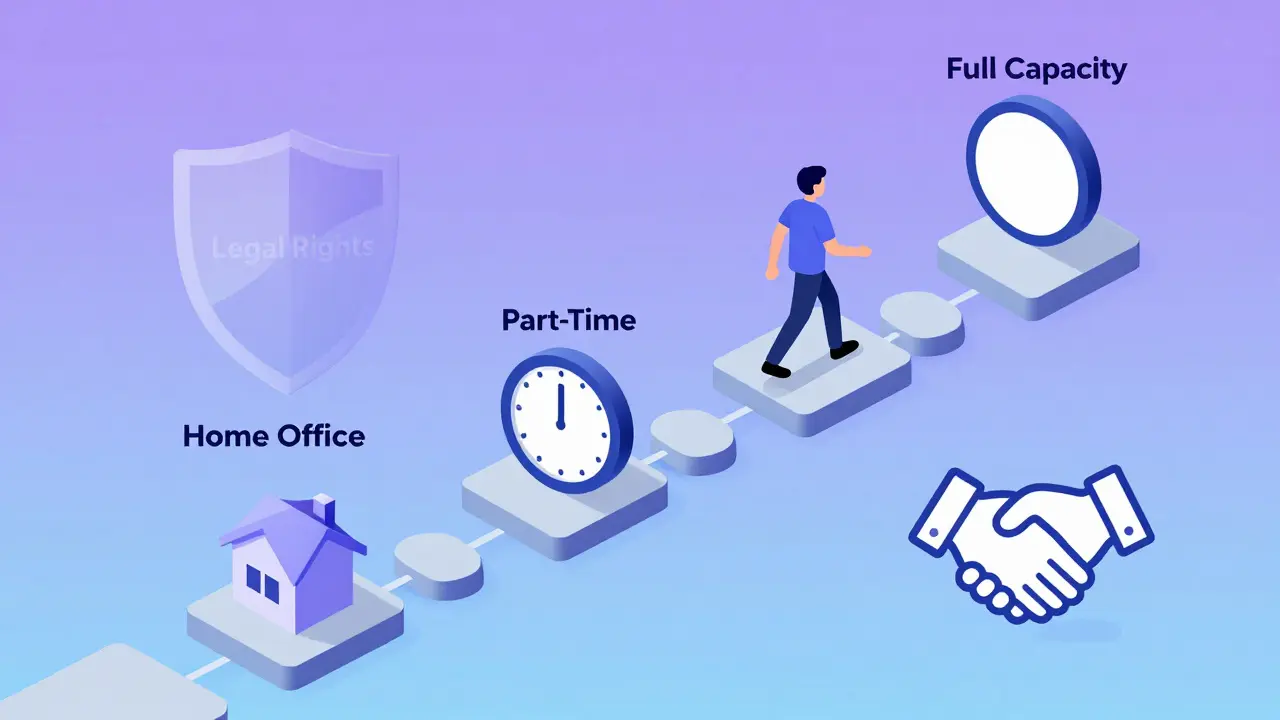
- Consider a Graduated Return: Research shows that graduated RTW approaches-where you return at 20% to 50% capacity initially-lead to 63% higher long-term retention than jumping straight back into full-time work. This allows your body to adjust gradually.
- Engage Occupational Therapists: An occupational therapy assessment can identify ergonomic adjustments that reduce pain-related work limitations by 37%. They act as neutral experts who translate medical needs into workplace solutions.
Navigating the Interactive Process
The "interactive process" is the dialogue between you and your employer to find a solution. It is not a demand; it is a negotiation. The EEOC stresses that employers cannot force you to accept a specific accommodation. You must engage in good faith dialogue.
Start by putting your request in writing. Mention the ADA explicitly. Document how your symptoms affect daily work functions. For federal employees, agencies typically respond within 10 business days. Private sector employers have no mandated timeline but must respond promptly. If you face resistance, remember that 41% of accommodation denials stem from the misconception that accommodations are permanent. Clarify that many adjustments, like modified hours during a flare-up, are temporary.
Supervisor attitude plays a huge role. Studies show that employees with strong coworker relationships are 2.3 times more likely to have accommodations successfully implemented. If your manager is unsupportive, involve Human Resources early. Use resources like the Job Accommodation Network (JAN), which resolves 82% of inquiries without formal complaints. They offer free, confidential guidance to both parties.
Overcoming Common Barriers
Despite legal protections, barriers remain. A significant 62% of employees with chronic pain delay requesting accommodations due to fear of discrimination. Thirty-one percent even leave their jobs rather than disclose their condition. This fear is understandable but often unfounded if you approach the process correctly.
Employers sometimes struggle with "invisible" disabilities. Forty-four percent report difficulty determining appropriate accommodations for pain conditions that aren't visible. To bridge this gap, educate your employer gently. Share articles from reputable sources like the CDC or JAN. Explain that accommodating your pain improves your productivity and retention, benefiting the company.
Another barrier is the "undue hardship" defense. Employers can deny requests if they prove significant difficulty or expense relative to their size. However, this threshold is high. For large corporations, it is very difficult to claim undue hardship for low-cost items like ergonomic chairs. For small businesses, the bar is lower, but creative solutions often exist. Always explore alternatives before accepting a denial.
Future Trends and Emerging Support
The landscape of chronic pain management at work is evolving. Long COVID has brought new attention to persistent pain conditions, with the EEOC issuing specific guidance confirming that long COVID can qualify as a disability. The Department of Labor launched the "Return to Work Initiative" in January 2023, providing grants to states for standardized RTW protocols.
Technology is also changing how we document pain. Wearable technology is beginning to be used in 7% of accommodation cases to objectively track movement and activity levels. While still emerging, this data could help validate functional limitations that are otherwise hard to measure. Legislative proposals are also underway to expand FMLA coverage to smaller employers, potentially protecting more workers in the future.
Do I have to tell my employer what my specific diagnosis is?
No, you do not have to disclose your specific diagnosis. Under the ADA, you only need to provide medical documentation that confirms you have a disability and explains how it limits your major life activities. Focus on the functional limitations (e.g., inability to stand for long periods) rather than the medical label.
What if my employer denies my accommodation request?
If denied, ask for the reason in writing. Often, denials are based on misunderstandings about cost or permanence. You can propose alternative, lower-cost solutions. If the denial persists, contact the Job Accommodation Network (JAN) for free advice or file a complaint with the Equal Employment Opportunity Commission (EEOC).
How much do workplace accommodations usually cost?
According to the Job Accommodation Network, 56% of accommodations cost employers nothing. For those that do have a cost, the one-time median expense is approximately $300. Most effective accommodations, like flexible schedules or minor ergonomic tweaks, are very affordable.
Can I request to work from home due to chronic pain?
Yes, telecommuting is a recognized reasonable accommodation. If your job duties can be performed remotely, your employer must consider this request. It eliminates the stress of commuting and allows you to control your physical environment, which can significantly reduce pain flares.
Is a gradual return to work better than going back full-time immediately?
Research suggests yes. Graduated return-to-work plans, where you start with reduced hours (20-50%) and slowly increase, result in 63% higher long-term job retention compared to immediate full-time returns. This approach allows your body to adjust and prevents setbacks from overexertion.